
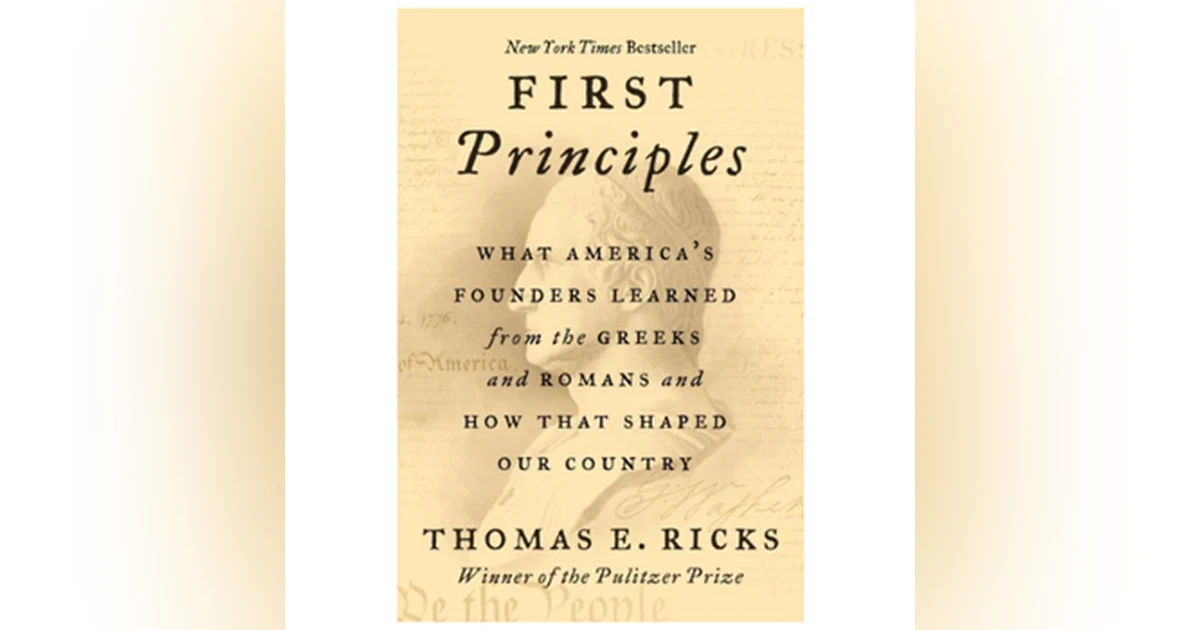
Book Review from Rick’s Library: First Principles, By Thomas E. Ricks

 Amazon Music
 Apple Podcasts
 Spotify
 iHeartRadio
 Youtube Music
 TuneIn
 Castro
 Audible
 RSS Feed
 Learn how the book, First Principles, by Thomas E. Ricks, teaches that the intellectual foundations of American democracy are as consequential as the political events that accompanied them—and that understanding those foundations is critical for addressing the challenges of our own time.
supporting links
1. First Principles[Amazon]
2. Thomas E. Ricks [Wikipedia]
3. History of the United States [Wikipedia]
4. Founding Fathers of the United States [Wikipedia]
Contact That's Life, I Swear
- Visit my website: https://www.thatslifeiswear.com
- Twitter at @RedPhantom
- Bluesky at @rickbarron.bsky.social
- Email us at https://www.thatslifeiswear.com/contact/
Episode Review
- Submit on Apple Podcast
- Submit on That's Life, I Swear website
Other topics?
- Do you have topics of interest you'd like to hear for future podcasts? Please email us
Interviews
- Contact me here https://www.thatslifeiswear.com/contact/, if you wish to be a guest for a interview on a topic of interest
Listen to podcast audios
- Apple https://apple.co/3MAFxhb
- Spotify https://spoti.fi/3xCzww4
- My Website: https://bit.ly/39CE9MB
Other
- Music and/or Sound Effects are cour...
⏱️ 12 min read
After the turbulence of recent years, many Americans have asked: Is this what the founding fathers intended?
Thomas E. Ricks new book First Principles begins with a similar question. Instead of offering partisan commentary, he does something far more interesting — he goes back to school. Back to the books that shaped the American Revolution generation. Back to the Greek and Roman thinkers who influenced how George Washington fought wars, how James Madison designed the Constitution, and how John Adams thought about virtue and ambition.
Ricks argues that America’s founding wasn’t just political — it was philosophical.
So, what did the founders believe? What did they fear? And what might we recover or reconsider from their intellectual playbook?
But here’s the larger question: If our democracy was shaped by the Greek and Roman thinkers, what happens when we forget them?
In this episode, we unpack the ancient ideas that helped shape a modern republic and ask what they might mean for us today.
Ready to begin? Let’s turn the page.
INTRO: Welcome to That's Life, I Swear. This podcast is about life's happenings in this world that conjure up such words as intriguing, frightening, life-changing, inspiring, and more. I'm Rick Barron, your host.
That said, here's the rest of this story
1. Abstract of the Book
Thomas E. Ricks’s First Principles takes readers on a detailed intellectual journey into the minds of America’s early leaders—George Washington, John Adams, Thomas Jefferson, and James Madison by examining how their classical educations in Greek and Roman thought shaped the founding of the United States. Rather than a conventional narrative of the Revolution and Constitution, Ricks’s central thesis is that the Revolutionary generation did not just react to British imperial overreach but actively built a new nation on the philosophical foundations of ancient political thought. He shows how the teachings of Cicero, Aristotle, Plutarch, Epicurus, and other classical thinkers informed not only the founders’ rhetoric but also their public philosophies of virtue, civic responsibility, risk, and governance.
Ricks begins with the moment of his own questioning—waking up after the shock of the 2016 election and asking what the American project was supposed to be. From there, he traces how classical ideas influenced military strategy during the Revolution (such as Washington’s adoption of Roman models of restraint against oppressive generals) and how those thinkers shaped constitutional debates, federal structures, and concerns about party.
The book does not romanticize the founders. Ricks consistently points out the profound contradictions between professed ideals and lived realities—especially regarding slavery, which many classical republics tolerated and American founders embedded into the Constitution.
In its final chapters, First Principles connects this past to the present, offering ten practical prescriptions—ranging from renewed civic education to campaign finance reform—that Ricks believes could help modern Americans recapture a sense of public-spiritedness and collective purpose. The overall argument is that understanding where our democratic ideals came from helps clarify how they might still guide us in an age of polarization and institutional stress.
2. About the Author
Thomas E. Ricks is one of America’s most respected historians and journalists—a Pulitzer Prize–winning author whose work has consistently explored the exercise of political and military power and how institutions respond to crisis. Although Ricks is widely known for his coverage of national security and military affairs, including books like Fiasco and The Generals, First Principles represents a shift into intellectual history, applying his analytical rigor to the philosophical foundations of the American republic.
Born in 1955, Ricks graduated from Brigham Young University and later received a master’s degree from the Columbia University Graduate School of Journalism. His career has included positions at The Wall Street Journal, where he reported on national security and the Pentagon, and later at Foreign Policy magazine. Over the years, Ricks’s reporting earned him not just a Pulitzer Prize but widespread recognition as someone able to make complex policy and military topics accessible to a general audience through narrative clarity and deep research.
Ricks’s strengths lie in contextualizing contemporary issues by situating them within broader historical and institutional frameworks. In earlier books, he dissected U.S. military strategy and leadership in Iraq and Afghanistan; in First Principles, he applies similar analytical tools to the intellectual roots of America itself. This book reflects not just historical curiosity but a civic aspiration: seeking to understand the conditions that make republics endure and the ideas that give them purpose.
Across his writing, his goal has always been not only to chronicle events but to help readers see why decisions were made, and what those decisions meant for the future. In First Principles, this lifelong commitment to thoughtful, evidence-based inquiry offers a lens through which contemporary Americans can reconsider their past—and their responsibilities as citizens.
3. What Drew My Interest in Reading This Book?
What drew me to First Principles was a convergence of historical curiosity and contemporary urgency. In the aftermath of the 2016 presidential election—a moment that surprised and unsettled many Americans—the question Ricks poses at the start of the book resonated deeply: What kind of nation do we now have, and is that what our founders intended? This question mirrors a broader cultural moment in which Americans are wrestling with not just who we are, but why we became what we are. Ricks’s approach—filing down that broad question through the lens of the founders' classical influences—offered a fresh and rigorous pathway for exploration.
My own interest has long centered on how foundational ideals evolve and how societies navigate the gap between principle and practice. In a polarized age—where appeals to history are often weaponized or oversimplified—Ricks’s method promised not only a rich intellectual history but a balanced one. By starting with the intellectual environment that shaped Washington, Adams, Jefferson, and Madison, the book invited reflection on how ideas like virtue and public-willingness were not abstract ideals, but active frameworks that guided the founders’ decisions. That angle felt especially relevant in a moment when civic language has become both contested and fragmented.
Moreover, I was intrigued by the notion that the American political experiment was deliberately rooted in the texts and teachings of Greek and Roman figures. Ricks’s promise to surface those classical roots and connect them to constitutional design, rhetoric, and governance offered the prospect of a deeper, less conventional understanding of early America.
Finally, beyond intellectual history, I was curious about where Ricks would take the narrative forward—how insights into foundational thinking could illuminate present challenges and possibilities for revitalizing civic engagement. In that sense, my interest was not merely academic, but existential: What can the founders’ first principles tell us about sustaining democracy today?
4. What Can We Learn From This Book? What’s the Takeaway?
At its core, First Principles teaches that the intellectual foundations of American democracy are as consequential as the political events that accompanied them—and that understanding those foundations is critical for addressing the challenges of our own time. Ricks’s central claim is that the founders’ immersion in classical Greek and Roman thought gave them a set of principles—virtue, civic duty, wariness of factionalism, and the public good—that shaped their approach to governance far more than simplistic partisan instincts or purely economic self-interest.
One of the most important lessons is that ideas matter. The founders did not stumble into nationhood; they actively drew upon a set of philosophical and historical models that guided their decisions. Washington looked to Roman generals for models of restraint and moral leadership; Adams saw himself in the tradition of Cicero’s republican virtue; Jefferson engaged with Greek philosophical ideals about happiness and civic life; Madison methodically studied the strengths and weaknesses of ancient confederacies in shaping his thinking at the Constitutional Convention.
Another takeaway is a sobering reflection on the limits of those principles. Ricks does not shy away from exposing the gap between the founders’ ideals and their actions, most notably on slavery and how some classical precedents may have misled them into justifying deeply unjust practices. This honesty about contradiction illustrates that even well-intentioned ideas can have harmful consequences if deployed without ethical scrutiny.
Finally, the book’s epilogue offers a contemporary civic lesson: that deep understanding of history, especially its foundational ideas, can help citizens navigate present dilemmas without panic, embrace the public good over narrow interests, and strengthen political institutions rather than undermine them. Whether one agrees with all of Ricks’s prescriptions or not, the takeaway is clear: a republic survives not by inertia but by sustained engagement with its founding principles and a willingness to adapt them thoughtfully to new eras.
Well, there you go my friends, That's life, I swear.
For further information regarding the material covered in this episode, I invite you to visit my website, which can be found on Apple Podcasts, for show notes and the episode transcript.
As always, I thank you for the privilege of you listening and your interest.
Be sure to subscribe here or wherever you listen to podcasts so you don't miss an episode.


