
How One Podcaster Is Reshaping France's Reckoning With Its Past

 Amazon Music
 Apple Podcasts
 Spotify
 iHeartRadio
 Youtube Music
 TuneIn
 Castro
 Audible
 RSS Feed
 Learn how if a society refuses to examine its darkest chapters, those chapters don’t disappear — they just wait for the right conditions to return.
Supporting links
1. Philippe Collin [Books written]
2. Facing History [Podcast]
3. Léon Blum [Wikipedia]
4. Alfred Dreyfus [Wikipedia]
Contact That's Life, I Swear
- Visit my website: https://www.thatslifeiswear.com
- Twitter at @RedPhantom
- Bluesky at @rickbarron.bsky.social
- Email us at https://www.thatslifeiswear.com/contact/
Episode Review
- Submit on Apple Podcast
- Submit on That's Life, I Swear website
Other topics?
- Do you have topics of interest you'd like to hear for future podcasts? Please email us
Interviews
- Contact me here https://www.thatslifeiswear.com/contact/, if you wish to be a guest for a interview on a topic of interest
Listen to podcast audios
- Apple https://apple.co/3MAFxhb
- Spotify https://spoti.fi/3xCzww4
- My Website: https://bit.ly/39CE9MB
Other
- Music and/or Sound Effects are cour...
⏱️ 18 min read
What if the most dangerous chapters of history aren’t the ones we remember, but the ones we quietly agree to forget?
My story begins with a massive stone castle in the forests of southwestern Germany. Nearly 900 years old. It’s Christmas,1944. World War II is still in full swing, but would be over five months later on May 8, 1945.
Inside that castle on Christmas of 1944, were members of France’s Nazi-backed collaborationist government celebrating — laughing, drinking, and talking about the day they believed they’d return to Paris… riding in on German tanks.
It’s a moment like this that most people in France were never taught. A chapter that doesn’t fit neatly into stories of resistance, heroism, and liberation.
And yet, millions of listeners today are now choosing to hear it.
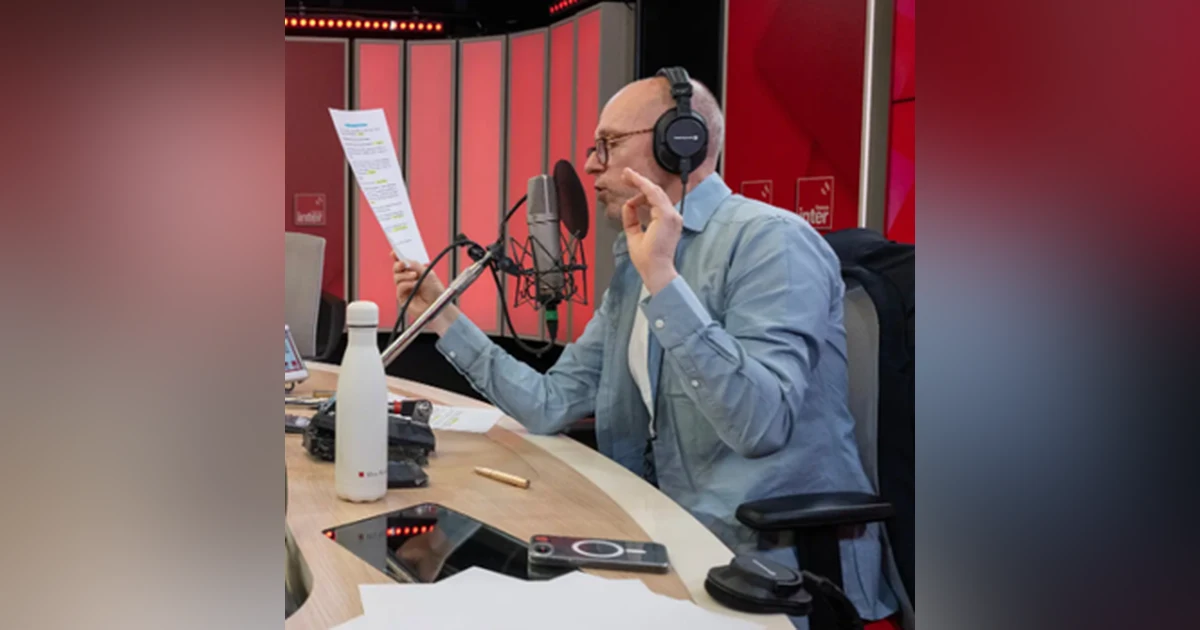
At the center of this reckoning is French podcaster Philippe Collin — a storyteller who has made it his mission to guide audiences straight into the most uncomfortable corners of his nation’s past. Through immersive sound and gripping narrative, his historical podcast series is reshaping how people understand World War II, collaboration, resistance, and the fragile choices ordinary people make in extraordinary times.
It’s about how democracies weaken. How memory fades. How easy it is to believe “this time is different.” And how revisiting history — honestly, fully, without polish — might be one of the most powerful tools a society has to protect itself.
But this story isn’t just about the 1940s. It’s about now.
Because sometimes, remembering isn’t about looking back. It’s about staying awake to the present.
Welcome to That's Life, I Swear. This podcast is about life's happenings in this world that conjure up such words as intriguing, frightening, life-changing, inspiring, and more. I'm Rick Barron your host.
That said, here's the rest of this story:
Our story begins in 2023, where millions of French podcast listeners found themselves transported through time and space, guided by the voice of Philippe Collin as he lead them through the shadowed corridors of their nation's most uncomfortable memories. On one such journey, they arrived at an imposing castle in southwestern Germany—a medieval fortress nearly nine centuries old—where the remnants of France's Nazi-collaborationist government sought refuge after Allied forces stormed the beaches of Normandy.
Through Philippe’s meticulous audio reconstruction, listeners can almost hear the echo of champagne glasses touching in toast, the nervous laughter of men and women who had bet their futures on the wrong side of history. In the castle's grand mirrored gallery, these French collaborators celebrated Christmas during the final winter of World War II, their reflections multiplied infinitely as they plotted their triumphant return to Paris atop German tanks—a return that would never come.
This is the territory where Philippe Collin has staked his claim as a historian of the airwaves, excavating the buried, the denied, the deliberately forgotten corners of French memory. His podcast series, "Facing History," has become something extraordinary in the landscape of French media: a cultural phenomenon that marries rigorous historical inquiry with compelling narrative storytelling, creating an experience that has captivated a nation hungry to understand itself.
The podcast numbers alone tell a remarkable story. More than forty million downloads. To put that number into perspective, I started my podcast in April of 2022, and I have only 10,000 downloads. Philippe’s episodes last eight to ten hours. These are episode series that require listeners to sit with discomfort, to confront national myths, to question the heroes and villains of their grandparents' generation. This is not light entertainment for the morning commute. This is a demanding, meticulous, and often painful examination of who France has been and who it might become.
At fifty years old, Philippe brings to this work a lifetime of experience in French radio. His career at France Inter, the country's most popular radio station, has been marked by versatility and innovation. From hosting afternoon talk shows to exploring American culture on weekly programs, he has always been someone willing to experiment, push boundaries, and try formats others might consider too risky or too complex. But nothing in his previous work prepared audiences for the depth and impact of what he would create with his historical podcast series.
The production values of Philippe’s podcast set it apart from conventional historical programming. Each series is a layered tapestry of sound and testimony. Archival radio clips crackle with the voices of people long dead, their words preserved on magnetic tape and now given new life through digital distribution. Actors read passages from letters and memoirs, breathing emotion into faded ink on yellowed pages. As many as 12 historians appear across each series, offering their expertise, interpretations, and debates about what happened and what it all means.
Philippe’s commitment to depth and authenticity has resonated profoundly with French audiences. The series exploring that German castle where French collaborators took refuge has alone been downloaded more than two million times. People are choosing to spend hours immersed in stories that offer no easy answers, no comfortable narratives of national innocence or heroism with compromise.
The podcast's influence has expanded outward in unexpected ways. Three books have emerged from the material Philippe has gathered. Three television documentaries have brought his audio narratives to visual life. A nine-hour theatrical production about Léon Blum—France's first Jewish prime minister, who survived imprisonment in the Buchenwald concentration camp—has drawn audiences willing to spend an entire day in a theater confronting this history. Two more plays inspired by the podcast series are currently in development.
Perhaps most tellingly, professional historians credit Philippe with uncovering new information, with asking questions that lead to archival discoveries, with creating connections between events that scholars had not previously considered. Henry Rousso, one of France's most celebrated historians of World War II, has appeared on three of Philippe's podcasts and speaks of him with genuine respect. Even Rousso, with decades of expertise, has learned new things from listening to Philippe's work. "For me, he is an historian," Rousso has said, praising his ability to create historical narratives that are uniquely his own.
Yet Philippe's work has not been without controversy. His podcast episode about France's brutal war in Algeria sparked an uproar among specialists when it appeared to downplay reports that Jean-Marie Le Pen, a far-right political leader, had tortured Algerians during the conflict.
The controversy took an unexpected turn when Le Pen's book was published, after his death, a confession acknowledging that the torture reports were indeed true. Some historians remain skeptical of Philippe's credentials and methods. Fabrice Riceputi, [RICE_PU_TEA] a historian who was motivated by the podcast controversy to write an entire book documenting Le Pen's torture of Algerians, has criticized Philippe as someone who "dabbles in everything" without truly knowing what he's talking about.
This type of criticism speaks to the tension at the heart of Philippe's project: he is a trained historian who never completed his doctorate, a radio professional who has claimed the authority to speak about the nation's past, a storyteller who must balance narrative drive with investigative passion. His master's degree focused on the purge of suspected collaborators near the end of World War II—a topic that clearly planted seeds for his later work. Financial constraints prevented him from continuing his academic studies, pushing him toward a career in radio instead. Now, decades later, he has found a way to merge those two topics.
The French passion for their national history provides part of the explanation for the podcast's success. France is a country where:
· intellectual debates make headlines
· where philosophers appear on television talk shows
· where historical arguments can spark genuine public controversy
Philippe believes the current moment today has made his work particularly resonant in ways that create general historical interest.
Philippe’s podcast "Facing History" launched less than a year before Russian forces invaded Ukraine, an event that shattered the post-Cold War assumption that major land wars in Europe were a thing of the past. As the conflict continues, fears have grown that the war might expand, that France itself might somehow be drawn into a larger European war. These are not abstract concerns for a nation that lived through two devastating world wars in the twentieth century.
As the worry of a European war escalating, France's far-right political party has surged in popularity. Current polling suggests that one of its leaders could win the 2027 presidential election, creating the first far-right government in France since the collaborationist Vichy regime during World War II. The historical echoes are impossible to ignore.
"People have a sense the Republic is threatened again and are looking for tools to combat that," Philippe believes. This sense of threat is compounded by demographic reality: the last surviving heroes of the French Resistance are dying. These men and women, who risked everything to oppose Nazi occupation, whom Philippe calls "the guardians of the memory of the resistance," are passing into history themselves. As the heroes of the French Resistance continue to pass, it removes living witnesses, people who can speak from direct experience about what fascism actually looks like, what resistance requires, what the stakes truly are.
Philippe believes France is in the process of breaking away from that past, and his podcast can be understood as an attempt to maintain that connection, to keep those memories alive in the absence of living witnesses.
By his own admission, Philippe is obsessed with France's World War II history. This obsession has deep personal roots. Born in 1975, he grew up in Le Fret, a tiny village in Brittany, the eldest of two sons. His mother worked as a childcare assistant; his father served in the Navy. Like many French families, theirs carried the war's legacy in their bones. Both of Philippe's grandfathers had been captured soldiers, and family meals were punctuated with their stories—the kinds of tales that shaped a young boy's imagination and moral framework.
But the most profound influence came from a terrible family discovery. Marcel Grob, Philippe's favorite great-uncle whom he visited every summer in the Alsace region, had fought with the Waffen SS—the fanatical Nazi unit notorious for civilian massacres. When Philippe learned this truth, he was devastated. He cut his great-uncle off completely, refusing even to attend his funeral. "I'm not going to the funeral of a Nazi," he told himself.
Years later, Philippe received his great-uncle's military service record. Reading through the documents, he realized he had made a profound and painful mistake. Marcel Grob had been just seventeen years old when he was conscripted by force into the Waffen SS. Further research revealed that families of conscripts who tried to evade their orders were sent to German labor camps. Grob had faced an impossible choice: serve in a genocidal military unit or condemn his family to imprisonment and possible death.
"All of a sudden, I said to myself, 'What would you have done in his place?'" Philippe recalls. This question—what would you have done?—has become central to his historical work. It's a question that resists easy moral judgment, that demands empathy without excusing evil, that acknowledges the terrible complexity of life under occupation and totalitarian rule.
In 2018, Philippe published a graphic novel titled "The Journey of Marcel Grob" as a form of apology to the great-uncle he had wrongly condemned. He spent eight years writing his 2024 novel "The Barman of the Ritz," which tells the story of a Jewish bartender during the war who served Nazi officers at night while secretly obtaining forged papers for Jewish employees by day. The novel proved so popular that its cover returned to Paris subway walls in January to announce the paperback edition—a rare honor that speaks to the book's cultural impact.
One of Philippe's stepsons, another prominent radio journalist at France Inter—recently asked him if he thinks about the war every single day. Philippe's answer was immediate and unequivocal: yes.
But his podcasts range beyond World War II. Working with a team of ten people, he has produced a series on Napoleon, the playwright Molière, and Jeanne du Barry, the official mistress of Louis XV. His latest series explores the Statue of Liberty, France's gift to the American people. His podcast on Alfred Dreyfus—the Jewish Army captain wrongly convicted of treason in the late nineteenth century, whose case tore France apart—helped inspire a French lawmaker to sponsor legislation granting Dreyfus a posthumous promotion. "I listened to the entirety of Philippe Collin's podcast," the lawmaker, Charles Sitzenstuhl, wrote. "It made a deep impression on me and helped me in my work."
If there is an underlying theme connecting all of Philippe's historical work, it is what he calls the "values of the French Republic"—liberty, equality, and fraternity, the three-word motto born during the French Revolution of 1789, along with the societal systems designed to make those promises real rather than merely rhetorical. He worries these values are under attack, that France's current divisions echo those of the 1930s, the decade that culminated in Nazi occupation and collaboration.
"Today, we are facing a form of radicalization and polarization within society, and we can clearly see the seeds of a civil war—an ideological civil war—being replanted," he warns. The comparison to the United States is never far from his mind. "We are losing our way, much like the United States, for that matter. People in the United States can no longer speak to each other. The 'other' is no longer a human being."
Philippe hopes his podcast offers an antidote to this polarization, a way for people to grapple with complexity, to see historical figures as human beings facing impossible choices, to understand that moral clarity is often a luxury of hindsight. He remains humble about what his work can accomplish. "We aren't in politics," he says. "We are just a podcast."
Yet "just a podcast" seems inadequate to describe what Philippe Collin has created—a new form of public history that combines historical rigor with emotional resonance, that reaches millions rather than dozens, that makes the past feel urgent and present. In an era when democracy seems fragile and historical memory grows distant, his work of remembering has become an act of resistance in itself. [2058 words]
What can we learn from this story? What's the takeaway?
Facing uncomfortable history is not about guilt — it’s about clarity, responsibility, and protecting the future.
Philippe Collin’s story isn’t really about castles, collaborators, or even World War II on its own. It’s about what happens to a society when it either remembers honestly… or chooses to forget.
Well, there you go, my friends; that's life, I swear
For further information regarding the material covered in this episode, I invite you to visit my website, which can be found on Apple Podcasts, for show notes and the episode transcript.
As always, I thank you for the privilege of you listening and your interest.
Be sure to subscribe here or wherever you listen to podcasts so you don't miss an episode.
See you soon.


