
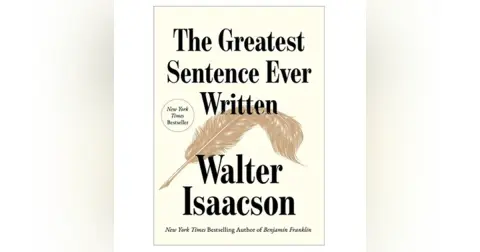
Book Review from Rick’s Library: The Greatest Sentence Ever Written, By Walter Isaacson

 Amazon Music
 Apple Podcasts
 Spotify
 iHeartRadio
 Youtube Music
 TuneIn
 Castro
 Audible
 RSS Feed
 Learn how In The Greatest Sentence Ever Written, Walter Isaacson dissects the famous line from the Declaration of Independence—“We hold these truths to be self-evident…”—and asks us to see it not as a relic, but as a living idea.
supporting links
1. The Greatest Sentence Ever Written[Amazon]
2. Walter Isaacson [Wikipedia]
3. American Enlightenment [Wikipedia]
Contact That's Life, I Swear
- Visit my website: https://www.thatslifeiswear.com
- Twitter at @RedPhantom
- Bluesky at @rickbarron.bsky.social
- Email us at https://www.thatslifeiswear.com/contact/
Episode Review
- Submit on Apple Podcast
- Submit on That's Life, I Swear website
Other topics?
- Do you have topics of interest you'd like to hear for future podcasts? Please email us
Interviews
- Contact me here https://www.thatslifeiswear.com/contact/, if you wish to be a guest for a interview on a topic of interest
Listen to podcast audios
- Apple https://apple.co/3MAFxhb
- Spotify https://spoti.fi/3xCzww4
- My Website: https://bit.ly/39CE9MB
Other
- Music and/or Sound Effects are cour...
⏱️ 12 min read
What if the most powerful idea in American history could be found not in a speech, not in a war, not even in a constitution—but in a single sentence?
In his new book The Greatest Sentence Ever Written, Walter Isaacson turns his attention to just 35 words from the Declaration of Independence—words we’ve memorized, quoted, and perhaps taken for granted: “We hold these truths to be self-evident…”
But what did those words really mean in 1776? What do they mean now? And can a sentence written in a room of imperfect men still guide a deeply divided nation nearly 250 years later?
Today, we unpack the power, the contradictions, and the enduring promise behind what Isaacson calls the most consequential sentence ever penned.
Ready to begin? Let’s turn the page.
Welcome to That's Life, I Swear. This podcast is about life's happenings in this world that conjure up such words as intriguing, frightening, life-changing, inspiring, and more. I'm Rick Barron, your host.
That said, here's the rest of this story
1. Abstract of the Book
Walter Isaacson’s The Greatest Sentence Ever Written is a focused and compelling dissection of arguably the most consequential line in American history: the second sentence of the Declaration of Independence—“We hold these truths to be self-evident, that all men are created equal, that they are endowed by their Creator with certain unalienable Rights, that among these are Life, Liberty, and the pursuit of Happiness.”
Rather than offering a broad narrative history of the Declaration or the Age of Revolution, Isaacson drills deeply into this single sentence as if it were a lens for understanding the philosophical foundations and civic aspirations of the United States.
The book, published to coincide with the nation’s 250th anniversary this July of 2026, explores not just the wording but the meaning and implications of these 35 words, tracking how Thomas Jefferson originally drafted them and how Benjamin Franklin and John Adams refined that draft in Philadelphia in 1776.
It examines how Enlightenment ideas about natural rights, reason, and human equality informed these words and how the phrasing has been interpreted, contested, and invoked over centuries of American history.
Despite its brevity—just under 80 pages—Isaacson’s analysis situates the sentence within broader debates about liberty, citizenship, and national purpose. He acknowledges the profound contradiction between the sentence’s lofty ideals and the reality that the Founders themselves enslaved hundreds of people and excluded women and Indigenous peoples from the rights they proclaimed.
Yet, he also argues that it is precisely this tension between ideal and practice that has made the sentence a lasting engine of moral and political struggle. In Isaacson’s telling, this sentence helped shape movements—from abolition and civil rights to women’s suffrage and contemporary debates about equality and justice—and remains a touchstone for defining shared values in a polarized age.
2. About the Author
Walter Isaacson is one of the most widely read American historians and biographers of our time, known for combining academic rigor with narrative storytelling that appeals to a broad readership.
Over the past three decades, he has authored acclaimed biographies of figures who have shaped science, technology, and thought—spanning the Renaissance genius of Leonardo da Vinci, the revolutionary insights of Albert Einstein, the entrepreneurial audacity of Steve Jobs, the gene-editing pioneer Jennifer Doudna, and the complex life of Elon Musk. Isaacson’s work often struggles with the intersection of creativity, leadership, and cultural impact, making complex subjects accessible without sacrificing intellectual depth.
Before his career as an author, Isaacson held influential roles in journalism and public life: he served as Editor of Time magazine, Chairman and CEO of CNN, and President and CEO of the Aspen Institute, a global nonprofit dedicated to values-based leadership and dialogue.
He is currently a professor of history at Tulane University, where he continues to teach and write. In recognition of his contributions to the humanities, he was awarded the National Humanities Medal in 2023. Across his body of work, a common thread is his fascination with how transformative ideas take shape and how individuals and societies struggle with them—whether through scientific discovery, technological innovation, or the crafting of foundational political documents.
With The Greatest Sentence Ever Written, Isaacson brings his biographical sensitivity to a line of text itself, treating language as a living artifact that reveals the tensions, aspirations, and contradictions at the heart of the American experiment.
His approach blends historical narrative, philosophical interpretation, and contemporary reflection, aiming to make readers see familiar words with fresh eyes and renewed curiosity.
3. What drew my interest in reading this book?
My interest in reading The Greatest Sentence Ever Written was sparked by a blend of personal curiosity about foundational ideals and a desire to understand how those ideals continue to resonate—or clash—with present realities.
The book’s unusual premise captured my attention immediately: rather than a biography or broad historical survey, it is a literal microscopic study of one sentence that has echoed through 250 years of American life.
The idea that a single line of text could be treated as a living artifact—with the power both to define a nation’s identity and to expose its failings—felt both intellectually provocative and deeply relevant today.
At a moment when political discourse is intensely polarized and debates about equality, rights, and belonging dominate public life, I was curious to see what insights could come from stepping back to examine the words themselves, stripped of myth but full of meaning. I was also drawn by Isaacson’s reputation: as an author whose previous works have transformed complex subjects into narratives that are both engaging and thoughtful, I hoped he would bring clarity and depth to a subject that, for many, is familiar yet rarely interrogated with precision.
Furthermore, the timing of the book’s publication in relation to the United States’ 250th anniversary intrigued me. It seemed designed not merely to look backward but to encourage reflection on how foundational principles might still inform our civic commitments and common ground.
I wanted to know how Isaacson would navigate the tension between the ideal expressed in those 35 words and the incomplete reality of their historical application—especially given contemporary debates about justice, inclusion, and national purpose.
Ultimately, my interest was both historical and philosophical: I wanted not just to know the sentence better, but to think with it—about how language shapes identity, expectation, and aspiration over generations
4. What Can We Learn from This Book? What’s the Takeaway?
The central lesson of The Greatest Sentence Ever Written is that language—in particular, foundational political language—carries enduring power to shape collective belief, aspiration, and action.
Isaacson’s close reading of the Declaration of Independence’s iconic sentence teaches us that understanding the precise meanings, historical contexts, and evolutions of words is not an abstract exercise, but a way to engage more thoughtfully with the ideals that continue to influence civic life.
One clear takeaway is the aspirational force embedded in the sentence. By asserting that “all men are created equal” and endowed with “unalienable Rights,” the Founders articulated a vision of human dignity and freedom that has been invoked, contested, and expanded over centuries—even by those whom the original text excluded. Isaacson’s analysis shows that the sentence was not a static pronouncement but a seed of ideas that would grow, falter, and be reinterpreted in the hands of abolitionists, civil rights leaders, suffragists, and others who pressed the nation to live up to its own words.
Another lesson is about the gap between ideals and practice: the book acknowledges the profound contradictions of a nation that proclaimed equality while permitting slavery and systemic exclusion.
However, rather than dismissing the sentence as mere rhetoric, Isaacson argues that its unfinishedness is part of its power—it invites ongoing engagement and revision in pursuit of justice. Beyond historical insight, the book encourages readers to apply the sentence’s dual commitments to common ground and the American Dream as lenses for thinking about contemporary issues—from economic opportunity to civic unity.
In a deeply polarized moment, revisiting these words reminds us that democracy depends not only on argument and ideology, but also on a shared language of principles that can unite disparate perspectives around core commitments to human dignity and collective flourishing.
Ultimately, the takeaway is not nostalgia for a past moment, but a challenge to carry these ideals forward in ways that are inclusive, reflective, and alive to current realities.
Well, there you go my friends, That's life, I swear.
For further information regarding the material covered in this episode, I invite you to visit my website, which can be found on Apple Podcasts, for show notes and the episode transcript.
As always, I thank you for the privilege of you listening and your interest.
Be sure to subscribe here or wherever you listen to podcasts so you don't miss an episode.
See you soon.


