
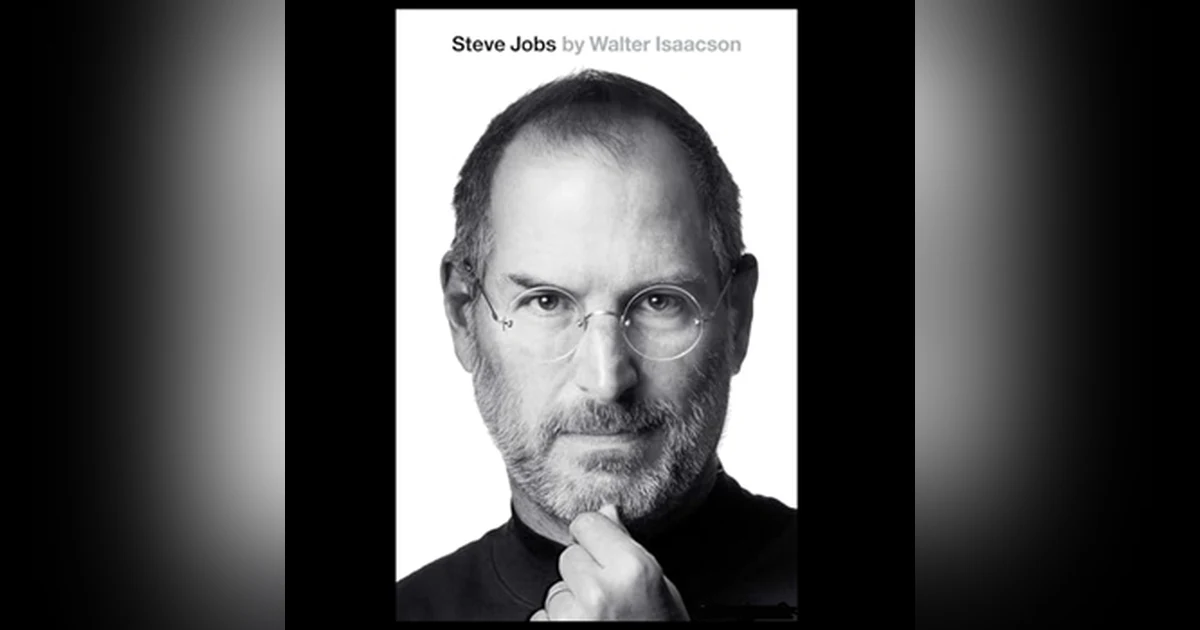
Book Review from Rick’s Library: Steve Jobs by Walter Isaacson

 Amazon Music
 Apple Podcasts
 Spotify
 iHeartRadio
 Youtube Music
 TuneIn
 Castro
 Audible
 RSS Feed
 In this book review, you’ll explore the life of someone who wanted to change the world. This is the biography of Steve Jobs by Walter Isaacson
supporting links
1. Remembering Steve Jobs [Apple]
2. Steve Jobs [Wikipedia]
3. Steve Jobs' 2005 Stanford Commencement Address [YouTube]
4. Why did Apple’s board fire Steve Jobs in 1985? [Corporate Governance Institute]
5. Steve Jobs [All About Steve Jobs]
Contact That's Life, I Swear
- Visit my website: https://www.thatslifeiswear.com
- Twitter at @RedPhantom
- Bluesky at @rickbarron.bsky.social
- Email us at https://www.thatslifeiswear.com/contact/
Episode Review
- Submit on Apple Podcast
- Submit on That's Life, I Swear website
Other topics?
- Do you have topics of interest you'd like to hear for future podcasts? Please email us
Interviews
- Contact me here https://www.thatslifeiswear.com/contact/, if you wish to be a guest for a interview on a topic of interest
Listen to podcast audios
- Apple https://apple.co/3MAFxhb
- Spotify https://spoti.fi/3xCzww4
- My Website: https://bit.ly/39CE9MB
Other
- Music and/or Sound Effects are cour...
⏱️ 11 min read
Hi everyone, and welcome to my podcast, That’s Life, I Swear. I’m your host, Rick Barron
Today, we’re going to explore the life of someone who wanted to change the world. In this book review, we’re diving into Walter Isaacson’s book, Steve Jobs — a biography that goes far beyond the Apple logo and the glow of a familiar screen. This is the story of a man whose ideas transformed not just technology, but the way we live, work, listen, and connect.
Steve Jobs was brilliant, demanding, contentious, and unforgettable. He built products that felt intuitive, beautiful, and bold, while also leaving behind a trail of conflict and criticism.
That tension is what makes his story so compelling. In this episode, we’ll unpack the rise, fall, and reinvention of a figure who helped define the modern era, and we’ll look at what his life can teach us about creativity, leadership, and the price of chasing excellence.
Ready to begin? Let’s turn the page.
Welcome to That's Life, I Swear. This podcast is about life's happenings in this world that conjure up such words as intriguing, frightening, life-changing, inspiring, and more. I'm Rick Barron, your host.
That said, here's the rest of this story:
1. Abstract of the Book
Walter Isaacson’s book, Steve Jobs is a sweeping biography that captures the extraordinary life of one of the most influential figures in modern technology. Rather than offering a simple success story, the book presents Jobs as a complex and often difficult man whose genius transformed not just Apple, but entire industries.
Based on more than forty interviews with Jobs over two years, along with extensive conversations with family, friends, rivals, and colleagues, the book traces his life from his adoptive upbringing and early fascination with electronics to the founding of Apple, his dramatic ouster, his return, and the groundbreaking products that made him a cultural icon. The biography is as much about personality as it is about innovation, because Jobs’s perfectionism, intensity, and vision were inseparable from the products he created.
Isaacson shows how Jobs helped revolutionize personal computers, animated films, music, phones, tablet computing, and digital publishing. But the biography is not simply a celebration of triumphs. It also examines Jobs’s failures, temper, impatience, and difficult relationships. That honesty gives the book its power. Jobs comes across not as a flawless hero, but as a force of nature: inspiring, maddening, brilliant, and deeply human. The reader sees how his obsession with design and simplicity shaped everything from the Macintosh to the iPhone, and how his desire to create beautifully integrated products changed the expectations of consumers around the world.
What makes the book especially engaging is the way Isaacson connects Jobs’s personal journey with the broader story of the digital age. The biography becomes a portrait of innovation itself, showing how one person’s uncompromising standards can reshape the way people work, communicate, and create. It is a compelling read for anyone interested in leadership, technology, creativity, or the price of genius. This book is more than a biography; it is a study of ambition, taste, and the relentless drive to make something exceptional.
2. About the Author
Walter Isaacson is one of the most respected biographers of our time, known for writing about figures who changed the world through ideas, invention, and determination. He has written acclaimed biographies of Benjamin Franklin, Albert Einstein, Leonardo da Vinci, and other major historical and cultural figures.
His subjects often share a common thread: they are thinkers who transformed their eras, and Isaacson is especially skilled at showing how their minds worked. In Steve Jobs, that skill is on full display. He does not merely recount events; he builds a vivid portrait of a man whose personality was as influential as his products.
Isaacson’s background in journalism and his long experience with biography give him a clear advantage. He knows how to gather testimony, identify patterns, and shape an enormous amount of material into a compelling narrative. His work often blends rigorous research with a readable, almost novelistic style. That balance is part of what makes his books so accessible to wide audiences. Even when he is writing about engineering, business strategy, or design philosophy, he keeps the story moving and the characters alive.
One of Isaacson’s strengths is his willingness to present his subjects honestly. He does not turn them into saints, and he does not shy away from contradictions. In Steve Jobs, that approach is essential. Jobs was a visionary, but he was also famously abrasive, emotionally volatile, and at times deeply hurtful to the people around him. Isaacson handles those qualities with care, showing how they shaped Jobs’s rise without excusing the damage they caused. The result is a biography that feels balanced rather than glorifying.
Isaacson is also a writer who understands why biography matters. He is interested not just in what people accomplished, but in how their inner lives influenced the world around them. That makes him especially effective with Jobs, whose ideas, instincts, and obsessions changed modern life in visible and lasting ways. Through Isaacson’s lens, the biography becomes more than a life story; it becomes a meditation on creativity, leadership, and the human cost of excellence.
3. What Drew My Interest in Reading This Book?
What drew my interest in Steve Jobs was the scale of his influence. Few people have changed the way we live as visibly as Jobs did. His impact reaches into the devices we use every day, the way we listen to music, the way we communicate, and even the way we think about design. That alone makes his life worth exploring. Walter Isaacson’s biography promised not just a look at Apple’s rise, but a deeper understanding of the man whose vision helped define the digital age. That combination of technology and personality is hard to resist.
I was also drawn to the fact that Jobs was such a contradictory figure. He was admired for his brilliance and criticized for his behavior, sometimes in the same breath. That tension makes him fascinating as a subject because it forces readers to think beyond simple labels. He was not just an entrepreneur, and not just a genius. He was a person driven by perfection, taste, ambition, and a deep belief that products could shape culture. For readers who enjoy nuanced storytelling, that complexity creates real momentum.
Another reason the book stands out is that it feels larger than a standard business biography. It is also a story about creativity, reinvention, failure, and return. Jobs’s journey includes success, exile, recovery, and a late-life resurgence that produced some of Apple’s most iconic products. That arc gives the biography a dramatic shape that makes it easy to follow and emotionally engaging. For anyone interested in how great ideas are built, tested, and refined, this book offers a rich case study.
As a subject for readers who care about storytelling, leadership, or innovation, Jobs is compelling because he forces us to think about the relationship between vision and personality. How much of greatness is talent, and how much is attitude? What does it take to make something unforgettable? Those are the kinds of questions this book raises, which is exactly why it is so memorable.
4. What Can We Learn from This Book? What’s the Takeaway?
One of the biggest lessons in Steve Jobs is that vision matters, but vision alone is not enough. Jobs had an extraordinary ability to imagine products people did not yet know they wanted. But his success also came from his obsession with detail, design, and execution. The takeaway is that truly transformative work requires both big ideas and relentless attention to how those ideas are brought to life. Dreaming is essential, but so is the discipline to refine, revise, and insist on excellence.
The book also teaches that leadership is complicated. Jobs was not a gentle leader, and the biography does not pretend otherwise. He could inspire teams to do their best work, but he could also intimidate, alienate, and frustrate the hell out of people around him. That makes the book valuable because it does not simplify leadership into positivity alone. Instead, it shows that influence can be powerful even when it is uncomfortable, and that the ethical side of leadership matters just as much as results.
Another important lesson is that failure is often part of reinvention. Jobs’s departure from Apple could have ended his story, but instead it became a turning point. He used that period to grow, build NeXT, support Pixar, and eventually return to Apple with a sharper focus and renewed purpose. That arc reminds readers that setbacks are not always final. Sometimes they prepare us for the work we are better equipped to do later.
The broader takeaway is that great products often reflect great conviction. Jobs believed deeply in simplicity, elegance, and integration, and he built a culture around those ideas. Whether one admires him personally or not, his example shows how strong principles can shape lasting work. The book encourages readers to think carefully about what they stand for and how their values show up in what they create. In that sense, it is a story about far more than technology. It is about ambition, resilience, and the power of ideas executed with intensity.
Well, there you go my friends, That's life, I swear.
For further information regarding the material covered in this episode, I invite you to visit my website, which can be found on Apple Podcasts, for show notes and the episode transcript.
As always, I thank you for the privilege of you listening and your interest.
Be sure to subscribe here or wherever you listen to podcasts so you don't miss an episode.
See you soon.


