
Movie Review from Rick’s Streaming Library: The Odyssey
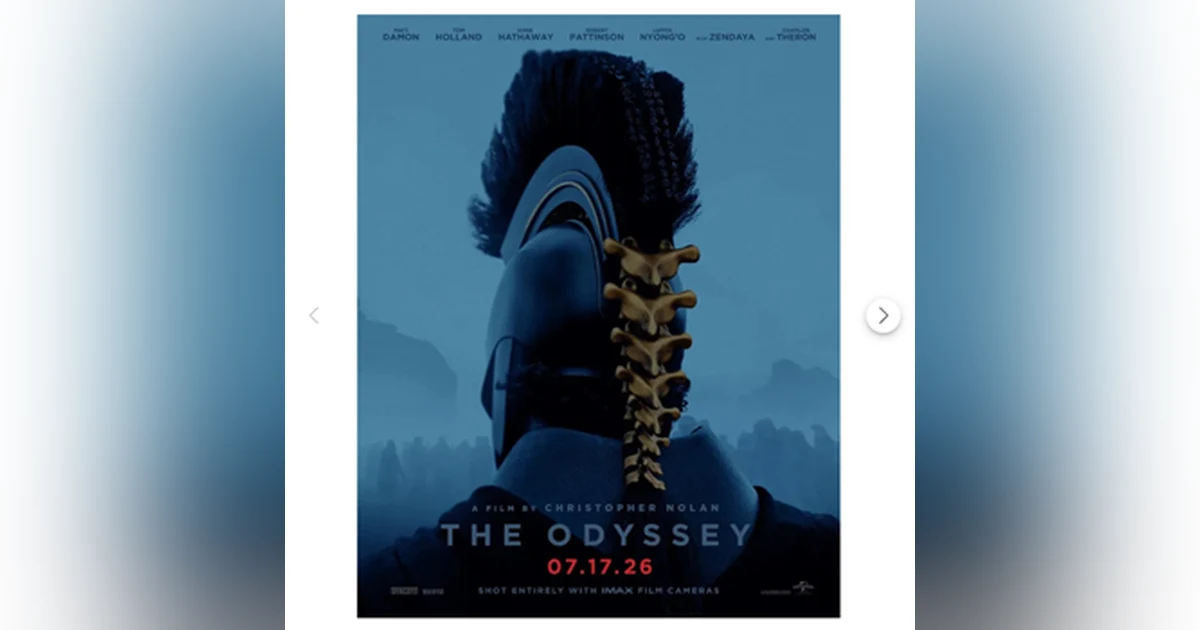
Homer called it The Odyssey. Most of us just call it the template for every story we've ever loved. supporting links 1. Christopher Nolan [IMDb] 2. The Odyssey [IMDb] 3. Odysseus [Wikipedia Contact That's Life, I Swear Visit my website: https://www.thatslifeiswear.com Twitter at @RedPhantom Bluesky at @rickbarron.bsky.social Email us at https://www.thatslifeiswear.com/contact/Episode Review Submit on Apple PodcastSubm...

 Amazon Music
 Apple Podcasts
 Spotify
 iHeartRadio
 Youtube Music
 TuneIn
 Castro
 Audible
 RSS Feed
 Homer called it The Odyssey. Most of us just call it the template for every story we've ever loved.
supporting links
1. Christopher Nolan [IMDb]
2. The Odyssey [IMDb]
3. Odysseus [Wikipedia
Contact That's Life, I Swear
- Visit my website: https://www.thatslifeiswear.com
- Twitter at @RedPhantom
- Bluesky at @rickbarron.bsky.social
- Email us at https://www.thatslifeiswear.com/contact/
Episode Review
- Submit on Apple Podcast
- Submit on That's Life, I Swear website
Other topics?
- Do you have topics of interest you'd like to hear for future podcasts? Please email us
Interviews
- Contact me here https://www.thatslifeiswear.com/contact/, if you wish to be a guest for a interview on a topic of interest
Listen to podcast audios
- Apple https://apple.co/3MAFxhb
- Spotify https://spoti.fi/3xCzww4
- My Website: https://bit.ly/39CE9MB
Other
- Music and/or Sound Effects are cour...
⏱️ 11 min read
Hi everyone, and welcome to my podcast, That’s Life, I Swear. I’m your host, Rick Barron
It is the oldest adventure story ever told. A king leaves home for a war that lasts ten years. Then he spends another ten years just trying to get back. Along the way: a one-eyed giant, a sorceress who turns men into pigs, a whirlpool that swallows ships whole, and gods who use human lives like chess pieces on a board they never have to sit at themselves.
Homer called it The Odyssey. Most of us just call it the template for every story we've ever loved.
Now, three thousand years later, Christopher Nolan — the man who made us feel the physics of a black hole and the weight of the atomic age — has put his cast on actual ships in actual seas, shot two million feet of IMAX film across seven countries, and asked Matt Damon to embody one of the most enduring characters in human literature. Today on the show, we're asking: can cinema do justice to myth? Can a $250 million Hollywood epic carry the same soul as a poem passed down by word of mouth across centuries? And what does it mean, in 2026, to make a film about a man who just wants to go home?"
Ready to begin? Get your popcorn 🍿
Welcome to That's Life, I Swear. This podcast is about life's happenings in this world that conjure up such words as intriguing, frightening, life-changing, inspiring, and more. I'm Rick Barron, your host.
That said, here's the rest of this story
1. Plot of the Movie
Nearly three thousand years after Homer first gave voice to the wandering king of Ithaca, Christopher Nolan has brought The Odyssey to IMAX screens — and if the evidence of his ambition is any guide, the sea has never looked more terrifying or more beautiful. The film follows Odysseus (Matt Damon), the cunning, battle-worn King of Ithaca, as he struggles to navigate the long, monstrous, god-haunted journey home following the decade-long Trojan War. What should be a homecoming becomes something far more harrowing: a voyage of ten years across uncharted seas, through realms of myth and madness.
The story is one of the great narrative architectures in all of human literature. Odysseus encounters such things as the:
2. Survives the Sirens
3. Endures captivity on the island of Calypso, played by Charlize Theron. Don’t see anything wrong with that.
4. And navigates the enchantments of the witch-goddess Circe
Talk about a hard day at the office!
Meanwhile, back in Ithaca, his faithful wife Penelope (Anne Hathaway) fends off a court full of entitled suitors who presume her husband dead, unraveling her weaving each night to delay the reckoning. Their son Telemachus (Tom Holland) grows from boy to man in his father's absence, searching for a hero he has never truly known.
Nolan drew inspiration from the 2017 Emily Wilson translation of Homer — the first English translation by a woman — and the practical creature effects of the legendary Ray Harryhausen. Nolan cast Robert Pattinson, Lupita Nyong'o, Zendaya (as Athena), and even rapper Travis Scott, whom Nolan placed in the film to draw an explicit connection between rap and the oral poetry traditions from which Homer's work emerged.
Shot across Morocco, Greece, Italy, Scotland, Iceland, Western Sahara, and Malta — with the cast genuinely at sea on real ships in real conditions. The Odyssey is a film that insists on being felt. "We really wanted to capture how hard those journeys would have been for people," Nolan has said. "The leap of faith made in an unmapped, uncharted world." That is precisely what cinema, at its most ambitious, asks of us too.
2. About the Director
There is a moment in every Christopher Nolan film where the extreme scale of the world he has constructed becomes undeniable — where you stop watching and start inhabiting. From the fractured timelines of Memento to the zero-gravity hotel corridors of Inception, the wartime shore of Dunkirk, and the blinding white flash of Oppenheimer, Nolan has spent a career using cinema's most extreme technical capabilities not as spectacle for its own sake, but as the architecture of human experience. The Odyssey is his thirteenth feature, and by every available measure, his most ambitious.
Born in London in 1970 and raised between England and Chicago, Nolan studied English Literature at Cambridge — the same discipline, one might note, that would eventually drive him toward Homer. He began making 16mm films as a student and broke through with movies such as The Following (1998) and Memento (2000), establishing a sensibility that has never really wavered: a fierce commitment to practical filmmaking, a suspicion of digital shortcuts, an obsession with the subjective experience of time, memory, and identity. The Dark Knight trilogy redefined the superhero blockbuster. Interstellar made theoretical physics feel like grief. Dunkirk turned military history into sensory immersion.
Oppenheimer (2023) won him his first Oscar for Best Director and Best Picture, finally crowning what was already one of the great careers in contemporary cinema. For The Odyssey, he shot over two million feet of IMAX film — more than any film in the format's history — across 91 days of principal photography, making it the first film ever shot entirely on IMAX 70mm. "I always try to have a point of view from inside the film," Nolan told 60 Minutes. "I'm not looking at characters from 30,000 feet — I'm trying to be in the race, in the maze with them." For a story about a man lost at sea for a decade, there is no director alive better suited to the task.
3. What Drew My Interest in Wanting to See This Movie?
The question is almost easier to answer in reverse: what wouldn't draw you to this film? But let me try to be more precise, because interest in The Odyssey is not merely excitement at a tentpole blockbuster. It is something deeper and stranger — the sensation of watching a piece of the cultural bedrock get lifted and re-examined by one of the few filmmakers alive who can handle the weight.
The Odyssey as a text has haunted Western storytelling for nearly three thousand years. It is the original adventure. Every road movie, every exile narrative, every story about a parent and child separated by circumstance and time — all of it flows, somewhere upstream, back to Odysseus on the wine-dark sea. The idea that Nolan, who has spent his career dissecting identity, time, and what it means to find your way home, would be the one to bring it to IMAX screens feels less like a coincidence than a convergence.
Then there is the casting. Matt Damon brings a specific quality to the screen that very few actors possess: a kind of weathered, credible humanity that makes even the mythological feel earned. He is not a movie star playing a legend; he is a man whose face registers cost. Anne Hathaway as Penelope — one of literature's great portraits of quiet, unbreakable endurance — is inspired. And Zendaya as Athena, the goddess who intervenes in mortal affairs with cool, strategic compassion, feels genuinely electric.
What sealed it for me was a single detail from Nolan's 60 Minutes interview: he put the cast on real ships in real open water, on real seas, in the actual locations of the ancient Mediterranean. The discomfort was intentional. The fear was real. "We wanted to capture how hard those journeys would have been," Nolan said. That is not a filmmaker making a movie about The Odyssey. That is a filmmaker trying to become it.
4. What Can We Learn from This Movie? The Takeaway
Homer's Odyssey has survived for centuries because it is not, at its core, a story about monsters. It is a story about persistence — about the particular human stubbornness that insists on returning, on finishing the journey, on being known and recognized by the people who love you even when you return unrecognizable. The monsters are obstacles. The gods are forces beyond our control. But the voyage itself is a choice, renewed daily, to keep moving toward home.
In Nolan's hands, this theme finds a natural resonance with his lifelong cinematic preoccupations. His films are filled with men who have lost their way, such as Leonard Shelby searching for memory, Bruce Wayne searching for justice, Cobb searching for his children, Oppenheimer searching for a conscience in the aftermath of what he built. Odysseus is the prototype of all of them: brilliant, flawed, capable of tremendous cruelty and tremendous love, navigating a world that is at once genuinely dangerous and profoundly indifferent to his survival.
What we take from this film is a renewed understanding of what the heroic journey actually demands. It is not strength. It is not strategy, though Odysseus has both in abundance. It is the willingness to endure — to be nobody, to be forgotten, to be tested past the limits of dignity — and still choose, in the end, to come home. The film's emotional core, the long-awaited reunion between a husband and wife separated by a decade of war and wandering, carries a weight that no special effect can manufacture. It is earned by everything that precedes it.
The takeaway is old and essential: the point of the journey is not the monsters you defeat. It is the people you are fighting to return to.
Well, there you go my friends, That's life, I swear.
For further information regarding the material covered in this episode, I invite you to visit my website, which can be found on Apple Podcasts, for show notes and the episode transcript.
As always, I thank you for the privilege of you listening and your interest.
Be sure to subscribe here or wherever you listen to podcasts so you don't miss an episode.
See you soon.


