
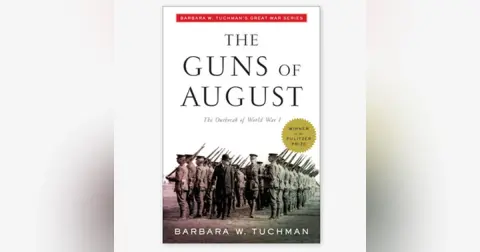
Book Review from Rick’s Library: The Guns of August by Barbara Tuchman

 Amazon Music
 Apple Podcasts
 Spotify
 iHeartRadio
 Youtube Music
 TuneIn
 Castro
 Audible
 RSS Feed
 The central argument of The Guns of August is both simple and terrifying: the First World War was not inevitable.
supporting links
1. Barbara W. Tuchman [Wikipedia]
2. Schlieffen Plan [World History Encyclopedia]
3. World War 1 [History Net]
4. The Guns of August [Amazon]
Contact That's Life, I Swear
- Visit my website: https://www.thatslifeiswear.com
- Twitter at @RedPhantom
- Bluesky at @rickbarron.bsky.social
- Email us at https://www.thatslifeiswear.com/contact/
Episode Review
- Submit on Apple Podcast
- Submit on That's Life, I Swear website
Other topics?
- Do you have topics of interest you'd like to hear for future podcasts? Please email us
Interviews
- Contact me here https://www.thatslifeiswear.com/contact/, if you wish to be a guest for a interview on a topic of interest
Listen to podcast audios
- Apple https://apple.co/3MAFxhb
- Spotify https://spoti.fi/3xCzww4
- My Website: https://bit.ly/39CE9MB
Other
- Music and/or Sound Effects are cour...
⏱️ 11 min read
Hi everyone, and welcome to my podcast, That’s Life, I Swear. I’m your host, Rick Barron
In the summer of 1914, the most powerful nations on earth stumbled into the most destructive war the world had ever seen, World War I. Not because they wanted catastrophe, not because they had run out of alternatives, but because their plans, their pride, and their failure to truly listen to one another made catastrophe all but inescapable.
In this book review, I’ll be diving deep into one of the most consequential books of the twentieth century — a book that won the Pulitzer Prize, lived on the desk of a president during the most dangerous nuclear standoff in human history, and still reads today with the dynamic force of a great thriller.
Barbara W. Tuchman's The Guns of August is the story of August 1914. It was during the thirty-one days of that month that:
1. The next four years of trench warfare
2. The Russian Revolution
3. The rise of fascism
4. A second world war
5. And the Cold War that followed were determined
It is a story about hubris and rigidity, about brilliant men making catastrophic choices, about the terrifying distance between what leaders believe they are doing and what they are actually setting in motion.
But most of all, this book tells a story about how the same mistakes keep happening — and what it costs when no one is reading history carefully enough to stop them. Buckle in. The guns are about to fire.
Ready to begin? Let’s turn the page.
Welcome to That's Life, I Swear. This podcast is about life's happenings in this world that conjure up such words as intriguing, frightening, life-changing, inspiring, and more. I'm Rick Barron, your host.
That said, here's the rest of this story:
1. Abstract of the Book
There are books that illuminate history, and then there are books that intervene in it. Barbara W. Tuchman's The Guns of August belongs to the second category. Published in 1962 and awarded the Pulitzer Prize the following year, it remains, more than six decades later, the definitive popular account of the thirty-one days in the summer of 1914 that detonated the modern world.
Tuchman's subject is the opening month of the First World War — from the mobilization orders and secret military timetables of the major European powers to the catastrophic failure of Germany's Schlieffen Plan and the grinding stalemate at the battle of Marne that condemned an entire generation to four years of industrial slaughter in the trenches. But to describe it merely as military history would be to undersell it. The Guns of August is a masterwork of narrative history, an inquiry into the mechanisms of human folly that reads less like a chronicle and more like an unfolding tragedy — one in which the audience, unlike the characters on stage, knows with terrible clarity how it all ends.
Tuchman opens with one of the most celebrated paragraphs in American letters: the funeral procession of King Edward VII in May 1910, when nine monarchs rode together through London's streets in a last, gorgeous pageant of the old order. It is a scene of dazzling brilliance poised at the edge of an abyss. From there, Tuchman traces the web of alliances, mobilization plans, military vanities, diplomatic miscalculations, and sheer institutional rigidity that dragged Europe's great powers into a war none of them had fully intended and none of them could stop.
The Schlieffen Plan's demand for the invasion of neutral Belgium, France's suicidal cult of the offensive, Britain's agonized entry into the conflict, Russia's lumbering advance into East Prussia — each thread is examined with forensic precision and rendered with the vividness of lived experience. The result is a book that achieves something almost paradoxical: it makes the reader forget they already know the outcome.
2. About the Author
Barbara W. Tuchman was born on January 30, 1912, into the kind of family for whom history was not an academic abstraction but a living inheritance. Her grandfather, Henry Morgenthau Sr., served as Woodrow Wilson's Ambassador to the Ottoman Empire during the First World War — a posting that placed him at the center of some of that conflict's most consequential and tragic events. Her uncle, Henry Morgenthau Jr., served as Franklin Roosevelt's Secretary of the Treasury. Raised in privilege on New York's Upper East Side, educated at Radcliffe, Tuchman, entered a world that expected brilliant women to observe history from the sidelines. She chose instead to write it.
What makes Tuchman's achievement so extraordinary is that she accomplished it entirely outside the academy. She earned no doctorate, held no professorship, and operated entirely beyond the organizational structures of professional historiography. Academic historians of her era frequently dismissed her as a mere popularizer — a label she accepted with cheerful defiance, understanding that it contained within it the highest possible compliment.
Her career began modestly, with journalism and research work in New York and Tokyo. She worked as an editorial assistant at The Nation magazine and as an American correspondent in London, experiences that sharpened her instinct for the telling detail and the clarifying anecdote. Her early books attracted modest attention; but it was The Guns of August, her fourth work, that made her a household name.
1. The book spent forty-two consecutive weeks on the New York Times bestseller list
2. Was selected by the Modern Library as one of the one hundred greatest nonfiction books in the English language, and earned the 1963 Pulitzer Prize for General Nonfiction.
3. She would win a second Pulitzer in 1972 for Stilwell and the American Experience in China, 1911–45.
4. Her subsequent works, “The Proud Tower, A Distant Mirror, The March of Folly — confirmed her as the preeminent narrative historian of the twentieth century. She died in 1989, having demonstrated, with rare and immeasurable force, that history written for everyone is not lesser history. It may, in fact, be the most important kind.
3. What Drew My Interest in Reading This Book?
I came to The Guns of August through an unlikely door, you might say: a remark made by President John F. Kennedy during the Cuban Missile Crisis. At the height of the most dangerous nuclear standoff the world has ever survived, Kennedy reportedly turned to his brother Robert and said, 'I am not going to follow a course which will allow anyone to write a comparable book about this time and call it The Missiles of October.'
He distributed copies of Tuchman's book to his national security team and to British Prime Minister Harold Macmillan. He ordered it sent to military bases around the world. This was, I thought, an astonishing testimony — a sitting president using a history book published mere months earlier as a real-time guide to avoiding the apocalypse. The idea that a single work of narrative history could span decades and genuinely alter the calculations of the most powerful man on earth seemed to me the most persuasive argument imaginable for why history matters.
What I encountered far exceeded the expectation that recommendation had created. The opening paragraph alone — Tuchman's description of Edward VII's funeral cortege, nine kings riding three abreast through London in a dying blaze of imperial splendor — stopped me cold. It took her eight hours to write and reads like it arrived fully formed from some higher register of English prose.
From there, I was not so much reading as being pulled forward, the narrative momentum operating less like the familiar drip of textbook chronology and more like the gathering force of a great novel. I found myself genuinely uncertain, despite knowing the history, whether the catastrophe could be averted.
What drew me to this book was the promise of a lesson that history rarely delivers clearly: that events which seem, in retrospect, to have been inevitable were in fact the product of specific, identifiable, and avoidable human failures. The Guns of August delivers that lesson with devastating authority.
4. What Can We Learn From This Book? What’s the Takeaway?
The central argument of The Guns of August is both simple and terrifying: the First World War was not inevitable. It was the product of hubris, rigidity, miscalculation, and the tragic momentum of institutional plans that had taken on a life of their own, plans so detailed, so deeply embedded in the machinery of state, that the human beings nominally in charge of them, found themselves unable to stop the machine once it began to move.
Tuchman shows, with patient and damning precision, how the Schlieffen Plan — Germany's elaborate strategy for a two-front war:
1. Transformed from a military option into a straitjacket,
2. How France's doctrine of the offensive led its generals to send men marching into artillery fire in bright red trousers,
3. And how the alliance system converted a regional crisis into a continental catastrophe with the grim efficiency of a conveyor belt.
The lesson is not merely historical. It is structural: organizations, nations, and institutions can develop such momentum in a particular direction that even their official leaders cannot reverse them.
The deeper takeaway, and the one that resonated so profoundly with Kennedy in October 1962, is about the danger of miscalculation — the gap between what decision-makers believe they are doing and what they are actually setting in motion. The German chancellor who, when asked after the war how it had all happened, replied 'Ah, if only one knew' — that exchange, relayed by Tuchman, haunted President Kennedy at the edge of nuclear catastrophe. He was determined not to be that chancellor.
The book teaches us that communication failures, in diplomacy as in war, have body counts. That the generals' confidence in their plans was directly proportional to the distance those plans would carry their armies from reality.
And it teaches, perhaps most urgently, that the willingness to pause, to seek alternatives, to exhaust every diplomatic option before accepting the logic of escalation, is not weakness. It is the most sophisticated and demanding form of strength. In an age of renewed great-power tension, this is not a lesson of the past. It is a warning for the present.
Well, there you go my friends, That's life, I swear.
For further information regarding the material covered in this episode, I invite you to visit my website, which can be found on Apple Podcasts, for show notes and the episode transcript.
As always, I thank you for the privilege of you listening and your interest.
Be sure to subscribe here or wherever you listen to podcasts so you don't miss an episode.
See you soon.


