
Interview #34 Rick Barron: What's Life Trying to Teach You? | A wisdom conversation
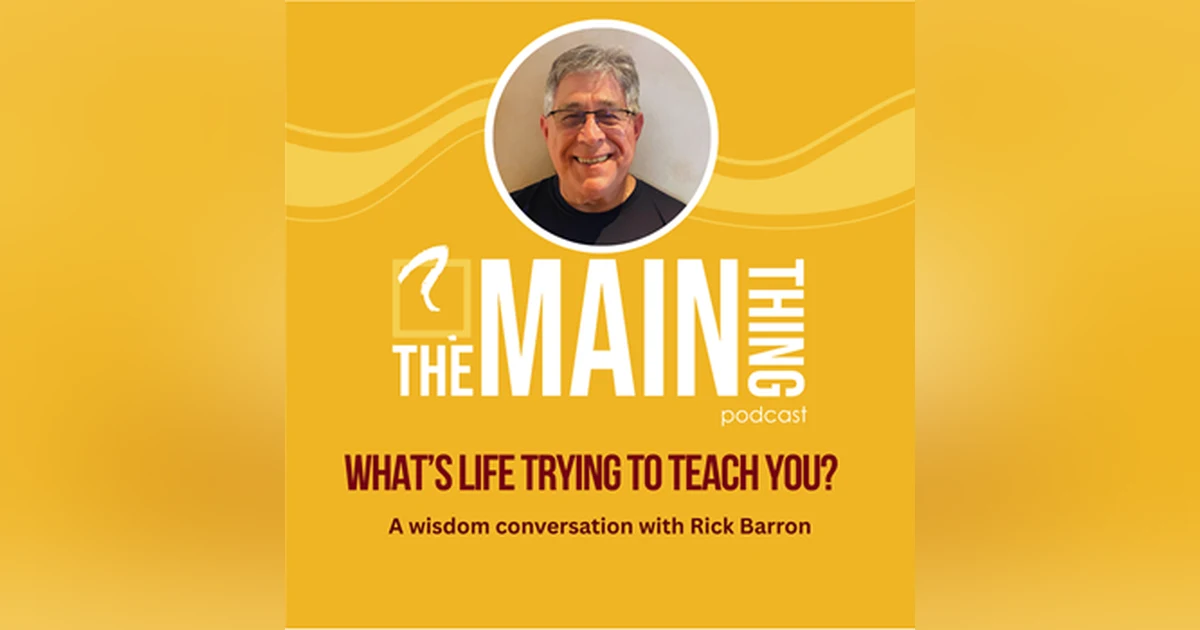
Summary I had the pleasure of being interviewed by Skip Lineberg, host of the podcast: The Main Thing. Content below is courtesy of Skip Lineberg. Rick Barron has lived several remarkable chapters. He served our country during the Vietnam era. Then, Rick helped manufacture the original Apple Macintosh. He spent 42 years working for technology leaders including Apple, Hewlett-Packard, Sun Microsystems, Motorola, Symantec and Intel. Today, he is a fellow podcaster whose curiosity and love...

 Amazon Music
 Apple Podcasts
 Spotify
 iHeartRadio
 Youtube Music
 TuneIn
 Castro
 Audible
 RSS Feed
 Summary
I had the pleasure of being interviewed by Skip Lineberg, host of the podcast: The Main Thing.
Content below is courtesy of Skip Lineberg.
Rick Barron has lived several remarkable chapters. He served our country during the Vietnam era. Then, Rick helped manufacture the original Apple Macintosh. He spent 42 years working for technology leaders including Apple, Hewlett-Packard, Sun Microsystems, Motorola, Symantec and Intel. Today, he is a fellow podcaster whose curiosity and love of storytelling continue to give his retirement fresh purpose.
Yet this conversation isn’t ultimately about technology or career success. It’s about what life teaches us. Rick shares unforgettable stories of watching Steve Jobs unveil Apple’s legendary “1984” commercial, receiving a melanoma diagnosis that threatened his arm, facing financial uncertainty with only $53 left in his checking account and encouraging a young intern named Amy Wong toward the career she dreamed of pursuing.
Chapters
[00:03:15] — How two podcasters connected
[00:04:42] — Inside Apple and the original Macintosh launch
[00:10:29] — Steve Jobs unveils the “1984” commercial
[00:14:05] — Vietnam and the preciousness of life
[00:17:47] — How retirement led Rick into podcasting
[00:20:27] — Melanoma and the fear of losing his arm
[00:24:41] — Rick reveals his “Main Thing”
[00:25:48] — The lesson inside a $53 checking balance
[00:29:51] — Why failure can become a powerful teacher
[00:33:56] — Mentoring Amy Wong and opening a path
[00:38:57] — Living fully in the present
[00:40:30] — Skip shares final reflections
Supporting links
Facebook:
facebookcom/pages/TheMainThingPodcast
LinkedIn:
https://www.linkedin.com/in/skiplineberg/
https://www.linkedin.com/company/the-main-thing-podcast
Instagram:
Contact That's Life, I Swear
- Visit my website: https://www.thatslifeiswear.com
- Twitter at @RedPhantom
- Bluesky at @rickbarron.bsky.social
- Email us at https://www.thatslifeiswear.com/contact/
Episode Review
- Submit on Apple Podcast
- Submit on That's Life, I Swear website
Other topics?
- Do you have topics of interest you'd like to hear for future podcasts? Please email us
Interviews
- Contact me here https://www.thatslifeiswear.com/contact/, if you wish to be a guest for a interview on a topic of interest
Listen to podcast audios
- Apple https://apple.co/3MAFxhb
- Spotify https://spoti.fi/3xCzww4
- My Website: https://bit.ly/39CE9MB
Other
- Music and/or Sound Effects are cour...
SPEAKER_01
Wisdom. It's an incredibly valuable asset. Some would say more precious than gold. It's attractive, appealing, admirable. Conversely, a lack of wisdom is the basis of immaturity, blind spots, and bad decisions. Wisdom. It can be gained over time, but it can't be rushed. But wisdom can be shared. That's precisely what we are here to do right now. Today, we are here to hack wisdom, to distill it, to understand it, and to process it. Why? To get better at life. Welcome to the main thing. This is your new Wisdom Podcast. I'm your host, Skip Lineberg, and I've set out to interview the wisest people I know. We'll see what we can learn from each one when they're faced with an incredibly difficult, soul-piercing question. Welcome back to the Main Thing Podcast. I'm your host, Skip Lineberg, coming to you today as always from Parkwood Studios in Almost Heaven, West Virginia. Every once in a while, you meet someone who has simply lived. Not just accumulated birthdays, but accumulated perspective. The kind of perspective that can only be earned by walking through hardship, making difficult decisions, recovering from disappointment, staying curious, and paying attention to what life is trying to teach us along the way. Today's guest is one of those people. Rick Barron spent 42 years in the heart of Silicon Valley, contributing to some of the most influential and transformative technology companies of our time, including Apple, Hewlett Packer, Sun Microsystems, Motorola, Symantec, and Intel. Early in his career, Rick even helped manufacture the original Apple Macintosh, which gave him a front row C into one of the most iconic product launches in modern history. But as fascinating as those stories are, this conversation really isn't about computers. It's about what life teaches us. Rick Barron served our nation during the Vietnam War at the tender age of 19 years old. He'll share lessons from military service, stories from his early days in Silicon Valley, what a battle with melanoma taught him about life, why he's so passionate about mentoring younger professionals, and how podcasting has become an unexpectedly joyful and meaningful chapter in his retirement. More than anything though, I think you're going to enjoy spending a little time with Rick Barron. He has that rare ability to tell stories that are both deeply personal and universally relatable. By the end of our conversation, I suspect you'll feel like you've just shared a cup of coffee with someone who's simply been a little further down the road and who genuinely wants to help the rest of us navigate it a little more wisely. Here's my wisdom conversation with Rick Barron. Enjoy. Rick Barron, welcome to the Main Thing Podcast. Thanks for making some time for us this morning.
SPEAKER_00
Oh, Skip, thank you so much. I've been looking forward to this very much. And I think in our past conversations led me to think that here's someone that I would really love to speak with again.
SPEAKER_01
Who are these two guys? How are they connected? And so do you want to start that? And I'll just jump in with some color commentary.
SPEAKER_00
Sure. We came across one another. Uh we're both part of a uh the Riverside Facebook podcast community group. And uh over time since I'd been uh using their software Riverside, uh we've been given the opportunity to seek people who may have an interest to be interviewed. So, you know, I put up my pitch like others did, and uh you were kind enough to uh accept my offer and we had a discussion and we said, okay, let's do it. And I think it was back in March of 2026.
SPEAKER_03
Yeah.
SPEAKER_00
We sat down and uh let me tell you, I've been getting a lot of hits on our conversation.
SPEAKER_01
Thank you for having me on your show, and it's uh it's a pleasure to uh reciprocate here today. I am not big in online communities, but my experience with you and the Riverside group is really good, really rich, really useful. I look at that when I see it come through my feed, I always look and click into the comments because there's there's knowledge sharing there that's uh invaluable.
SPEAKER_00
All over, yeah. Yeah, it's a great community. Where I live, um in Silicon Valley in California, and I'm now retired, but over the 40 years I was in that industry, um I was able to work for numerous uh great companies, Hewler-Packard, Sun Microsystems. Uh but throughout all those years, um, other than Sun Microsystems, if I had to pick one that was really something that I could really relate to with fond memory, was when I worked at Apple Computer.
SPEAKER_03
Yeah.
SPEAKER_00
And uh that was back in uh gosh, I think it was 1983. Yeah, I'm dating myself here. Okay. Uh that uh I looked in the WAN ads and there was this ad for um a production uh manager, and that's all it said uh at Apple Computer. It was a very simple, so I answered the ad.
SPEAKER_03
Okay.
SPEAKER_00
Uh submitted my resume. Um about a few weeks from finally got a call and said, Hey, why don't you come in and we'll have a chat? And the process went very smoothly. And wow, gosh, I think about maybe a month later, they said, We'd like to bring you on board. Now I wasn't quite sure what it was I was going to be doing per se. They were still fairly young, but yeah, they were getting such p publicity with you know the likes of Steve Jobs and all of the great things that they were wanting to create because they really were uh so religious about making the computer so simple to use and not have it be something that one would be afraid of to even attempt to use at home, let alone work. So they their simplification was something they took as a religion. So anyway, when I when I got to Apple, I was told to go to this building down the street in Cupertino, and he said it's gonna be behind a gas station. And I thought, okay.
SPEAKER_01
So this sounds a little sketchy at this point. It does.
SPEAKER_00
And I went there and uh I found the gas station, but I didn't see anything that had the Apple logo of like, okay, this is the office. Yeah, yeah. So I was told to go to this door and knock on the door, identify who you are because they're expecting you. I said, okay. So I went, I parked my car and I thought, geez, this feels so clandestine. It does. And I knocked on the door and I identified who I was. Oh yeah, Greg, we've been expecting you. Come on in. And that's where I met uh five other people, and it was in this very large, well, not a large building, but it was where they were uh building prototypes of the first Macintosh.
SPEAKER_03
Oh wow.
SPEAKER_00
And that's when I had my first exposure to seeing this product that I I had heard about, but didn't really get a grasp of what it was all about.
SPEAKER_01
So still right in right in the prototyping phase.
SPEAKER_00
Absolutely. And I thought this is so surreal because here we are, people are walking up and down the street and have no idea what's going on in this building. For sure. Just being exposed to the prototypes of the chassis, the motherboard, everything that was being pulled together. And we were having extensive meetings late in the night to get this up and running because we had a very tight schedule to meet to then address the major launch which was coming.
SPEAKER_01
Rick, did it already have a name? Was it already known as Macintosh?
SPEAKER_00
It was known as Macintosh, okay. Even the prototypes had the labels on them. Okay, cool. And uh one real uh uh neat uh tidb is uh inside the bezel uh was the signature of every engineer that was behind the manufacturing or the creation of the Macintosh. Wow. So I mean it was in the first launch of the Macintosh computers, so it was kind of chiseled chiseled in per se. Yeah, yeah. So everyone had that. Uh but I think it was like uh two weeks later, that's when I went up to the factory in a place called uh Fremont.
SPEAKER_03
Okay.
SPEAKER_00
And that's where I was introduced to the other key supervisors who were had separate who had responsibilities for various parts of the uh Macintosh manufacturing. That's when I got exposed to automation of robots doing various uh loading of chips into the boards.
SPEAKER_03
Yeah.
SPEAKER_00
It was a sight to see. We got to meet the uh manager of the what we call the Mac factory, and that's when we had a session with all the supervisors and the people who were part of the manufacturing process on what our objective was. Okay. And we were told that we had to be ready with X number of Macintoshes to then have it be ready so that they would launch it come uh in January of 1984. And we were like four months away.
SPEAKER_03
Yeah.
SPEAKER_00
And I thought, whoa, this we're gonna be working some long hours. We even work some weekends.
SPEAKER_01
Yeah. And Rick, as a as a marketing guy, but you know, that's my my profession, my career's been in marketing. January 1984 is a significant landmark date in the advertising world. Because the the commercial for that product debuted, was seen by the world at the Super Bowl halftime of that year.
SPEAKER_00
Well, there's a story there. When we got to the point of where we had the volume that we needed to meet the launch, um, we were told we were going to have a special guest come out to the factory. And we all met somewhat central of the manufacturing floor. And we were waiting and waiting. All of a sudden, someone said, Oh my god, it's him. And I turned around and it was Steve Jobs. And uh he came out and he said, I'd like to have you guys uh get in your cars and drive up to this breakfast place that's up the road, and uh, we're gonna treat you guys to breakfast. And the crew was fairly small at the time. So we got there, we were having our breakfast, and then Steve Jobs was doing his pitch about what the work we did we did and how we're getting ready to launch it come January. And he said, you know, typically he always said, but there is one more thing. Okay. And that's that's when he said out we are going to debut a commercial to launch the Macintosh. And I said, I'd like to show it to you guys. And when the the they closed the screens, and he said, just so you know, you were the first Apple employees, other than us in management, to see this commercial. So he launched it, and you could have heard a pin drop. It was just unbelievable. When it was over, everyone stood up and just clapped. It wasn't like, okay, let's all stand up and clap. It was like it just happened spontaneously. Everyone was just like, oh my gosh, this is gonna knock them off their socks. And he said, Well, let's let's run it one more time. Okay, it was the same thrill. Same thrill.
SPEAKER_03
Yeah.
SPEAKER_00
But uh after we had the launch uh to a lot of fanfare, uh Steve Jobs had management uh present all of the people on the manufacturing um facile be presented uh with a free Macintosh along with the only two pieces of software at the time, MacRate. Um I'm sorry, Mac Wright and Mac Paint. That was it. Okay, yeah, yeah. So wow it was quite a joy to work there.
SPEAKER_01
Amazing, amazing. Thanks for sharing that story. No, you're welcome. I just want to mention for folks that are listening, because you're Apple fans and you love technology, you love the Apple brand, you're part of that community. Uh we had a guest on about a year ago at this time, uh Anita Steubenrah, who was uh a longtime Apple employee who wrote the Apple Credo, which is uh their their shared values. Here's who we are and what we believe in. And she she wrote that and and she reads it uh, you know, in her own voice, of course, on the on that episode. And it is also goosebumps-inducing uh type of message that uh Apple is known for.
SPEAKER_00
Well, that was the one thing uh about Apple. It was there was just something magical about that place. I mean, you walk into the fact the factory floor, or you walk onto the campus buildings. I mean, there was just a buzz. Absolute buzz.
SPEAKER_01
Rick, you've worked for, and you mentioned some of them, uh, many of the titans of technology in Silicon Valley and throughout the region, uh Hewlett-Packard. We mentioned the Skunkworks earlier. I know you had some time at HP, Sun, Motorola, uh, Symantec, so on the on the software side of the industry. But I wouldn't want to overlook, Rick, your military service. And I want to thank you for uh serving our nation in the uh the Vietnam War. If you would uh speak to Americans today, what how you would like us to remember and frame up uh the importance of uh of the Vietnam conflict.
SPEAKER_00
Sure. Um yeah, I I was uh I joined in when I was 19 and I was drafted in a different period of time because um you know people were just protesting the war uh uh quite extensively.
SPEAKER_03
Yeah.
SPEAKER_00
And I felt that it was it made no sense for us to be there. And I know when uh well I'll t tell you a little story here. My both my brother and I were drafted together.
SPEAKER_03
Oh wow, okay.
SPEAKER_00
And my mother said, Well, can't we fight it because they can't take both of you? And we both said, you know, it's best that we go together and just get it behind us. Now, my brother went to Vietnam, but I worked in a hospital. And in the hospital, we were getting choppers coming in every day bringing in the wounded. Wow. And I was just turning 20 when I got exposed to that. And just seeing that skeptical, uh it just made me realize how precious life is. It just in the blink of an eye, you could lose everything. And seeing a lot of these individuals uh who were just um their spirits were just broken. Uh but again, it made me think that I know I don't like this war, but I felt that my country, or I'm sorry, our country has its faults. Like any country in the world. But I wouldn't trade it for anything. And I think that people need to understand that we're going to maybe someday do this again. War is not a pretty thing. Uh it never has been, it never will be. But, you know, I mean, I I came across a friend of mine at at the PX that we were in uh basic training together and he was in, you know, um medical gear, you know, his army-issued, you know, blue uh kimona. And um I noticed that he had a scar on his chin and he had been hit by shrapnel.
SPEAKER_03
Oh, great.
SPEAKER_00
But he said, well, but I'm the lucky one because the uh the way I got this was the guy who was taking point that day, he hit the landline and he was you know gone in an instant, but the shrapnel hit me. But I think to answer your question about what I would tell kids today is if you don't know what you want to do in your life as of yet, join the military, and I'll I'll tell you why, because it will prepare you for life more than you realize how to survive, how to have a good discipline, a spirit of mind that will guide you going forward. Eventually I did go back to to college and uh I finished up and got my degree, and that's when I eventually got into the uh the high tech arena. But I would tell any uh person today that there's nothing wrong with serving your country.
SPEAKER_01
We're both podcasters. I mentioned earlier, uh briefly, that I had been on your show. And so speaking about your show, uh here's what it says on the website every Wednesday. Join Rick as he unravels the intricate threads of life's most captivating stories. I love that. Yeah, I love stories. I've already said that probably twice in this short period of time. How'd you get into podcasting and how long you've been doing it?
SPEAKER_00
Sure. Um I really got into it purely by accident, to be honest. I was watching the news and there sometimes there were uh news clips I would watch and I would have my opinionist and I'd be talking out loud about what I was watching. And it was my wife who turned to me and said, Why don't you do a podcast on something like this? And I said, Uh, what do you mean? He said, Well, you know, have you ever heard of podcasting? I've heard of it, but I don't really know that much about it. So I don't know why. I said, you know, well, I'm retired, I got time. So I did my research and uh I started joining.
SPEAKER_01
Let's learn about it. Let's go.
SPEAKER_00
A lot of things I learned cold turkey. Um uh, but the part that intrigued me the most was the writing aspect of it all. Uh crafting a story.
SPEAKER_02
Yeah.
SPEAKER_00
Um and the other part was uh I learned the the research that would be involved, which I just love to do, peeling the skin of the onion. Like, oh, here's another facet of this story.
SPEAKER_03
Yeah.
SPEAKER_00
I just love doing that. But to answer your question, when I started uh was in April of 2022, I did my introduction.
SPEAKER_03
Okay.
SPEAKER_00
And then my first podcast, I mean, I'd written like five or six stories to get going. But I wanted the first one to have uh some purpose and some meaning that spoke to my introduction about what I do every Wednesday.
SPEAKER_03
Yeah.
SPEAKER_00
And I thought, you know, I'm gonna dedicate my first one to my wife. And that first one involved about why men are afraid to go see the doctor.
SPEAKER_03
Oh wow.
SPEAKER_00
Yeah, it was a story about when we uh I think it was our first year of marriage and we were coming out towards Christmas, and my wife said, I'd like you to promise me uh a small Christmas, uh Christmas Rish.
SPEAKER_03
Okay.
SPEAKER_00
I said, Okay. And so I want you to promise me that you will go see the doctor every year for an annual checkup.
SPEAKER_03
Huh.
SPEAKER_00
And I thought, hmm, okay, you know, so I did. I mean, I was good about going to the dentist, but I wouldn't go to a doctor or anything.
SPEAKER_01
I get it, yeah.
SPEAKER_00
You know, and um so I I said, okay, and about maybe eight years into seeing the doctor, he noticed um a mark on my wrist. And he said, How long have you had that? I said, I don't know, I guess maybe about a year or two. He said, Let's get that checked out. So he had me go across the street that day uh to see another doctor, and he took a sample and he said, I'll call you probably tonight and tell you what I found.
SPEAKER_03
Okay, wow.
SPEAKER_00
Uh okay. And then so I told my wife as soon as I got home, and the phone rang and I had chills. I thought it's gotta be the doctor. And he came straight to the point, he said, You have melanoma. I said, Oh. I said, I need you to come back to see two doctors tomorrow. So I drove up, my wife came with me, and I spoke to the first doctor, and she took copious notes and about what uh the next steps were. And she said, Uh, so I'm gonna have you meet the next doctor who's gonna do the surgery. And I said, Whoa, wait a minute. Surgery surgery.
SPEAKER_01
Yeah, we're moving, we're moving pretty fast here. Very fast.
SPEAKER_00
Yeah. And the doctor came in, introduced himself, and he explained the nature of stages of melanoma. And he said, uh, we're gonna have to, you know, obviously, you know, you know, do some cuts here. I don't know how deep I'm gonna have to go. And he's so I'm just prepping you, you know. You could lose the the feeling of your fingers, your entire hand. And and then he dropped a bomb on me. He said, If this is is if this is goes beyond serious, yeah. Uh he said, You could lose your arm.
SPEAKER_03
Oh my gosh.
SPEAKER_00
And I fell to the floor and I started to cry. Yeah, and I said, of course. I'm not hearing this. So uh they had the surgery, it went well, uh, but the um the healing wasn't as um uh positive as a doctor would have liked it, so we had to go in for a second surgery.
SPEAKER_01
Okay, and Rick, I want to ask, I'm just sitting here wondering, was this your arm that you write with is your dominant arm or your other? No, it was my left hand or left arm.
SPEAKER_00
I guess it goes back to what I was saying about the military. You don't know when life is gonna throw a curveball at you.
SPEAKER_03
Yeah.
SPEAKER_00
And I thought, well, okay, it's just gonna be my moment. And um after the second surgery, I was awaking up because I thought to myself, okay, so what happens if in this time my arm is gone? Yeah, and I woke up, my wife was at the at the foot of the bed, she was looking and she was smiling, and she says, Go ahead, take a look. I know you want to. I said, I can still I could still see my my arm. I said, Okay, good.
SPEAKER_01
Still the Hallelujah.
SPEAKER_00
Yeah, wow. But it was uh a wake-me up call. And I think that podcast, the very first one, yeah. I did that uh early May of 2022. Okay. To this day, I am still getting hits on it.
SPEAKER_01
Wow. Well, that's a power that's a powerful story, and I love how you framed it. The title, Why Men Are Afraid to Go to the Doctor, that's so relatable. We all are.
SPEAKER_00
It's true that it was a couple of ladies uh who emailed me and thanked me because it's because of your podcast. My husband is now going to see the doctor. Wow, that's well, if I could do a small contribution, then thank you.
SPEAKER_01
That makes it all worthwhile. Rick, I want to just compliment you, and this is sincere, and I've said it before on your show on the live mic, but your quality of production, your storytelling is a plus plus. It's extraordinary. I feel like when I'm listening to one of your solo episodes, that I'm listening to a news package on NPR on National Public Radio. I mean it's that it's that good.
SPEAKER_00
Thank you.
SPEAKER_01
So, Rick, your main thing is that overcoming hardships involves using past experiences to help us make better decisions later on. Overcoming hardships is valuable. Don't overlook that, don't devalue what you get from overcoming hardships. That's a good analysis. I've lived that, I think for most of my life. I would be in a hardship or see one coming, and I would want to dodge it, get over it, around it as quickly as possible. Only and I would say, Rick, the last five years have I began to believe to say, let's look for the blessing in here. Let's look for the value. But your main thing, overcoming hardships, uses past experiences to help us make better decisions later on is something that I know and I believe deeply. So thank you for adding that to our wisdom library. I wonder if you might share with us when did this crystallize for you? Wow.
SPEAKER_00
Uh there's been a number of them, you know, very quickly, I think what I learned when I was uh in the service, um, seeing what I saw. And I um as I said, I I grew up very fast uh during that time period. But when I came home, uh went to college, started working, uh there was a point in time where I just got tired of paying rent and I wanted to buy a house. And I really had to scrimp and save to get that home that I always wanted. Sure. And when I did that, you know, that the real estate agent was wanting me to take a look at homes that, well, that's kind of beyond my my pocket.
unknown
Good.
SPEAKER_00
But eventually, yeah, I said, but eventually you'll get raises. I know, but I want to eat. You know, so eventually, you know, uh the house I'm in in today was my very first house. So I've been here. Um it'll be uh 42 years this coming in uh July 13th.
SPEAKER_01
That's awesome.
SPEAKER_00
That I've lived here. Uh but to kind of share an experience that I had when I first moved in, uh the house was a fixer upper. I mean, there were so many things I needed to address, but I thought, yeah, but I have a home. I was writing my bills one evening and I just got through feeding my dog and cat. And I had to pay the mortgage. Sure. And then when I paid the mortgage, I thought, okay, I still have a few more bills. And I thought, oh gosh, after I pay all this off, I only have $53 left in my checking account. And payday was two weeks away. Sure. Two weeks away. Tight. And well, tight and scary. For sure. I I thought, oh my God, what am I gonna do? And the first thing that hit me right away was like, I'm not gonna go to my parents for help. Because I remember when I was working for my dad, how he taught me to uh live up to your responsibilities. Uh he said, you'll probably face a lot of hardships along the way. But he said that's where you're gonna learn who you are.
SPEAKER_03
Yeah.
SPEAKER_00
And he said, if you run away from that, he said you'll never grow up. You'll never make it. You'll make it, but you won't make it the way that you would like to. And um my my fear was uh of failure that gosh, here I wanted to get this home and now I might lose it.
SPEAKER_03
Yeah.
SPEAKER_00
And then I realized, well, wait a minute, you know, I still have some stock that I can sell. And I did do that. I got through it. And I learned that's another lesson. I learned how how to be prepared for the what if. So I made sure I was financially um in a good position the next time if that ever happened again.
SPEAKER_03
Yeah.
SPEAKER_00
Um, I kind of let my expenses overexceed uh my wisdom of how to maintain a balanced account.
SPEAKER_04
Yeah.
SPEAKER_00
But that was scary, you know, and but I learned so many facets of what happened that that day, of how to be more responsible about your finances, how to stand up for yourself and say, I'm gonna figure this out. I may have to feel a little pain, but by God, I'm gonna get through it.
SPEAKER_01
A listener out there, this has raised their ears up and they're going, what are these guys talking about? Overcoming hardships is very valuable and uh it's gonna help me grow and and make better decisions later on. They're going, really? I don't I don't see that yet. What might be some characteristics of their life absent this wisdom that they would be bumping into that would be a signal that, hey, maybe I should be open to what Rick's main thing is here.
SPEAKER_00
I I guess I'll try to simplify this, and that would be don't be afraid to fail. Um because to a certain degree, failing is probably gonna be the best lesson you're gonna learn. Because if you don't fail and you think everything's gonna be perfect, you're you're living in a dream world. Truly. You really are. It's uh you have to understand that there are hardships we will all face. And to think that I just can't walk out there thinking that if I don't do this right, I'm gonna fail. No, don't don't even think that way. Look at it, just and embrace it. Take life and embrace what's coming at you.
SPEAKER_03
Yeah.
SPEAKER_00
And and learn along the way.
SPEAKER_01
I just had a couple ideas um talking about signals or pain points that someone might need to uh dig into your wisdom. If they seek the easy way out all the time, I'm always looking for the easy way out. Um if I'm constantly in debt and and I'm not able to make ends meet ever, I'm always in that overdraft, overdrawn, running up credit card balances. I mean, this is not a financial podcast, but that could be a symptom of it.
SPEAKER_00
Yeah.
SPEAKER_01
Um I think about someone that's always in a hurry, not willing to slow down and learn and observe and and be thoughtful about things.
SPEAKER_00
Um, that's right.
SPEAKER_01
Yeah, yeah. And I think um, and this is a big part of American culture, and I think we all see people around us. I've been there with materialism. I need more and more more stuff, more things. Always uh I'm not happy unless I've got an order on its way, the package coming inbound of something that I bought, you know. I'm always always on the hunt for for stuff. That could be a signal of uh that you're not willing to endure hardship for growth.
SPEAKER_00
Well, I think that's a good part of it. I think you know um some people today see that, hey, I want to enjoy life. Sure, who doesn't? But there comes a point where this is today. What are you gonna do tomorrow if that enjoyment is not gonna work out? How do you get out of this? Right. Well, because you didn't want to learn back here, now you gotta pay the consequences here. So you're not learning. So stop, you know, smell the coffee, and uh don't be afraid to fail. That's that's all I could really tell someone is learn from it. I'm not saying make a habit of failing, but learn from those experiences because it's gonna make you a stronger person really well in the in the end.
SPEAKER_01
Rick, I always like to kind of wrap up on the main thing as we're exploring this and we're digging into the nuance of your your main thing uh is application. How can a listener take this and apply it to their life? Uh you've already given us a great one. Don't be afraid to fail.
SPEAKER_00
But I think if there was one thing I would also add uh to what we're discussing, is I would encourage people to travel.
SPEAKER_02
Yeah.
SPEAKER_00
Go to various countries, and you know, if you can spend a few days here, a few days there, but really get to know the culture.
SPEAKER_03
Yeah.
SPEAKER_00
Because you'll see that, you know, as you talk to some of these people, which I have, uh, you understand their outlook on life from their side of the world versus what we're seeing on our side of the world.
SPEAKER_03
Yeah.
SPEAKER_00
But in the end, brother, this is it. This is the only world we have. I don't know if we have uh Earth 2 out there somewhere, but let me know when you find it.
SPEAKER_01
We're both big on mentoring. We've been blessed to be mentored by some great leaders. We've talked about some of them. I've talked about many of them on my podcast, but we also enjoy mentoring younger professionals. And uh I wondered if you would talk a little bit about that, what what mentoring means to you, why it's so important to you, and and also, you know, maybe how that kind of fills your bucket.
SPEAKER_00
Well, for me, uh I love passing on my experiences to others who are just you know kind of getting started in life. You know, as I express, yeah, I've been down the block, so I've I've learned a few things here and there. But I I go back to a person that I got to meet who worked for my wife. Uh, she was an intern. And uh one day I was waiting for my wife, she was in a meeting, so she said, Well, uh, give me another half an hour. So I went down to the intern's office and we started talking. And uh her name is Amy Wong, and very young girl, just getting out of uh Kel Berkeley. And she we just got to talking. And uh, I don't know how we got on the topic, and I asked her, so what is it that you would really love to do down the road? And she stopped for a moment and she said, you know what, I would really like to be uh uh a motivating uh speaker, help companies to get their employees up and running when they're in a um a funk, if you will, uh to just share thoughts of life and how you pull all that together to move on. And I told her about well, you know, we have courses here at this company where you can learn to be, you know, speakers, and we even have um speakers like what you want to be who come to the campus. I said, I didn't know that. I said, Oh yeah, let me get you the curriculum and you because you can participate, even though you're an intern, you can go in and get some insight. So she started doing that.
SPEAKER_03
Wow.
SPEAKER_00
And uh but long story short, uh, she's very successful now. She's you know written a book, she's done a TED talk. Um and I took a course at Stanford where she was teaching people who wanted to take a course in some of the sessions that she teaches. And when everyone arrived, and I didn't know this was coming. I mean, this is honest to God, a true story. Everyone sat down, and before we started, Amy got to the middle of the room, introduced herself, and you know, she talked about the book, but she said, you know, there's one person I've always wanted to thank for where I am today, and she told that story about what I just explained to you and how she started the progression. And she said, and the person who helped me get to where I am today because it helped motivate me to do this, yeah, is right over here. Oh, and everybody just started clapping. I thought, whoa, you know, I was not expecting that.
SPEAKER_03
Yeah. Wow. Yeah.
SPEAKER_00
But that was so um, you know, very precious of her to do that for me. And then when I saw her at the TEDx talk with my wife, watching her speak, I thought, God, such a natural this, she was meant to do this. Yeah, she was meant to do this.
SPEAKER_01
Yeah. I have this, as you were telling the story, I have this image of, you know, when you met her early on, that you just uh there was a path that she wanted to be on, and you led her down a trail, and you're like, okay, here's that path. It's here it is, Amy. You can you can uh start right here. You gave her the the path, the on-ramp into that that path that she pursued. Yeah.
SPEAKER_00
Well, it's just like to say, you know, I've been down the block. I I totally can't go down this block, you know.
SPEAKER_01
There was an article shared on a Friday across our work team of about 20 marketing professionals, and someone had found this valuable article, and it was and it got the the email of our team just kept pinging back. People were saying, This is great. Make sure you read this. I didn't know this part. And it just got a lot of it was valuable and it got a lot of buzz going. And I'm like, I wonder who the author is here. And I looked and I'm like, oh my gosh, this is Amy Wong. This is Rick's friend. It was either Forbes or Business Insider or Business Week, one of those publications. And she was she was writing on uh on a topic that was very timely. And and so I clicked on about the author, and I I I watched all or most of one of her TED talks, and so I uh appreciated her even more. I just want to wrap up here before we say goodbye to give you uh open mic time to speak to anything that uh that you want to emphasize or any points that you want to leave our audience with. Of our audience is about a thousand people who are wisdom seekers, they're very focused on personal growth and development. Uh, what would you leave them with, Rick, in the way of a parting thought today?
SPEAKER_00
Sure. You know, I I gave this a lot of thought. Uh I think what I'm gonna express is to the again to the point. And it's something I I came across uh quite a few years ago, and I'll I'll just read this out. Uh forget forget regret, or life is yours to miss. No other road, no other way, no day but today. Now, let me give you uh a translation for that. I think it expresses a philosophy of living fully in the present rather than being trapped by past mistakes, you know, as it's I said, you know, regret, afraid of to fail, or um future worries.
SPEAKER_03
Yeah.
SPEAKER_00
And I think the only time we truly have is right now. Right now. So we should love, create, you know, connect and live realistically in the present moment. Because that present moment is what's gonna help you get to tomorrow. That's how I look at it.
SPEAKER_01
I love that. Rick, will you send that to me? Sure. Rick, I uh will say with gratitude, uh, so long for now, and thank you so much.
SPEAKER_00
Oh, and thank you very much, and so long to you, Skip. It's been enjoyable.
SPEAKER_01
Hey, it's Skip here, and I wanted to just share a few final reflections about my wisdom conversation with Rick Barron. You know, Rick reminded us today that hardships aren't just obstacles to survive, they're opportunities to learn. Whether he was talking about serving in Vietnam at 19, scraping together enough money to keep his first home, battling melanoma, or learning the craft of podcasting, the pattern was the same. Every challenge became a classroom. I also loved Rick's reminder that failure isn't something to fear. In fact, some of our most valuable lessons come when things don't go according to plan. If we're willing to pay attention, yesterday has a remarkable way of preparing us for tomorrow. As you've been listening today, I wonder what hardship has been coming to mind for you? What did it teach you? Maybe that's a conversation worth having with yourself or maybe with someone you trust. One thing I've noticed about so many of our recent highly accomplished guests is this. It's almost impossible to overlook their genuine humility. Rick was no exception. He has accomplished so much in his life, but he wears those accomplishments lightly. Instead of talking about his success, he talked about learning. Instead of trying to impress us, Rick simply shared what his life has taught him. And he encouraged us to keep learning too. So here's my encouragement for all of us this week. The next time you find yourself facing a hardship, instead of asking, how do I get out of this? How do I go around this? How do I hurry through it? Try asking instead, what is this trying to teach me? That one question just might change the way you experience whatever comes next. And if it helps all of us become just a little bit better at this thing called light, I'd say that's wisdom worth carrying with us. See you next time. That goes by incredibly fast, doesn't it? Time flies when you're hacking wisdom. Thank you for listening to this wisdom conversation. Let's give a big hearty thank you to the crew of the Main Thing Podcast. These are the folks who truly keep the wisdom pipeline flowing. Audio engineer Bob Hotchkiss, Strategy Advisor Andy Malinowski, Public Relations and Partnerships guru Rachel Bell, social media and digital marketing expert Chloe Lineberg, graphic designer Emma Malinowski, and of course our patrons, those generous folks who provide monthly funding support to help underwrite our cost of production. I couldn't do it without you, nor would I want to. Your feedback matters a lot. If you have a question, a suggestion, maybe an idea, or even a nomination of a future show guest, I'd love to hear from you. Email me at infotemainpodcast.com. Well that's a wrap for this show. I'm your host, Skip Lineberg, signing off for now and inviting you to join us again next time for another special delivery of wisdom.


