
Movie Review from Rick’s Streaming Library: Butch Cassidy and the Sundance Kid

 Amazon Music

 Apple Podcasts

 Spotify

 iHeartRadio

 Youtube Music

 TuneIn

 Castro

 Audible

 RSS Feed
Key Takeaways
- At first glance, Butch Cassidy and the Sundance Kid looks like a celebration of friendship, of freedom, of two men who lived gloriously on their own terms and went out the same way.
- Butch and Sundance are an extreme case, but they speak to something universal in that experience. Their response — keep moving, keep laughing, keep riding together — is not practical advice, but it is deeply human.
- The friendship between them — easy, unspoken, rooted in genuine mutual respect and affection — is the real treasure the film is protecting. Everything else is negotiable. That is not a bad thing to carry out of the cinema with you.
Butch Cassidy and the Sundance Kid movie is really about obsolescence — about people who are excellent at things the world no longer needs — and lands on the quieter point that the quality of your companions matters far more than the quality of your circumstances.
Supporting links
1. Etta Place: Riding into History with Butch Cassidy and the Sundance Kid [Amazon]
2. Butch Cassidy and the Sundance Kid [IMDb]
3. Robert Redford [Wikipedia]
4. Paul Newman [Wikipedia]
5. George Roy Hill [Wikipedia]
Contact That's Life, I Swear
- Visit my website: https://www.thatslifeiswear.com
- Twitter at @RedPhantom
- Bluesky at @rickbarron.bsky.social
- Email us at https://www.thatslifeiswear.com/contact/
Episode Review
- Submit on Apple Podcast
- Submit on That's Life, I Swear website
Other topics?
- Do you have topics of interest you'd like to hear for future podcasts? Please email us
Interviews
- Contact me here https://www.thatslifeiswear.com/contact/, if you wish to be a guest for a interview on a topic of interest
Listen to podcast audios
- Apple https://apple.co/3MAFxhb
- Spotify https://spoti.fi/3xCzww4
- My Website: https://bit.ly/39CE9MB
Other
- Music and/or Sound Effects are cour...
⏱️ 13 min read
Hi everyone, and welcome to my podcast, That’s Life, I Swear. I’m your host, Rick Barron
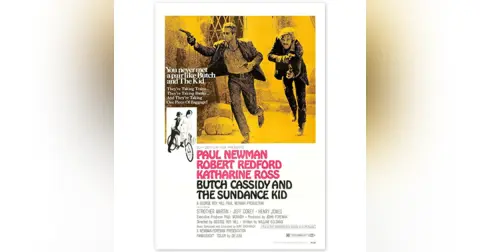
Picture two of the biggest movie stars on the planet, a script that sat on a shelf for years because no studio could figure out what to do with it, and a director who fought tooth and nail for the right to cast his own leads — against the explicit wishes of the studio executives who were funding the whole thing.
The film we’re exploring today went on to become the highest-grossing movie of 1969, winning four Academy Awards, and launching one of the most beloved screen partnerships in Hollywood history.
That film is Butch Cassidy and the Sundance Kid — a western that isn't really a western, a comedy that breaks your heart, and a buddy movie that set the template for every mismatched-duo film that came after it. Today we're riding into the mythology of this glorious, sun-drenched, ultimately tragic film — a movie that makes you laugh until you realize, almost too late, that you've been falling in love with two men who were never going to make it out alive.
Ready to begin? Get your popcorn 🍿
Welcome to That's Life, I Swear. This podcast is about life's happenings in this world that conjure up such words as intriguing, frightening, life-changing, inspiring, and more. I'm Rick Barron, your host.
That said, here's the rest of this story
1. Plot of the Movie
The American West is dying, and nobody seems to have told Butch Cassidy. It's the turn of the 20th century, and Butch (played by Paul Newman) — charming, irrepressible, inherently allergic to actual violence — is still running the Hole-in-the-Wall Gang, a loose confederation of outlaws that robs trains with the cheerful regularity of a small business. His partner is the Sundance Kid (played by Robert Redford), a concise, deadly-accurate gunfighter who communicates largely in raised eyebrows and lethal glances. Together, they are impressive, gloriously obsolete cowboys in a world that has already moved on without them.
The film opens with a train robbery that goes smoothly enough, but their second attempt on the same railroad triggers a catastrophic miscalculation. The railroad's furious owner dispatches a relentless, near-mythic group of trackers and lawmen who pursue Butch and Sundance across the scorched Utah landscape with mechanical, unstoppable efficiency.
In one of cinema's great sustained sequences, the two men are hunted for what feels like forever, unable to shake the posse no matter what tricks they deploy. "Who are those guys?" Butch keeps asking, with mounting desperation, and the question becomes the film's haunting refrain.
Facing the impossible, they flee to Bolivia with Butch's schoolteacher girlfriend Etta Place (played by Katharine Ross), convinced that South America represents a fresh start, a new frontier where their old skills might still have currency. Bolivia, however, turns out to be dusty, impoverished, and nothing like the paradise Butch had imagined from a travel brochure. Their attempt to go straight — briefly working as payroll guards — collapses almost immediately, and they slide back into robbery with a kind of helpless inevitability, now pursued by the Bolivian army with the same relentless efficiency as that original group of trackers and lawmen that started the chase.
The ending is one of cinema's most perfectly judged conclusions — a freeze-frame that captures Butch and Sundance in a last, defiant charge that we know, even as the image crystallizes, cannot possibly end well. The film earns that ending by spending two hours making us love these men without question.
Trivia worth knowing: Steve McQueen was the original choice for Sundance, and the film was almost made as a McQueen-Newman vehicle with Newman playing Butch and McQueen as Sundance. McQueen passed because he didn't want second billing. Marlon Brando, Warren Beatty, and Jack Nicholson were also considered. It is staggering to imagine the film with anyone other than Redford, who was then a relative unknown and was cast largely on Newman's personal insistence.
Goof alert: During the famous bicycle scene — set to Burt Bacharach's "Raindrops Keep Fallin' on My Head" — eagle-eyed viewers will notice that Etta's hair changes length between shots, a continuity slip that somehow no one caught in editing.
Also, the Bolivian banditos who ambush Butch and Sundance near the film's end carry Mauser rifles that weren't actually manufactured until several years after the scene is set.
2. About the Director
George Roy Hill is one of those directors who gets chronically underrated in serious film conversation, perhaps because he was so good at making difficult things look effortless. Born in Minneapolis in 1921, Hill was a man of unusual breadth:
1. He flew transport planes in both World War II and the Korean War,
2. Studied music at Yale,
3. Trained as an actor under Stanislavski in Dublin,
4. Worked extensively in live television drama before arriving in Hollywood.
That range shows in his work, which is characterized by strong confidence — an ability to hold humor and heartbreak in the same frame without either quality undermining the other.
Hill was not a self-promoter. He didn't give lengthy interviews about his artistic process or position himself as a writer in the European mold. He showed up, prepared thoroughly, listened to his actors, and made films that audiences adored. His résumé is remarkable for its consistency: Thoroughly Modern Millie (1967), Butch Cassidy & The Sundance Kid (1969), The Sting (1973) — which reteamed Newman and Redford and won him the Academy Award for Best Director — and Slaughterhouse-Five (1972), an adaptation of Kurt Vonnegut's supposedly unfilmable novel that remains criminally underseen.
On Butch Cassidy, Hill fought the studio on almost every significant creative decision and won most of them. Fox executives wanted the film shot in color but with sequences in sepia-toned black and white — Hill agreed to the sepia opening but refused to compromise the film's visual grammar beyond that. They were deeply uncertain about the choice of Redford, then untested as a leading man; Hill backed his instinct and proved right in the most decisive way possible. He also championed William Goldman's original screenplay at a time when the studio's development notes were threatening to sand away everything that made it distinctive.
What Hill understood about this material — intuitively, completely — was that its real subject was not outlaws or the West, but friendship. The film is fundamentally a love story between two men, and Hill directed it with the same delicacy and emotional intelligence he might have brought to a romance. He trusted the chemistry between Newman and Redford to carry enormous weight, and that trust was entirely vindicated. The result is one of the warmest films ever made about people who are, actually, criminals.
3. What Drew My Interest in Wanting to See This Movie?
There is a particular kind of film that announces itself as something different within its first five minutes — not through spectacle or shock, but through sheer confidence of tone. Butch Cassidy and the Sundance Kid is that kind of film. From the moment the sepia-toned silent movie begins, it gives way to Paul Newman's grin, and something clicks into place. You know, on some level you can't entirely articulate that you are in the hands of people who know exactly what they're doing.
What first drew me to this film was Newman. Paul Newman in his prime was arguably the most effortlessly charismatic screen presence American cinema ever produced — and Butch Cassidy is perhaps his greatest role precisely because it gives him room to be funny. Hollywood in the 1960s was often suspicious of leading men who were too willing to be ridiculous, but Newman leaned into Butch's absurdity with obvious relish. The man talks his way out of a knife fight with a logical objection about the rules. He is perpetually, infectiously optimistic in the face of evidence that should have broken any reasonable person. He is, in short, irresistible.
Then there was the question of what kind of film this was going to be. The western was, by 1969, a genre in the middle of a dramatic reinvention — The Wild Bunch came out the same year and deconstructed the myth of the frontier with operatic, blood-soaked fury. Butch Cassidy went in the opposite direction: not darker and more violent, but warmer and more somber. Where The Wild Bunch gave us the West's brutality, Hill gave us its charm — and then quietly, heartbreakingly, showed us why that charm was no match for the modern world closing in from all sides.
The film also drew me in through its soundtrack — Burt Bacharach's score is one of the great left-field choices in film history, a selection so apparently wrong that it becomes completely right. Pop music over a western should feel jarring. Instead, "Raindrops Keep Fallin' on My Head" over that bicycle scene feels like pure, irreplaceable joy. It's the kind of creative decision that only works because everyone committed to it completely, and it remains one of cinema's most surprising pleasures.
4. What Can We Learn from This Movie? The Takeaway
At first glance, Butch Cassidy and the Sundance Kid looks like a celebration of friendship, of freedom, of two men who lived gloriously on their own terms and went out the same way. And it is that. But the deeper you look, the more clearly the film reveals itself as a meditation on obsolescence, on the particular sadness of people who are perfectly adapted to a world that no longer exists.
Butch and Sundance are not failures. They are, in their own context, genuinely excellent — resourceful, brave, funny, loyal, and skilled. The tragedy is not that they are inadequate; it is that the world has changed around them while they were busy being exactly who they are.
That is not just a plot device. It represents freshness itself: organized, relentless, and utterly indifferent to charm. You cannot talk your way out of progress. You cannot shoot it, outrun it, or escape to Bolivia to avoid it.
There is something in this that feels unexpectedly resonant across generations. We all know what it is to feel slightly out of step with a world that seems to be accelerating away from us — to be good at something that the world has decided it no longer needs, or to value something that the culture has quietly stopped valuing.
Butch and Sundance are an extreme case, but they speak to something universal in that experience. Their response — keep moving, keep laughing, keep riding together — is not practical advice, but it is deeply human.
The other great lesson of the film is simpler and perhaps more important: the quality of your companions matters more than the quality of your circumstances. Butch and Sundance end up broke, hunted, and cornered in a foreign country — and they are, somehow, having the time of their lives.
The friendship between them — easy, unspoken, rooted in genuine mutual respect and affection — is the real treasure the film is protecting. Everything else is negotiable. That is not a bad thing to carry out of the cinema with you.
Final verdict: A masterpiece of tone, chemistry, and heartbreak dressed up as a good time. ★★★★★
Well, there you go my friends, That's life, I swear.
For further information regarding the material covered in this episode, I invite you to visit my website, which can be found on Apple Podcasts, for show notes and the episode transcript.
As always, I thank you for the privilege of you listening and your interest.
Be sure to subscribe here or wherever you listen to podcasts so you don't miss an episode.
See you soon.


