
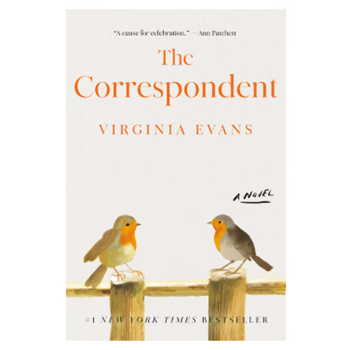
Book Review from Rick’s Library: The Correspondent by Virginia Evans


 Amazon Music
 Apple Podcasts
 Spotify
 iHeartRadio
 Youtube Music
 TuneIn
 Castro
 Audible
 RSS Feed
 Learn how life is cumulative, and correspondence—whether via letter or through care, presence, and reflection—helps us make sense of it.
supporting links
1. Virginia Evans [Website]
2. Virginia Evans [Instagram]
3. Bookreporter Talks To... Virginia Evans [YouTube]
Contact That's Life, I Swear
- Visit my website: https://www.thatslifeiswear.com
- Twitter at @RedPhantom
- Bluesky at @rickbarron.bsky.social
- Email us at https://www.thatslifeiswear.com/contact/
Episode Review
- Submit on Apple Podcast
- Submit on That's Life, I Swear website
Other topics?
- Do you have topics of interest you'd like to hear for future podcasts? Please email us
Interviews
- Contact me here https://www.thatslifeiswear.com/contact/, if you wish to be a guest for a interview on a topic of interest
Listen to podcast audios
- Apple https://apple.co/3MAFxhb
- Spotify https://spoti.fi/3xCzww4
- My Website: https://bit.ly/39CE9MB
Other
- Music and/or Sound Effects are cour...
⏱️ 11min read
Have you ever read a book that lingered. Today’s book review is one such story. In The Correspondent by Virginia Evans, we meet Sybil Van Antwerp—a retired lawyer, mother and grandmother, a woman who each morning sits down and writes letters. Many are sent, some are not. What emerges in these pages is not just the story of one life, but a reflection on aging, regret, the written word, and transformation.
I’ll share with you why this story resonated with me, what the epistolary format reveals, and how a life viewed through correspondence can teach us about connection, loss, and renewal. I’ll also share how this book unexpectedly drew me in, and what I believe we can all take away. Ready to begin? Let’s turn the page.
Welcome to That's Life, I Swear. This podcast is about life's happenings in this world that conjure up such words as intriguing, frightening, life-changing, inspiring, and more. I'm Rick Barron, your host.
That said, here's the rest of this story
1-Abstract of the book
The Correspondent is an epistolary novel that follows the life of Sybil Van Antwerp, a woman in her seventies, a retired lawyer whose daily ritual is writing letters. Most mornings around 10:30 a.m., she settles at her desk and writes letters—to her brother, her best friend, the university president who once denied her auditing a class, and to one person she writes often yet never sends.
As Sybil’s eyesight begins to fail, and as letters from someone in her past force her into painful revisitation of the decisions she made—and the person she became—the narrative shows how a life lived in the quiet margins of correspondence begins to shift. Through the letters she writes and receives, we learn of her early ambitions, the marriage and divorce, motherhood, the death of a child, the estrangement of a daughter, and her stubborn independence.
What begins as a steady rhythm of letter-writing evolves into a reckoning: Sybil must confront the fact that the letters she sends (and those she withholds) are not just habits, but the building blocks of her identity. When change seems impossible, the novel shows that transformation can begin at any age.
The Correspondent is really a novel about life, about aging, illness, and how we end up where we do.
In summary, the book is both meditative and revealing—a portrait of one woman’s life through the written word, where the act of correspondence becomes a metaphor for connection, regret, forgiveness, and, finally, renewal.
2-About the author
Virginia Evans is an American novelist from the East Coast. She earned her Bachelor’s degree in English Literature at James Madison University and then completed a Master of Philosophy in creative writing at Trinity College Dublin in Ireland.
She lives in Winston-Salem, North Carolina, with her husband, two children, and a Red Labrador named Brigid.
Although The Correspondent is often introduced as her debut novel, it comes after many years of writing, questioning, and refining work. In a Q&A, she revealed that she had written eight previous novels that didn’t find their home; The Correspondent represents nearly twenty years of persistence. Now there's a person who doesn’t quit!
What seems especially characteristic of Evans is her affinity for the epistolary form (inspired by reading the book, 84 Charing Cross Road by Helene Hanff and her interest in exploring a life lived thoughtfully, with attention to literature, memory, and the small details.
Given all this, Evans emerges as a writer who has both matured her craft and chosen to tell a story that invites slowing down—inviting the reader to inhabit a quieter, interior world where letters, regret, and late-life shifts matter.
3-What drew my interest in reading this book?
There were several reasons I was drawn to The Correspondent.
First, the epistolary format appealed to me. I liked the idea of an entire novel composed of letters and emails, which feels both intimate and unusual in contemporary literary fiction, and I was curious to see how that would be handled. Reviews indicate that Evans uses this format skillfully to reveal character and history.
Second, the protagonist, Sybil Van Antwerp, intrigued me. A retired lawyer in her seventies, living alone, writing letters, her voice promised to be unconventional, mature, and reflective. Many novels focus on younger protagonists; I appreciated the chance to follow someone later in life as they grapple with loss, change, and identity. Sybil comes off as “fiercely intelligent… riddled with guilt and self-recrimination,” yet also witty and stubborn.
Third, I was drawn by the themes hinted at in the descriptions: aging, friendship, regret, and forgiveness. The idea of someone having spent a lifetime writing letters and then confronting who they have become felt rich for reflection, especially for a podcast audience that might themselves be looking back or thinking about how our lives build up.
Finally, the critical praise helped set expectations. The book has been described as a portrait of a small life expanding, as well as humorous, moving, and quietly powerful.
4-What can we learn from this book? What's the take away?
The Correspondent offers several lessons and points of reflection—some subtle, some deeply resonant.
The value of small gestures and ordinary rituals. Sybil’s daily letter-writing may at first appear quaint, even traditional, but the novel shows how such a ritual can hold meaning: how writing connects us to the world, to people we might otherwise ignore, how it becomes a way to track our inner lives. The takeaway: small acts matter; the letters we write (or don’t write) are testimonies to who we are.
It’s never too late to reflect and change. Although Sybil is in her seventies, the story emphasizes that transformation — emotional, relational, internal — remains possible even late in life. The novel challenges the idea that change must happen early or quickly. Instead, it suggests a kind of slow unfolding: mistakes, regrets, and all, can be revisited, forgiven, or at least understood. The lesson: Life is long, and chapters we think are final can still open into something new.
The power and limitations of the written word. Because of the epistolary form, the novel invites readers to think about writing as connection—and also its limits. Some letters are never sent, some responses are unexpected, and correspondence becomes both a refuge and a mirror. Sybil’s story raises the question: what do our letters do? Do they bridge distance, do they reveal truth, or sometimes do they keep things locked away? The takeaway: Words—written words—are powerful tools of self-examination and relationship, but they don’t replace lived connection.
Aging, regret, and reconciliation. Sybil’s back story includes loss (the death of a child), divorce, estrangement, a career in a male-dominated profession. The novel doesn’t shy away from how past decisions and societal structures (sexism in academia and the law) shape a life.
But the emphasis is less on blame and more on what can be done now: self-forgiveness, reconsideration, reaching out. This novel is really a novel about life, about aging, illness, and how we end up where we do.” The takeaway: We might not be able to rewrite our past, but we can understand, repair, and live differently from this point onward.
Connection across generations and lives. Through the letters, Sybil writes to family members, authors, colleagues, people she knows and those she doesn’t. In doing so, the novel suggests that every person’s life is interconnected, sometimes in unexpected ways. It also proposes that listening (and writing) matter: hearing other lives, acknowledging our own place in a web of relationships, is meaningful. The takeaway: Our lives ripple outward, and correspondence—literal or metaphorical—keeps us linked.
In closing, if there is one overarching takeaway: life is cumulative, and correspondence—whether via letter or through care, presence, and reflection—helps us make sense of it. The novel invites us to pause, to listen to the voices we’ve ignored (including our own), to pick up a pen or open a page and say something, even if it’s late. It reminds us that even small words, sent or unsent, can matter deeply.
Well, there you go my friends. That's life, I swear.
For further information regarding the material covered in this episode, I invite you to visit my website, which can be found on Apple Podcasts, for show notes and the episode transcript.
As always, I thank you for the privilege of you listening and your interest.
Be sure to subscribe here or wherever you listen to podcasts so you don't miss an episode.
See you soon.


