
Margaret Gipsy Moth: A Fearless CNN Camera Operator who Covered Conflicts Across the Globe

 Amazon Music
 Apple Podcasts
 Spotify
 iHeartRadio
 Youtube Music
 TuneIn
 Castro
 Audible
 RSS Feed
 Margaret “Gipsy” Moth’s story resists any simple moral—but that’s exactly where its power lies. It forces us to sit with uncomfortable truths about courage, purpose, and the cost of bearing witness.
Supporting links
1. Bosnia War [Wikipedia]
2. Margaret Moth [Wikipedia]
3. Margaret Moth [Biography Central]
4. War Videographer Margaret Moth Gets the Shot in ‘Never Look Away’ [KQED]
Never Look Away | Directed by Lucy Lawless | Official Trailer [YouTube]
Contact That's Life, I Swear
- Visit my website: https://www.thatslifeiswear.com
- Twitter at @RedPhantom
- Bluesky at @rickbarron.bsky.social
- Email us at https://www.thatslifeiswear.com/contact/
Episode Review
- Submit on Apple Podcast
- Submit on That's Life, I Swear website
Other topics?
- Do you have topics of interest you'd like to hear for future podcasts? Please email us
Interviews
- Contact me here https://www.thatslifeiswear.com/contact/, if you wish to be a guest for a interview on a topic of interest
Listen to podcast audios
- Apple https://apple.co/3MAFxhb
- Spotify https://spoti.fi/3xCzww4
- My Website: https://bit.ly/39CE9MB
Other
- Music and/or Sound Effects are cour...
⏱️ 11 min read
Hi everyone, and welcome to my podcast, That’s Life, I Swear. I’m your host, Rick Barron
Margaret Moth slept in combat boots. Not as a quirk — as a philosophy. She wanted to be ready, always, for whatever the world threw at her next. And the world threw plenty.
She covered wars on five continents, survived a sniper's bullet that permanently changed the way she spoke, and laughed off anyone who called it a death wish. Margaret Moth didn't chase danger because she didn't care about living — she chased it because she loved life more than almost anyone around her.
This is the story of Margaret Gipsy Moth, a fearless CNN Camera Operator.
Welcome to That's Life, I Swear. This podcast is about life's happenings in this world that conjure up such words as intriguing, frightening, life-changing, inspiring, and more. I'm Rick Barron your host.
That said, here's the rest of this story
The Woman Who Looked War in the Eye
Margaret Gipsy Moth: camera operator, war correspondent, force of nature
Welcome to Sniper Alley
The van was white, the road was dangerous, and Margaret Moth was exactly where she wanted to be. It was July 1992, and Sarajevo — the capital of Bosnia and Herzegovina — was in the grip of the longest siege of a capital city in the history of modern warfare. As the former Yugoslavia fractured along ethnic and political fault lines, Bosnian Serb troops had encircled the city, strangling it from the hills above. Journalists from around the world had descended on the blockaded capital to document the horror. Moth, a camera operator for CNN, was among them.
She was riding in the network's white van along a stretch of road soldiers who had already christened Sniper Alley when the bullet found her. It shattered her jaw. It tore through the base of her tongue. The injuries left her speech permanently slurred, and she would endure 25 surgeries in the years that followed. By almost any measure, she was lucky to be alive.
However, gutsy as she was, she went back anyway for more. Joking that she needed to return to Sarajevo to find her missing teeth, Moth resumed covering the conflict as soon as she had recovered. It was, she would later say, simply what she did. For another 15 years at CNN, she continued to point her camera at the cruelty humans inflicted on one another — the Chechen war, the U.S. invasion of Afghanistan, the second Palestinian intifada, the civil war in Sierra Leone. The shooting had not broken her. If anything, it had confirmed her sense of purpose.
Born to Reinvent Herself
She was born Margaret Annette Wilson on January 30, 1951, in Gisborne, New Zealand — a small coastal city on the country's North Island. Her mother, Nona, worked in a factory and raised her largely alone; her father, Raymond, was a bricklayer and plasterer. Little is known of her childhood, and that obscurity was partly deliberate. The actress Lucy Lawless, who directed the 2024 documentary Never Look Away about Margaret's life, observed that she had "compartmentalized her life so thoroughly that very few people knew all the pieces."
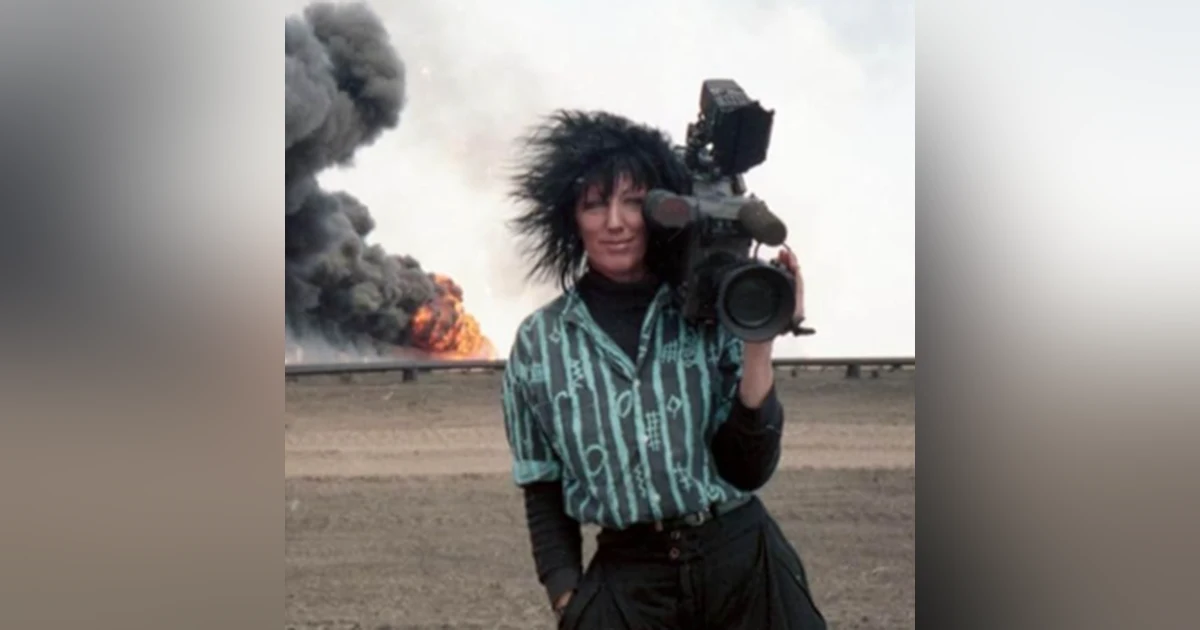
What is clear is that she set about constructing herself from scratch. She renamed herself after the de Havilland Moth series of light aircraft — specifically those powered by Gipsy engines. She became an avid skydiver, logging more than 800 jumps on a customized square black parachute. She dyed her naturally blond hair jet-black, wore it spiky or heavily teased, and dressed head-to-toe in black every single day. She was almost never seen without her signature thick black eyeliner. She slept in a pair of black combat boots, she once explained, so she was always ready to move at a moment's notice. She smoked Cuban Montecristo No. 5 cigars. She treasured Penguin Classics editions of Dostoyevsky.
The look was not arrogance — it was armor, identity, and declaration all at once. She was constructing the person she intended to be, and she was doing it deliberately and completely.
Finding the Frame
Margaret’s path to journalism was indirect. She studied photography at the University of Canterbury's fine arts school in Christchurch, where a course on moving images sparked a new obsession. She fell in love with cinema — Federico Fellini's Satyricon and Wim Wenders's Wings of Desire became particular touchstones — and began to see the camera not merely as a recording device but as a way of perceiving and interpreting the world.
She moved to the United States around 1980, settling in Houston, where she worked in the media department of the University of Texas MD Anderson Cancer Center, painted houses on the side, and interned at local television station KPRC-TV before joining KHOU, a CBS affiliate, in 1984. She was hired by CNN's Dallas bureau in 1990. The timing was lucky. Within months, dozens of CNN staffers were being deployed to cover the Gulf War, and Margaret volunteered without hesitation to go and capture the Allied drive to push Saddam Hussein's army from Kuwait.
She had been considered one of the first female television camera operators in all of Australasia a distinction she'd earned by pushing through an industry that openly doubted women could do the work. She had no patience for that kind of thinking, and even less for machismo of any variety. In a marketplace in Iraq after the Gulf War ended, a man shoved her camera into her nose. She smacked the cigarette from his mouth and walked on.
Calmest in the Chaos
War, Lucy Lawless said simply, was "sort of Margaret’s vibration." She was calmest in the chaos, most fully herself when the situation was most dangerous. In 1991, as militiamen opened fire on protesters in Tbilisi, Georgia, most photojournalists scrambled for cover behind vehicles. In true form, Margaret stood up and filmed the gunmen. In 2002, as Israeli troops encircled Palestinian leader Yasir Arafat's headquarters following a suicide bombing, she walked into the compound with a group of medical professionals and came out with an exclusive interview.
CNN senior executive Eason Jordan described her as "the best-qualified and most impressive prospect" the network had for covering Sarajevo. Her assignment there began in the spring of 1992, and the attack that nearly killed her that July became a turning point not just for her but for the entire news organization. Within hours of the shooting, CNN began overhauling its approach to journalist safety:
· armored vehicles were procured,
· bulletproof vests and helmets became standard equipment,
· pre-deployment risk training was established,
· and security advisers began accompanying news teams into conflict zones.
"Everybody was a little more careless in the beginning," said Stefano Kotsonis, a CNN correspondent who was in the van with Margaret when she was shot. "Everything changed" after the attack.
No Death Wish — Only Life
Margaret was asked many times over the years whether she had a death wish. The question infuriated her. "I don't know anyone who's enjoyed life more or values my life more," she said in Fearless: The Margaret Moth Story, a 2009 CNN documentary. She was a great storyteller, a party anchor, someone who held court with stories and sharp opinions and genuine warmth.
She took younger journalists under her wing, mentored them through their fear, and showed them by example that courage was not the absence of danger but the choice to remain present inside it.
Jeff Russi, her companion in the 1980s, put it plainly: "As dark and real as she would get, she didn't indulge in the dark side of human behavior. That's what gave her the strength to witness the atrocities she had to witness."
When asked what she would do if she ever came face to face with the sniper who shot her in Sarajevo, she said she would simply want to understand his intentions. She felt no anger. "When you are in a war zone, both sides are fighting each other," she said.
"If you're on one side, you're sort of 'with' that side, and you have to take what comes with it." It was a characteristically pragmatic answer from a woman who had built her life around clear-eyed observation rather than the comfort of easy emotion. In 1992, she received the International Women's Media Foundation's Courage in Journalism Award.
The Final Frame
Around 2006, Margaret learned she had colon cancer. She moved back to the United States, and the disease that had no geography — no front line she could film, no enemy she could outsmart with courage and instinct — ultimately claimed her. She died on March 21, 2010, in Rochester, Minnesota. She was 59.
Margaret said "I would have liked to have gone out with a bit more flair, but I feel like if I can die with dignity, then that's the main thing. I don't think it matters how long you live, as long as you can say that 'I've gotten everything out of life.'" By any accounting, she had.
In 2024, Lucy Lawless released Never Look Away, a new documentary examining Margaret's extraordinary life. Her former CNN colleague Joe Duran, who knew her for years, expressed no surprise at the continued interest. "I think her story will only grow," he said.
Margaret herself had perhaps the most fitting summary of her own philosophy. Life, she said, was like a game of tennis. "You have no choice over how that ball comes to you. But it's how you hit it back that counts."
She always hit it back.
What can we learn from this story? What’s the takeaway
Margaret “Gipsy” Moth’s story resists any simple moral—but that’s exactly where its power lies. It forces us to sit with uncomfortable truths about courage, purpose, and the cost of bearing witness.
A meaningful life often requires stepping into discomfort, standing close to truth, and committing to something larger than yourself. You may not control the forces around you—but you can decide how fully, and how bravely, you engage with them.
Margaret did all this and more.
Well, there you go, my friends; that's life, I swear
For further information regarding the material covered in this episode, I invite you to visit my website, which can be found on Apple Podcasts, for show notes and the episode transcript.
As always, I thank you for the privilege of you listening and your interest.
Be sure to subscribe here or wherever you listen to podcasts so you don't miss an episode.
See you soon.


