
Betty Reid Soskin: The Ranger Who Rewrote American Memory

 Amazon Music
 Apple Podcasts
 Spotify
 iHeartRadio
 Youtube Music
 TuneIn
 Castro
 Audible
 RSS Feed
 Learn how Betty Reid Soskin understood that simply being seen—as an elderly Black woman in a ranger’s uniform—challenged assumptions about who belongs in American institutions. Representation isn’t symbolic; it’s transformative.
Supporting links
1. Betty Reid Soskin [Wikipedia]
2. National Park Service [Wikipedia]
3. What life feels like at 101 [YouTube]
4. Sign My Name to Freedom: A Memoir of a Pioneering Life [Amazon]
Contact That's Life, I Swear
- Visit my website: https://www.thatslifeiswear.com
- Twitter at @RedPhantom
- Bluesky at @rickbarron.bsky.social
- Email us at https://www.thatslifeiswear.com/contact/
Episode Review
- Submit on Apple Podcast
- Submit on That's Life, I Swear website
Other topics?
- Do you have topics of interest you'd like to hear for future podcasts? Please email us
Interviews
- Contact me here https://www.thatslifeiswear.com/contact/, if you wish to be a guest for a interview on a topic of interest
Listen to podcast audios
- Apple https://apple.co/3MAFxhb
- Spotify https://spoti.fi/3xCzww4
- My Website: https://bit.ly/39CE9MB
Other
- Music and/or Sound Effects are cour...
⏱️ 14 min read
She was born just a generation removed from slavery—and lived long enough to wear the uniform of the National Park Service.
Today’s profile is about Betty Reid Soskin, a woman whose life quietly spanned the most turbulent chapters of American history—and who refused to let those chapters be written without her voice.
As a young Black woman during World War II, she answered her country’s call to serve, only to be sidelined by segregation and told—without explanation—that her contribution mattered less. Decades later, she would help shape a national park dedicated to that very war effort, insisting that the stories of people like her be told honestly, not conveniently.
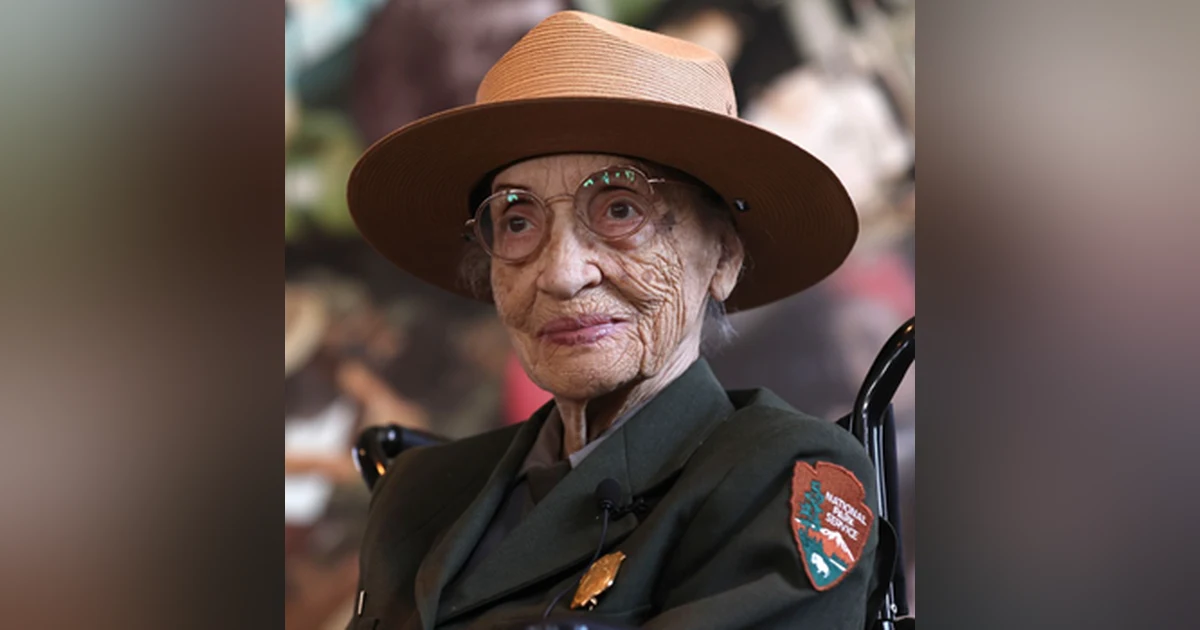
At 85, she became a National Park ranger. At 100, she was still working. And everywhere she went—on buses, in theaters, even on escalators—she understood that her presence alone was a kind of protest, a kind of promise.
She once carried a photograph of her great-grandmother, who had been born into slavery, in her pocket while standing beside President Barack Obama at the White House.
She called that moment poetry.
This is the story of a woman who didn’t just witness history—she corrected it. And in doing so, she showed us what it really means to belong.
Welcome to That's Life, I Swear. This podcast is about life's happenings in this world that conjure up such words as intriguing, frightening, life-changing, inspiring, and more. I'm Rick Barron your host.
That said, here's the rest of this story
She was born into a nation that had not yet decided who counted as fully American, and she lived long enough to help rewrite that answer—one story, one memory, one uniform at a time.
Betty Reid Soskin’s life stretched across more than a century, but it also stretched across eras that are often taught as separate chapters: slavery’s afterlife, the Great Migration, wartime mobilization, civil rights, political awakening, and the slow, unfinished work of national reckoning.
Betty passed away on December 21, 2025. When she died at the age of 104 in her home in Richmond, California, she left behind far more than a résumé of achievements. She left a living bridge between what the country had been and what it still aspired to become.
To many Americans, she was best known as the oldest active ranger in the National Park Service—a woman who wore the green-and-gray uniform not as a costume of nostalgia but as a declaration of belonging. To others, she was a historian, a songwriter, an activist, a mother, a businesswoman, and a witness. But to understand the symbolism of her life is to understand how presence itself can become a form of resistance, and how memory, when spoken aloud, can change the shape of public truth.
A Childhood Framed by Displacement
Betty Charbonnet entered the world on September 22, 1921, in Detroit, Michigan. Her parents soon returned the family to New Orleans, where generations before her had lived under systems designed to limit Black possibility. Her lineage carried contradictions: African, French, and Spanish ancestry braided together, alongside the unbroken trauma of enslavement. Her great-grandmother, Leontine Breaux Allen, had been born into slavery—an ancestral fact that would later travel with Betty through history in the form of a small photograph kept close to her heart.
When a devastating flood forced the family to leave New Orleans, they joined a tide of Black families moving west in search of safety and opportunity. By the time Betty was six, she was growing up in the San Francisco Bay Area, a place often glorified as progressive, but one that would soon reveal its own racial fault lines.
From an early age, she learned what it meant to navigate spaces that were technically open, yet spiritually hostile. California, she would later discover, practiced a quieter kind of exclusion—less codified, no less corrosive.
After high school, Betty married Mel Reid, and together they founded Reid's Records in Berkeley in 1945, one of California's first Black-owned record shops specializing in jazz, gospel, and rhythm and blues. Mel and his uncle Paul Reid became successful music promoters.
She loved writing songs and would perform them across the San Francisco Bay Area.
While raising four children in the predominantly white Berkeley suburb of Walnut Creek, the Soskins faced racial hostility and death threats.
In the late 1960s, Soskin organized fundraisers through her church for the Black Panthers, delivering proceeds to Kathleen and Eldridge Cleaver. She served as a delegate to the 1972 Democratic National Convention that nominated Senator George McGovern against President Nixon.
Soskin and Reid divorced in 1972. She subsequently married William Soskin, a psychology professor at UC Berkeley, though that marriage also ended in divorce. She assumed management of Reid's Records in 1978 when her first husband's health declined, working to revitalize the business by pressing Berkeley officials to address drug problems on Sacramento Street where the store was located.
The War That Promised Unity—and Delivered Contradiction
When World War II reshaped the American economy, it also reshaped women’s roles in public life. Across the country, images of “Rosie the Riveter” appeared on posters and factory walls, urging women to step into defense jobs left vacant by men sent overseas. The message was clear: the nation needed everyone.
Betty believed that message. In Richmond, a city transformed almost overnight by wartime shipbuilding, she sought work through the boilermakers’ union that supplied labor to the massive shipyards across the bay from San Francisco. What she encountered instead was segregation repackaged as bureaucracy. The union’s Black members—women in particular—were shunted into an auxiliary wing, far from the machinery, noise, and prestige of the yards themselves.
For the duration of the war, Betty sorted index cards in a union hall miles from the ships she had hoped to help build. While others welded steel and launched vessels bound for the Pacific, she filed paperwork. The task was quiet, invisible, and deeply humiliating.
Years later, she would describe the experience not simply as exclusion, but as invisible. She had answered the call to serve, only to be told—without words—that her labor, like her citizenship, came with limits.
From Margins to Memory
What history denied her in real time, she reclaimed decades later through remembrance.
By the turn of the millennium, Betty Reid Soskin—now seasoned by activism, motherhood, loss, and reinvention—found herself seated at a table where history itself was being shaped. Working as an aide to California Assembly woman, Dion Aroner, she became involved in planning what would become the Rosie the Riveter/World War II Home Front National Historical Park in Richmond.
Once again, she noticed who was missing.
As plans were drawn and narratives drafted, the official story of the home front threatened to replicate the exclusions of the past. The heroism of industrial labor was being celebrated, but the racial hierarchies that governed that labor were largely absent from the conversation.
She spoke up.
In rooms where she was often the only person of color, Betty insisted that the park tell the whole story—not just the triumphant mobilization, but the contradictions that defined it. Not just unity, but segregation. Not just opportunity, but who was denied it, and why.
Her insistence changed the park.
By the time the site opened, it reflected a broader, more honest vision of the American wartime experience—one that included African American workers, Japanese Americans forcibly removed from the West Coast and sent to internment camps, Latino laborers, Native Americans, and LGBTQ people whose contributions had long gone unrecorded.
When Betty officially became a ranger in 2007, at the age of 85, she was not stepping into retirement-pageantry. She was stepping into authorship.
The Power of Standing There
As a ranger, Betty Reid Soskin did not merely recite facts. She embodied them.
She led narrated bus tours through Richmond, her voice weaving personal memory with collective history. In the park’s theater, she spoke plainly and powerfully about what it meant to fight fascism abroad while living under discrimination at home. Visitors did not just learn; they recalibrated.
Her presence—an elderly Black woman in uniform, speaking with authority—rearranged expectations. She was living proof that history was not an abstraction. It walked, spoke, and remembered.
Park officials later acknowledged that her influence reshaped their entire approach. Scholars of African American history were brought in. Films and exhibits were reviewed and revised. Forgotten narratives were elevated—not as footnotes, but as foundational elements of the American story.
In this way, Betty became something rare: a public servant who did not merely preserve history, but corrected it.
A Pocketful of Poetry
In 2009, she stood on the National Mall as a guest of her congressman, George Miller, witnessing the inauguration of President Barack Obama. Six years later, she introduced him during the nationally televised Christmas tree lighting ceremony in Washington.
That night, as she often did, she carried with her the photograph of her great-grandmother—the woman born into bondage, whose life had unfolded without legal freedom.
In one pocket, an ancestor who had been counted as property. Before her, the first African American president of the United States.
She later described the moment as poetry. And it was—not because it erased history’s cruelty, but because it refused to let that cruelty be the final word.
Memory as Resistance
Even in her later years, Betty refused to retreat. She learned to use a computer in her eighties and began a blog that eventually became the foundation for her book, Sign My Name to Freedom. In its pages, she recounted moments of casual cruelty—like the evening she and her children were turned away from a suburban diner under the pretense of closing time.
The wound lingered not because it was unique, but because it was ordinary, and for Betty, that was the danger.
After a stroke in 2019, she returned to work on a reduced schedule, often appearing via video conference. Even off duty, she wore her ranger uniform in public.
When little girls of color saw her—on an escalator, in an elevator, on the street—they saw a possibility they may never have imagined. Not just a job, but a place within the nation’s story.
What She Stood For
Betty Reid Soskin’s life was symbolic not because it was flawless or triumphant, but because it was persistent. She lived long enough to see institutions change, and she lived actively enough to help change them.
She did not ask to be remembered. She insisted on remembering—and invited the country to do the same.
In a nation that often rushes past its contradictions, she slowed time down and said: look again.
And in doing so, she made history not only something that happened—but something that could still be shaped. [1579 words]
Thank you, Betty, and we thank you for your life and service in so many ways.
What can we learn from this story? What's the takeaway?
Betty’s life shows that history doesn’t just forget—it excludes. Without people willing to speak up, entire communities are erased from the national story. Telling the truth requires courage, not just archives.
Becoming a ranger at 85 and returning to work after a stroke, Betty dismantled the idea that relevance expires with age. Purpose, she showed, has no deadline.
In the end, Betty shared how, from segregated union halls to the White House lawn, her life traced America’s contradictions without pretending they were resolved. Progress happened because people like her insisted it happen.
Well, there you go, my friends; that's life, I swear
For further information regarding the material covered in this episode, I invite you to visit my website, which can be found on Apple Podcasts, for show notes and the episode transcript.
As always, I thank you for the privilege of you listening and your interest.
Be sure to subscribe here or wherever you listen to podcasts so you don't miss an episode.
See you soon.


