
Book Review from Rick’s Library: My Name is Selma by Selma van de Perre

Send us Fan Mail Learn about how Selma van de Perre joined the resistance during World War II. How she survived the unsurvivable, and what her life teaches us about courage, memory, and the fight against hatred that continues in our own time. supporting links 1. My Name Is Selma [Amazon] 2. Ravensbrücke [Holocaust Encyclopedia] 3. Nazi concentration camps [Wikipedia] 4. Dutch resistance [Wikipedia] Contact That's...

 Amazon Music
 Apple Podcasts
 Spotify
 iHeartRadio
 Youtube Music
 TuneIn
 Castro
 Audible
 RSS Feed
 Learn about how Selma van de Perre joined the resistance during World War II. How she survived the unsurvivable, and what her life teaches us about courage, memory, and the fight against hatred that continues in our own time.
supporting links
1. My Name Is Selma [Amazon]
2. Ravensbrücke [Holocaust Encyclopedia]
3. Nazi concentration camps [Wikipedia]
4. Dutch resistance [Wikipedia]
Contact That's Life, I Swear
- Visit my website: https://www.thatslifeiswear.com
- Twitter at @RedPhantom
- Bluesky at @rickbarron.bsky.social
- Email us at https://www.thatslifeiswear.com/contact/
Episode Review
- Submit on Apple Podcast
- Submit on That's Life, I Swear website
Other topics?
- Do you have topics of interest you'd like to hear for future podcasts? Please email us
Interviews
- Contact me here https://www.thatslifeiswear.com/contact/, if you wish to be a guest for a interview on a topic of interest
Listen to podcast audios
- Apple https://apple.co/3MAFxhb
- Spotify https://spoti.fi/3xCzww4
- My Website: https://bit.ly/39CE9MB
Other
- Music and/or Sound Effects are cour...
⏱️ 12 min read
Today I’ll be sharing a book I read a while back —a memoir that sat silent for 75 years before finally demanding to be heard—My Name Is Selma: The Remarkable Memoir of a Jewish Resistance Fighter and Ravensbrück Survivor.
This isn't just another Holocaust story. This is the account of a 17-year-old girl who chose to fight back, who smuggled secrets under the noses of Nazi soldiers, who hid her Jewish identity even in the death camps, and who carried these memories—these ghosts—for eight decades before finally, at 99 years old, deciding the world needed to know.
Selma's recent passing makes this conversation both heartbreaking and urgent. We're running out of time to hear these voices firsthand. But through her words, preserved on the page, Selma still speaks to us.
We’ll explore what drew this young woman into the resistance, how she survived the unsurvivable, why she waited so long to tell her story, and what her life teaches us about courage, memory, and the fight against hatred that continues in our own time.
Welcome to That's Life, I Swear. This podcast is about life's happenings in this world that conjure up such words as intriguing, frightening, life-changing, inspiring, and more. I'm Rick Barron, your host.
1. Abstract of the Book
My Name Is Selma is a powerful Holocaust memoir that chronicles the extraordinary life of Selma van de Perre during World War II. Born into a Jewish family in the Netherlands, Selma's story begins with the Nazi occupation and her courageous decision to join the Dutch resistance at just seventeen years old. Operating under the assumed identity of Margareta van der Kuit, she worked as a courier for the underground movement, smuggling illegal newspapers and forged identity papers while risking her life daily.
The memoir details her eventual capture by the Nazis in 1944, her imprisonment, and her subsequent deportation to Ravensbrück concentration camp in Germany, one of the largest women's camps established by the Nazi regime. Throughout her ordeal, Selma managed to conceal her Jewish identity, which likely saved her life. The book offers an unflinching account of the horrors she witnessed and endured—the brutality, starvation, disease, and death that surrounded her—yet it is equally a testament to human resilience, the bonds of friendship formed in the darkest circumstances, and the indomitable will to survive. Selma's narrative takes readers from the terror of Nazi-occupied Europe through liberation and into her subsequent life, offering a deeply personal perspective on one of history's darkest chapters.
2. About the Author
Selma van de Perre (1922-2025) was a Dutch-Jewish Holocaust survivor, resistance fighter, and author whose life spanned more than a century of remarkable history. Born in Amsterdam, she came of age during the Nazi occupation of the Netherlands, a period that would define her youth and forge her character in unimaginable ways.
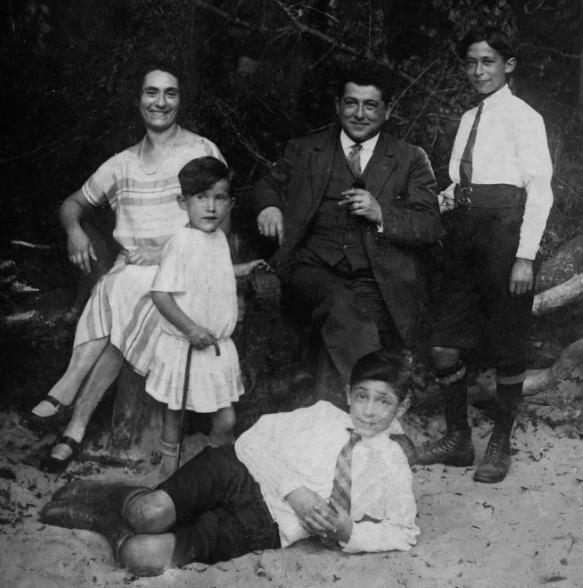
The author, second from the left. Courtesy of New York Times
After surviving Ravensbrück, Selma eventually settled in London, where she built a new life, married, and worked for many years. For decades, she remained largely silent about her wartime experiences, a common response among survivors grappling with trauma. It wasn't until her nineties that Selma decided to break her silence and share her story with the world. Published when she was 99 years old, My Name Is Selma became an international success, resonating with readers across generations who were moved by her clarity, honesty, and lack of bitterness despite all she had endured.
Selma became an important voice in Holocaust education, speaking to audiences about the importance of remembering history and standing against hatred and intolerance. To those survivors who survived the nightmare of prison camps, it marks the end of an era, as the world continues to lose the last living witnesses to the Holocaust. Selma’s memoir remains an invaluable gift to future generations—a firsthand account that ensures the voices of those who lived through this darkness will never be forgotten.
3. What Drew My Interest in Reading This Book?
In an age when Holocaust survivors are leaving us, there is an urgent quality to reading their testimonies while we still can. What drew me to My Name Is Selma was the opportunity to hear directly from someone who not only survived the Holocaust but also actively resisted it. Selma was not a passive victim of history; she was a fighter who chose danger over safety, risking everything to oppose evil when she could have hidden.
The timing of reading this book feels particularly poignant given Selma's recent passing. There's something profoundly moving about a woman who carried these memories for nearly eight decades before finding the strength—or perhaps the necessity—to speak them aloud.
I was also drawn to the perspective of a young woman in the resistance. Many Holocaust narratives focus on the camps themselves, but Selma's story illuminates the dangerous work of the underground movements, the daily acts of courage by ordinary people who became extraordinary through their choices. The fact that she maintained a false identity even in the concentration camp, living with the constant fear of discovery, adds a layer of psychological tension that makes her survival story uniquely compelling.
Furthermore, in our current times, when antisemitism and authoritarianism are resurgent in various forms around the world, reading firsthand accounts of where hatred can lead feels not just interesting but essential.
4. What Can We Learn From This Book? What's the Take Away?
My Name Is Selma offers lessons that extend far beyond historical documentation, speaking to timeless aspects of human nature, morality, and resilience. After finishing reading this book, I walked away with six lessons, Slema conveyed:
The Power of Individual Resistance: Selma's story demonstrates that even in the face of overwhelming evil, individual acts of courage matter. At seventeen, she could have chosen self-preservation, but instead, she decided to fight. Her work in the resistance—delivering newspapers, carrying documents, connecting networks—reminds us that resistance takes many forms and that ordinary people can make extraordinary differences.
The Complexity of Survival: The book reveals the impossible moral choices that extreme circumstances create. Selma's decision to hide her Jewish identity even from fellow prisoners was a survival strategy, yet it came with its own burden of guilt and isolation. Her story teaches us not to judge the choices made by those in unimaginable situations, but rather to work toward creating a world where such decisions are never necessary.
The Importance of Bearing Witness: Perhaps most significantly, Selma's decision to finally share her story in her nineties underscores the critical importance of testimony. For decades, she carried this history in silence but ultimately recognized that her memories belonged not just to her but to all of humanity. As the generation of survivors passes away, their written and recorded testimonies become our sacred responsibility to preserve and share.
Resilience and the Will to Live: Throughout the most degrading and brutal conditions, Selma found ways to maintain her humanity and her hope. The friendships she formed, the small acts of kindness she witnessed and received, the determination to see liberation—these elements of her story remind us of the remarkable resilience of the human spirit.
The Relevance of History: Finally, and urgently, this book teaches us that the Holocaust is not ancient history disconnected from our present. With survivors now passing away rapidly, we are reminded that these events occurred within living memory, that the survivors walked among us until very recently, and that the lessons of this period remain vitally relevant. The book serves as a warning about the dangers of prejudice, the ease with which ordinary people can become complicit in evil, and the necessity of standing up for justice.
The ultimate takeaway is a call to remembrance and action: we must honor survivors like Selma by ensuring their stories continue to be told, by actively opposing hatred and antisemitism wherever we encounter it, and by remembering that the choices we make in our own times matter. Selma's life—spanning from 1922 to 2025, from Nazi-occupied Amsterdam to modern London—bridges an enormous arc of history. Her memoir is not just a look backward but a torch passed forward, illuminating the path we must take to ensure such atrocities never happen again.
In reading My Name Is Selma, we don't just learn about the past; we are challenged to examine our own courage, our own willingness to stand against injustice, and our own responsibility to future generations. It is a book that stays with you long after you turn the final page, a voice that continues to speak even after its author has fallen silent.
In her memoir, she wrote that she scrawled a note on toilet paper to a girlfriend and slipped it through the slats of the cattle car in which she was crammed, hoping that someone would find it and pass it on.
In 1995, as that girlfriend was moving into a new house, she found the note. It had apparently been found near the tracks by a railroad worker and forwarded to her, but she had forgotten about it for 50 years.
“Keep your spirits up,” the note said. “I’ll do the same, although I do wish the end was in sight.”
Despite her grievous losses, Ms. van de Perre expressed awe in her memoir at how many people became heroes during the war.
“I can still hardly believe that people who should have remained unremarkable ended up memorialized on lists and monuments,” she wrote. “We were ordinary people plunged into extraordinary circumstances.”
I’ll end this story by sharing with you that Selma passed away on October 20, 2025, in London, at the age of 103.
Well, there you go my friends. That's life, I swear.
For further information regarding the material covered in this episode, I invite you to visit my website, which can be found on Apple Podcasts, for show notes and the episode transcript.
As always, I thank you for the privilege of you listening and your interest.
Be sure to subscribe here or wherever you listen to podcasts so you don't miss an episode.
See you soon.


