
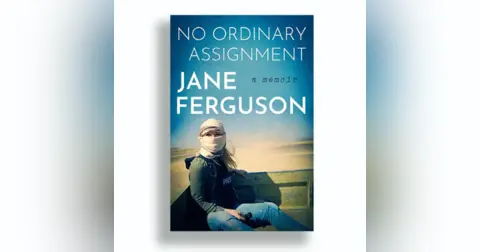
Book Review from Rick’s Library: No Ordinary Assignment by Jane Ferguson

 Amazon Music
 Apple Podcasts
 Spotify
 iHeartRadio
 Youtube Music
 TuneIn
 Castro
 Audible
 RSS Feed
 No Ordinary Assignment offers lessons that extend far beyond journalism, though it is indispensable reading for anyone who practices or admires the craft.
supporting links
1. Jane Ferguson details career reporting in war zones [YouTube]
2. Life on the Frontlines of War Reporting | Jane Ferguson [TED]
3. Jan Ferguson [Wikipedia]
4. Jane Ferguson [PBS News]
5. Jan Ferguzon [LinkedIn]
6. Jane Ferguson [Instagram]
Contact That's Life, I Swear
- Visit my website: https://www.thatslifeiswear.com
- Twitter at @RedPhantom
- Bluesky at @rickbarron.bsky.social
- Email us at https://www.thatslifeiswear.com/contact/
Episode Review
- Submit on Apple Podcast
- Submit on That's Life, I Swear website
Other topics?
- Do you have topics of interest you'd like to hear for future podcasts? Please email us
Interviews
- Contact me here https://www.thatslifeiswear.com/contact/, if you wish to be a guest for a interview on a topic of interest
Listen to podcast audios
- Apple https://apple.co/3MAFxhb
- Spotify https://spoti.fi/3xCzww4
- My Website: https://bit.ly/39CE9MB
Other
- Music and/or Sound Effects are cour...
⏱️ 12 min read
Hi everyone, and welcome to my podcast, That’s Life, I Swear. I’m your host, Rick Barron
Today, my book review will call out going somewhere most people never go — not just geographically, but emotionally and ethically. We're sitting down with a book that asks one of the most deceptively simple questions a human being can pose to themselves: Why the hell do you do this!?
The book is No Ordinary Assignment by Jane Ferguson — award-winning war correspondent, PBS NewsHour Special Correspondent, contributor to The New Yorker, and one of the most clear-eyed witnesses to the defining conflicts of our era. She grew up in Northern Ireland during what was called The Troubles, where bombs were a fact of daily life and silence was a survival strategy. And somehow, that upbringing didn't make her run from danger — it made her fluent in it.
In this episode, we're unpacking a memoir that takes us from Kabul to Mogadishu, from Sanaa to the rubble of Aleppo — and then brings us right back to the interior landscape of a woman trying to understand why she keeps going back. This is not a chest-thumping war story. It's something rarer and more honest: a journalist interrogating her own demons while the world burns around her.
So, buckle up — or maybe, more fittingly, take a deep breath and step through the checkpoint. This is Jane Ferguson's world. And by the end of this book review, you'll be very glad she chose to take you there.
Ready to begin? Let’s turn the page.
Welcome to That's Life, I Swear. This podcast is about life's happenings in this world that conjure up such words as intriguing, frightening, life-changing, inspiring, and more. I'm Rick Barron, your host.
That said, here's the rest of this story:
1. Abstract of the Book
No Ordinary Assignment is the unflinching, deeply personal story of Jane Ferguson — an award-winning war correspondent whose career has taken her into some of the most volatile and heartbreaking corners of the modern world. Published in 2023 by HarperCollins, the book charts Ferguson's remarkable journey from a childhood shaped by the quiet menace of The Troubles in Northern Ireland to the front lines of the Arab Spring, the ruins of Syria, the desperate refugee camps of Yemen, the dusty chaos of Somalia, and finally the devastating fall of Kabul in 2021.
Jane’s story is organized not merely as a geographic narrative of conflict zones, but as an honest reckoning with the question she poses to herself in the very first pages: Why do you do this work? Her answer is not bravado or chest-pounding. Instead, it winds through memories of a tense and difficult home life, the peculiar nervous energy that Northern Ireland's culture of enforced silence instilled in her, and the electric revelation she felt when, after studying Arabic in Yemen post-college, she discovered that bearing witness to history was not only possible — it was her calling.
Jane covers nearly every significant conflict of the 2010s and early 2020s, embedding with soldiers, visiting makeshift field hospitals, and traveling mountain roads to reach communities the rest of the world had forgotten. But what distinguishes No Ordinary Assignment from conventional war journalism memoirs is its unflinching honesty about the emotional and psychological toll of the work — the financial insecurity, the strained relationships, the sabbaticals that never quite healed the wounds, and the irresistible pull back to the field. This is not a book about bang-bang journalism; it is a book about people — the ones caught in cycles of violence they never chose, and the one journalist who refused to look away.
The New York Times named it an Editor's Choice, and reviewers across the spectrum praised it as a rare story that is as beautifully written as it is courageously lived. Without question, Jane earns every page.
2. About the Author
Jane Ferguson is not a journalist who stumbled into war reporting — she built her career with grit, nerve, and a willingness to go where others would not. Born and raised in Northern Ireland during The Troubles, she grew up understanding, in a bone-deep way, that violence is not always announced. It seeps through silence, through coded language, through the careful avoidance of certain streets. That childhood education in reading danger would serve her well in the decades ahead.
After earning a degree in Politics from the University of York in England, Jane pursued a path that few would have engineered: she traveled to Yemen to study Arabic, immersing herself in a region on the cusp of extraordinary transformation. Her first formal journalism position was with Gulf News in Dubai — where she covered cricket matches and celebrity parties — but she quickly grew restless. An epiphany moment at a Dubai car dealership led to a fateful decision: she would go freelance and head to Kabul. It was a choice that changed everything.
From Afghanistan, she went to Yemen during its civil war, embedding deep in rebel-held territory. She reported from Somalia while embedded with African Union troops in war-torn Mogadishu. She secured rare access to rebel-held Syria at a time when foreign journalists were effectively banned. She covered Ukraine following Russia's 2022 invasion. Each assignment added another chapter to a career of extraordinary range and moral seriousness.
Today, Jane is a Special Correspondent for PBS NewsHour and a frequent contributor to The New Yorker. Her work has earned her an Emmy Award, a Peabody Award, the George Polk Award, and the Aurora Humanitarian Journalism Award, among others. She serves as a guest professor at Princeton University, where she has designed and taught a semester-long course on war reporting. She lives in New York City, though the world remains her office.
3. What Drew My Interest in Reading This Book?
There is a particular kind of book that doesn't merely inform — it interrogates. No Ordinary Assignment is precisely that kind of book, and it drew me in from the first moment I encountered its premise: a woman, raised in the shadow of political violence, who spends her adult life voluntarily returning to the epicenters of other people's wars. The audacity of that choice — and the honesty with which Ferguson examines it — felt unlike anything I had encountered in the genre.
Chronicles by journalists can be tricky terrain. They risk sliding into self-glorification, into a parade of datelines and near-misses designed to burnish the author's reputation rather than illuminate the world they claim to be witnessing. Jane announced, in her very first pages, that she was attempting something different: she wanted to answer — with complete raw honesty — the question of why she does what she does. That kind of stated vulnerability is rare. It promised a look inward as much as outward, and that promise was what kept me reading.
I was also drawn in by the geography of the book — Yemen, Syria, Afghanistan, Somalia, Ukraine — regions that have saturated news headlines for a decade and a half, yet remain profoundly misunderstood by much of the Western world. Jane promised not the broad deliberate narrative of geopolitical analysts, but the granular, human-scale reality of people living inside these conflicts. The prospect of seeing those countries through eyes that are at once journalistically rigorous and personally invested felt invaluable.
And finally, as someone fascinated by the intersection of personal identity and professional vocation, I was captivated by Jane's Northern Irish origins. The idea that a childhood spent parsing silence — reading the political temperature of a village, decoding what was said and what was carefully unsaid — might serve as the formative training ground for a war correspondent is both counterintuitive and profoundly resonant.
4. What Can We Learn From This Book? What’s the Takeaway?
No Ordinary Assignment offers lessons that extend far beyond journalism, though it is indispensable reading for anyone who practices or admires the craft. Its deeper wisdom touches on courage, identity, vocation, and the cost of bearing witness to a world in pain.
Some lessons her from this book reflect the following:
The first lesson is about the nature of courage. Jane is not fearless — she is frequently terrified. The courage she models is not the absence of fear but the decision to act in spite of it, to return again and again to places where fear is entirely rational. In a culture that often confuses bravado with bravery, this is a vital distinction. Real courage is always a choice made in full awareness of the stakes.
The second lesson is about the ethics of witnessing. Jane is relentlessly focused on the people she covers — not as symbols, not as statistics, not as props in a geopolitical narrative, but as full human beings with lives and losses that deserve to be rendered with precision and care. Her work is a rebuke to the kind of journalism that reduces suffering to spectacle. She shows us that it is possible — essential if you will— to report on a catastrophe without dehumanizing its victims.
Third, the book teaches us something important about the price of passion. Jane is very candid about the financial precarity of freelance war reporting, the relationships strained or broken by her absences, and the psychological weight that accumulates over years of immersion in violence. Her sabbatical in Beirut, her struggles with whether to take safer, better-paying work — these passages are among the most honest in the book. The takeaway is not that passion should override everything, but that the costs of a calling must be acknowledged and metabolized, not ignored.
Finally, No Ordinary Assignment is a love letter to the importance of storytelling itself. The world Jane covered — Yemen's famine, Syria's destruction, Afghanistan's periodic tragedy — was too often reduced to abstractions in the corridors of power. Jane's insistence on showing us the faces, the voices, the specific and irreducible humanity of the people in those places is an argument, delivered through action rather than rhetoric, for why journalism matters. The takeaway is simple and enormous: stories save lives, and the people willing to risk theirs to tell those stories deserve our full attention.
Well, there you go my friends, That's life, I swear.
For further information regarding the material covered in this episode, I invite you to visit my website, which can be found on Apple Podcasts, for show notes and the episode transcript.
As always, I thank you for the privilege of you listening and your interest.
Be sure to subscribe here or wherever you listen to podcasts so you don't miss an episode.
See you soon.


