
For Gen X: Drink Like It's 1999

 Amazon Music

 Apple Podcasts

 Spotify

 iHeartRadio

 Youtube Music

 TuneIn

 Castro

 Audible

 RSS Feed
Key Takeaways
- The core insight: businesses follow reliable revenue, not demographic prestige. For decades, "young and cool" was the default target market for nightlife — but that's really a proxy for "people who drink a lot."
For an industry watching its future customer base sober up, Gen X has become an unlikely lifeline — dependable, nostalgic for a good bassline, and still willing to close out a tab well before midnight.
Supporting links
1. Mad Room Hospitality [Website]
2. Gomberg-Fredrikson report [Website]
3. Cancer warning labels on alcoholic drinks [NPR]
Contact That's Life, I Swear
- Visit my website: https://www.thatslifeiswear.com
- Twitter at @RedPhantom
- Bluesky at @rickbarron.bsky.social
- Email us at https://www.thatslifeiswear.com/contact/
Episode Review
- Submit on Apple Podcast
- Submit on That's Life, I Swear website
Other topics?
- Do you have topics of interest you'd like to hear for future podcasts? Please email us
Interviews
- Contact me here https://www.thatslifeiswear.com/contact/, if you wish to be a guest for a interview on a topic of interest
Listen to podcast audios
- Apple https://apple.co/3MAFxhb
- Spotify https://spoti.fi/3xCzww4
- My Website: https://bit.ly/39CE9MB
Other
- Music and/or Sound Effects are cour...
⏱️ 10 min read
Hi everyone, and welcome to my podcast, That’s Life, I Swear. I’m your host, Rick Barron
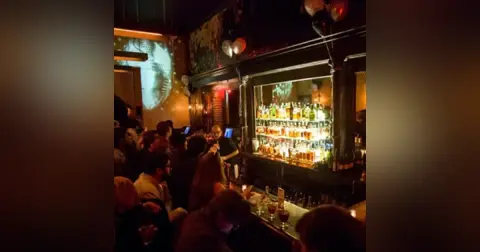
The lights are low, the eyeshadow is purple, and the crowd singing along to "1999" was mostly born well before 1999. It's 7:30 pm on a Friday night at Philadelphia's Trestle Inn, and the dance floor is already packed — with people over 50, several drinks deep, having the time of their lives before most millennials have even left the office.
This is not an accident. It's a business strategy.
Welcome to That's Life, I Swear. This podcast is about life's happenings in this world that conjure up such words as intriguing, frightening, life-changing, inspiring, and more. I'm Rick Barron your host.
That said, here's the rest of this story
Across the country, bars and nightclubs are quietly rewriting their playbooks, and the guest of honor is no longer the twentysomething with a fake ID and a bottomless appetite for tequila shots. It's Gen X, the generation [1965-1980] sandwiched between boomers and millennials, often overlooked, chronically self-reliant, and, as it turns out, still very much willing to buy a round.
The shift comes down to simple math. Younger drinkers are opting out. A long-running University of Michigan study tracking substance use among Americans ages 19 to 65 found that alcohol consumption among the youngest adults dropped to record lows in 2024, even as people roughly between the ages of 45 and 60 kept their habits largely intact. For an industry built on turning bodies into bar tabs, that divergence is impossible to ignore.
So, what’s the plan? Venue owners are chasing the money where it still flows freely. Ian Cross, who owns the Trestle Inn, said he started noticing the pattern when younger crowds simply weren't drinking the way earlier generations had. Early-evening theme nights, he found, were a reliable way to lure in an older set that still wants to dress up, dance, and order a proper cocktail — and is happy to do it before 9 p.m.
The results speak for themselves in dollar terms. At the Magic Bag, a live-music venue outside Detroit, general manager Andrew Bochenek said events that skew toward Gen X audiences bring in roughly a quarter more in alcohol sales than nights built around younger crowds. That gap has nudged the 30-year-old venue away from its traditional indie-rock bookings and toward '80s and '90s nostalgia nights, complete with tribute sets for bands like Duran Duran and Talking Heads. Bochenek's blunt read on the trend: venues chasing cool points can't out-earn venues chasing paying customers.
Even the timing has been rebuilt around Gen X's calendar. The Earlybirds Club, a dance-party series that runs from 6 to 10 p.m., launched in Chicago in early 2024 as a night out for women — as its own branding puts it — with responsibilities waiting for them the next morning. It has since expanded to more than 50 cities across the U.S. and Canada, proof that "going out" no longer has to mean staying out.
Culturally, Gen X may be primed for this moment. Often characterized as the latchkey generation — raised with minimal supervision, plenty of unsupervised bike rides, and a healthy independent streak — many members of the cohort came of age with a level of freedom their own kids will never know. Dina Cirillo Strachan, a 56-year-old high school counselor and Trestle Inn regular, remembers adolescence as a string of loosely organized gatherings where showing up with beer wasn't unusual. She's watched her own Gen Z children grow up under near-constant digital oversight, tracked by phone apps and social media in ways her own parents never could have managed. For her, that generational gap in freedom helps explain why going out to drink feels different now than it did then.
There's also a pharmacological head start baked into the story. David Jernigan, a public health professor at Boston University, has studied how the alcohol industry targeted young consumers in the 1980s and '90s with sweet, low-alcohol products like wine coolers — essentially, he argues, training wheels designed to build lifelong drinking habits before people even hit their twenties. Jernigan's research points to a simple industry truth: habits formed in adolescence and the early twenties tend to stick, and the alcohol business has long understood that.
Gen X also came of drinking age during a uniquely permissive information environment. A famous 1991 "60 Minutes" segment on the so-called French paradox — the theory that wine consumption explained France's comparatively low heart disease rates despite a less health-conscious diet — sent red wine sales soaring by as much as 45% in the following weeks, according to industry tracking from the Gomberg-Fredrikson report. For years afterward, research seemed to back the idea that moderate drinking carried real health benefits.
Gen Z has grown up with the opposite messaging. A wave of research through the 2010s undercut the French paradox, and public health bodies including the World Health Organization have since shifted toward advising that no amount of alcohol is truly safe. Last year, the U.S. Surgeon General called for cancer warning labels on alcoholic drinks, a move that rattled beverage-industry stocks. Jernigan describes the resulting shift in public sentiment as a wellness narrative that has actively worked against the industry's bottom line.
None of this means Gen Z has sworn off drinking entirely — a 2026 global survey from market research firm IWSR found that 74% of Gen Z respondents had consumed alcohol in the first half of the year. But how they drink looks different. Bar operators describe younger patrons arriving in large groups, ordering sparingly, and asking for cups of water, while Gen X customers tend to settle in and drink steadily through the night. Zack Bush, co-founder of Mad Room Hospitality, which runs Miami's Ball & Chain nightclub among other venues, said Gen X shows up earlier, drinks with more intention, and simply stays longer.
Even sober-curious Gen Xers are proving to be good for business. Randy Maupin, general manager of San Francisco's Cat Club and the Eagle, said his generation hasn't escaped the broader move toward moderation — but even Gen Xers who've cut back tend to still buy something, whether it's bottled water or a mocktail, out of loyalty to the venues they've supported for years. He contrasted that with younger customers who come in packs and share a couple of drinks between them.
For an industry watching its future customer base sober up, Gen X has become an unlikely lifeline — dependable, nostalgic for a good bassline, and still willing to close out a tab well before midnight.
What can we learn from this story? What's the takeaway?
The core insight: businesses follow reliable revenue, not demographic prestige. For decades, "young and cool" was the default target market for nightlife — but that's really a proxy for "people who drink a lot."
Once the drinking stopped tracking with youth, smart operators dropped the demographic assumption and chased the behavior instead.
The bigger lesson extends past bars: any industry built on a habit (spending, drinking, media consumption) needs to watch cohort behavior, not just cohort age, because generational identity and generational habits can decouple. Gen X's edge here isn't nostalgia marketing working on them — it's that they never really changed their behavior while the ground shifted under everyone else.
Well, there you go, my friends; that's life, I swear
For further information regarding the material covered in this episode, I invite you to visit my website, which can be found on Apple Podcasts, for show notes and the episode transcript.
As always, I thank you for the privilege of you listening and your interest.
Be sure to subscribe here or wherever you listen to podcasts so you don't miss an episode.
See you soon.
Reader Mail
The story for this podcast came from the Wall Street Journal. Within a week, there was reader mail from WSJ readers responding to Generation X's Drinking habits.
The feedback was not edited and is provided courtesy of the Wall Street Journal.
“Hold my wine cooler!” joked Gen X reader Adam Sah in response to WSJ’s recent article, “Bars Are Giving Up on Young People and Catering to Gen X Instead.” The 55-year-old, who says his favorite bar is New York City’s Double Chicken Please, is representative of a generation that has largely maintained its drinking habits, even as younger Americans have cut back. In a comments section full of quips, readers weighed in about why they drink at the bar—or don’t bother. Here, a selection of their comments, lightly edited for space and clarity.
Gen X Responds:
Gen X finally gets the recognition we deserve: Expensive cocktails, ‘80s music, and everyone home by 10 because we’ve got a bad back. —Andrew Silver
Step aside, Millennials. Gen X has got this one. —Ross Murchison
I’m Gen X and would be happy to frequent bars more often. As soon as you stop charging $10 for a draft beer, let’s talk. —Kevin Mathews
Bars are supposed to be happy social places. Gen Z has been trained to be perpetually miserable, Boomers that have more than a few drinks take days to recover and Millennials have the misfortune of being forced into being responsible. All that is left is Gen X. —Donald Waltermire
Heck Yeah! Absolutely love going out and pulling a stool up to a bar. We don’t go out to get drunk, we go out to drink, and socialize. As a frequent traveler, it’s a great way to meet people and get a feel for the town you’re in. Tell some jokes, have a laugh, and find out what makes people tick. Sure beats the cesspool called the internet. Life is too short not to stop at a bar in a blown-out town in eastern Ohio with no windows. —Jason Kompf
“…These early parties were a way to get older folks in the door,” said Ian Cross, the bar’s owner. “They spend money on cocktails, they drink, they have fun…” He forgot to mention they tip well, and are too old to get into fights. Send the bouncers home. —Miles Fitzgerald
Ah, yes, drinking in the 80s. Any other Gen Xers remember Bartles and Jaymes? —Juliet Schneider
Young folks don’t have any money, that’s a fact. Gen X has some money to blow, but ought to know better, ‘cause so many of our pop idols shipwrecked on the rocky shores of booze and drugs. I can name more that are in the ground than I can that are above it. —Reginald Smythe
Baby Boomers Respond:
I’m almost 82 and I have a couple of groups of friends who meet for happy hour four or five times a month. Discounted food and drinks, and one of my friend’s husbands acts as an Uber driver. I may be drinking more than I did in my youth, but sharing food and drinks with my over-70 groups of friends is wonderful since I’ve had to give almost everything else I love (skiing, tennis, pickleball, and this week, salads). —Mary Silverberg
This morning at coffee with my ancient friends, I noted that the younger generations are drinking less and having fewer children. I also noted that but for alcohol, half of us wouldn’t be here. —Eddie Smith
Heck, I’m past 65 and still hit the dance floor from 10 pm to 1:30 am. Got to keep it going late night as do many 55-pluses. Got one tonight starting at 10:30!! Because adults don’t always need to roll out of bed on a Sunday morning at 7 am.—Peter H
A Millennial Responds:
Millennials and Gen Z drink. We just don’t want to spend $10 for a beer to hang out in a bar and then pay for an Uber to get home. We drink at our homes with our friends, throw the music on Spotify, and have just as much fun for way less money.—Aron Kerr


