
Dismantling of USAID was Cruel and Jaw-droppingly Stupid!
Expertise is invisible until it's gone. The most important systems — disease surveillance, early warning networks, on-the-ground aid presence — look like nothing when they're working. Supporting links 1. Deadly Ebola Outbreak in Eastern DR Congo [MEDAIR] 2. Ebola disease caused by Bundibugyo virus [WHO] 3. Ebola Outbreak Is a Test of International Health Cooperation [Global Affairs] 4. Ebola [Wikipedia] Con...

 Amazon Music
 Apple Podcasts
 Spotify
 iHeartRadio
 Youtube Music
 TuneIn
 Castro
 Audible
 RSS Feed
 Expertise is invisible until it's gone. The most important systems — disease surveillance, early warning networks, on-the-ground aid presence — look like nothing when they're working.
Supporting links
1. Deadly Ebola Outbreak in Eastern DR Congo [MEDAIR]
2. Ebola disease caused by Bundibugyo virus [WHO]
3. Ebola Outbreak Is a Test of International Health Cooperation [Global Affairs]
4. Ebola [Wikipedia]
Contact That's Life, I Swear
- Visit my website: https://www.thatslifeiswear.com
- Twitter at @RedPhantom
- Bluesky at @rickbarron.bsky.social
- Email us at https://www.thatslifeiswear.com/contact/
Episode Review
- Submit on Apple Podcast
- Submit on That's Life, I Swear website
Other topics?
- Do you have topics of interest you'd like to hear for future podcasts? Please email us
Interviews
- Contact me here https://www.thatslifeiswear.com/contact/, if you wish to be a guest for a interview on a topic of interest
Listen to podcast audios
- Apple https://apple.co/3MAFxhb
- Spotify https://spoti.fi/3xCzww4
- My Website: https://bit.ly/39CE9MB
Other
- Music and/or Sound Effects are cour...
⏱️ 14 min read
Hi everyone, and welcome to my podcast, That’s Life, I Swear. I’m your host, Rick Barron
The dismantling of USAID was not just cruel. It was spectacularly, jaw-droppingly stupid — and now Ebola is proving the point.
Elon Musk called it "feeding USAID into the wood chipper," and he said it with the satisfied grin of a man who had finally cleaned out the garage. What he had actually cleaned out, it turns out, was the fire department.
Welcome to That's Life, I Swear. This podcast is about life's happenings in this world that conjure up such words as intriguing, frightening, life-changing, inspiring, and more. I'm Rick Barron your host.
That said, here's the rest of this story
Before I get started here, allow me to provide some context. In May 2026, an epidemic of Ebola was reported in the Ituri Province of the Democratic Republic of the Congo (DRC). It is the 17th Ebola outbreak in DRC and began only five months after the end of the previous outbreak.
Picture, if you will, a man in a hard hat and a cape standing before a perfectly functioning smoke detector, hacksaw in hand, grinning at the crowd gathering below his ladder. "This thing," he announces, "is costing us money every year, and it has never once detected a fire in my presence. Clearly, it does nothing."
The crowd cheers. The hacksaw sings. The detector falls.
Six months later, the building is on fire.
This is, stripped of all euphemism and diplomatic courtesy, what happened when Elon Musk announced — with the breezy satisfaction of a man discovering he'd accidentally won something — that he had "spent the weekend feeding USAID into the wood chipper." He said this as though he'd reorganized a cluttered garage, as though decades of painstakingly constructed global health infrastructure were the equivalent of old paint cans and broken lawn chairs. Donald Trump nodded along, as he tends to do when someone tells him something that confirms a suspicion he already enjoyed having. American humanitarian aid, they both agreed, was essentially a vanity project. Woke charity theater. Money wasted on people who didn't vote.
Global health is unpredictable, and it’s not certain that the U.S. Agency for International Development would have stopped Ebola this time. But in three ways, Trump’s assault on global health has left us in a worse position to combat Ebola.
The first: Taking U.S.A.I.D. down
There is a particular species of confidence that blooms in those who have never had to understand a thing in order to destroy it. Musk had built rockets and electric cars. Trump had built casinos (and then un-built several of them, financially speaking). Neither man had spent much time in the Ituri province of the Democratic Republic of Congo, watching aid workers track unexplained fevers through remote villages, building the kind of early-warning networks that look, from the outside, like nothing at all — right up until the moment they're gone and something ancient and hemorrhagic comes roaring through the gap they left behind.
That something is now here. Ebola is back — not as a theoretical risk, not as a footnote in a preparedness document, but as an active, spreading, third-worst-on-record outbreak. And the wood chipper, it turns out, ate some rather important things.
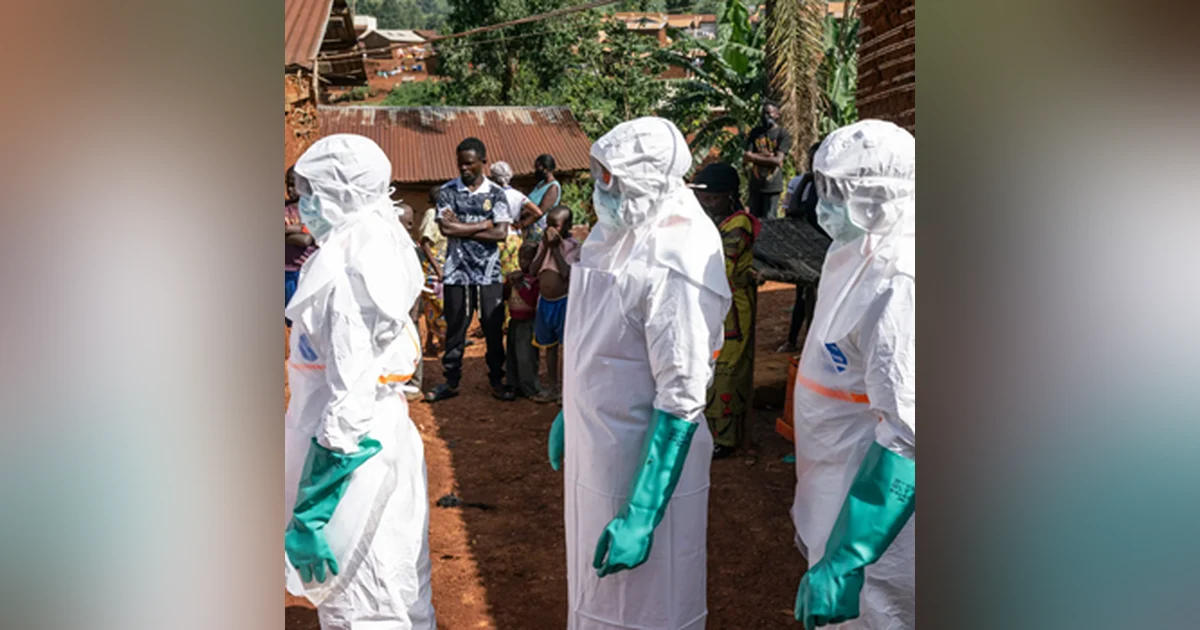
Ebola is a terrifying disease, initially producing a fever, muscle ache and headaches and then leading to vomiting, diarrhea and often bleeding and death. It is transmitted by body fluids, but in a broader sense it is transmitted by love: When people tend to an ailing loved one or prepare a body for burial, it is easy to be infected by blood, vomit or diarrhea.
The Art of Not Knowing What You're Cutting
Let's pause on the sheer conceptual comedy of what happened with USAID's Congo operations. The United States had, over many years, built up a humanitarian infrastructure in the DRC so comprehensive that it financed roughly 70 percent of all humanitarian work in the country, according to Physicians for Human Rights. Seventy percent. America was not a minor player in Congo's stability and health. America was, functionally, the floor.
Then, over a weekend — a weekend — the floor was removed. Aid workers were sent home. Programs that had taken years to build were shuttered with the administrative grace of someone canceling a streaming subscription. No transition. No handover. No plan.
Jeremy Konyndyk, who ran USAID's response to the 2014 Ebola outbreak, has noted that the agency used to maintain a substantial presence in precisely the region where this new outbreak began. If those teams had still been there, he has said plainly, this outbreak would not have gone undetected for as long as it did. Health workers on the ground would have flagged the clusters of unexplained hemorrhagic fever. The alerts would have gone up the chain. The White House would have been notified. Time — the most precious resource in any epidemic response — would not have been squandered.
Instead, by the time the world began responding to this outbreak, there were somewhere between 400 and 500 cases. When the world began responding to the 2014 epidemic, there were 40 to 50. Dr. Tom Frieden, who directed the Centers for Disease Control and Prevention during that earlier crisis, put it with the kind of blunt clarity that only people who have actually watched epidemics work tend to possess: "With Ebola, time is lives. Get to an outbreak in days, and you can stop it in weeks. Get there in weeks, and it goes on for months. Get there in months, and it can go on for years."
This outbreak had what Frieden called "a running head start." The metaphorical smoke detector had been removed, and the fire had been burning quietly for some time before anyone noticed the smell.
The second: Hostility aimed at the WHO
Ok, it was an Imperfect Institution that, like seat belts, works better when you use it.
If the USAID destruction was the first act of this farce, the administration's handling of the World Health Organization was the second. Trump withdrew the United States from the WHO — an organization with obvious flaws, as most large bureaucracies have obvious flaws, and also with the genuine, irreplaceable function of serving as the world's shared early warning system for exactly this kind of outbreak.
The result of this posturing was that the United States learned about the current Ebola outbreak nine days after the WHO did. Nine days. In Ebola terms, that is an eternity. That is the difference between containment and catastrophe.
There's a darkly comedic quality to the image of American health officials — some reportedly barred from even communicating with their WHO counterparts — watching from the sidelines as the rest of the world's public health apparatus tried to manage a crisis that the U.S. had previously led efforts to contain. Like a championship basketball team refusing to play in the playoffs because they objected to the referee's outfit, then criticizing the team that replaced them for not winning.
"For all its weaknesses, the WHO is essential," Frieden has said. "The stronger the WHO is, the safer we are." This is not a complicated point. It is the kind of thing that becomes obvious the moment you consider the alternative, which is, apparently, the situation we are now in.
The Third: The Binder Nobody Opened
The third act of the absurdist drama involves a binder. Or, more accurately, several hundred pages of infectious disease preparedness planning that the Biden administration assembled specifically for the incoming Trump team. Documents detailing exactly how to handle an outbreak like the one now spreading through the DRC. A road map, essentially, for the scenario currently unfolding.
The Trump administration reportedly ignored it.
This is the kind of detail that would seem too on-the-nose if you encountered it in a satirical novel. The previous occupants of the building left a laminated guide titled "What To Do When The Smoke Detector We Removed Would Have Gone Off." The new occupants used it as a coaster.
Meanwhile, positions dedicated to disease preparedness sat vacant. Funding for the Global Alliance for Vaccines and ImmunizationGAVI, the vaccine alliance helping develop a treatment for this specific strain of Ebola — the Bundibugyo strain, unusual enough to pose extra challenges — was cut. Secretary of State Marco Rubio has since suggested the administration will "re-engage" on GAVI, a phrase so vague as to be entirely without nutritional value.
The administration is also reportedly eyeing cuts to PEPFAR — the program that has saved more than 26 million lives from HIV/AIDS — on the grounds that, one can only assume, 26 million lives is not the kind of number that moves them. Eight former CDC directors recently co-authored a warning that these cuts would degrade the surveillance networks that catch diseases like Ebola early. Eight former directors. The kind of bipartisan, expert consensus that used to mean something.
The Courage That Fills the Gap
Here is where the absurdist comedy gives way to something altogether harder to sit with.
The people who actually deal with Ebola — the doctors, nurses, burial teams, and community health workers in places like Ituri — are not operating with the luxury of ideological certainty. They are working, according to reports from the front lines, without adequate protective equipment. They are tending to patients who are hemorrhaging, managing bodies that are highly infectious, doing the work that the dismantled infrastructure was supposed to support — and doing it anyway, with whatever they have.
A Congolese doctor, interviewed in a searing video circulated by Dr. Celine Gounder, described a colleague — a fellow physician — who, after the aid cuts eliminated his position, became a cassava farmer. A doctor growing cassava. Because the system that had supported his work was fed into a wood chipper one weekend by a man who had never heard of him.
This is the true cost of treating global health as a line item to be slashed in a DOGE spreadsheet. It is not abstract. It is a physician with a machete instead of a stethoscope, and it is a spreading outbreak that should have been caught months earlier.
One recent study found that in areas of Africa that received significant U.S. assistance, the abrupt shutdown of USAID caused roughly a 10 percent increase in violence — riots, combat deaths, and destabilization. A Boston University researcher has estimated that the aid cuts have already cost more than 750,000 lives worldwide.
Seven hundred and fifty thousand lives. Saved, on average, at the cost of what amounts to a rounding error in the American federal budget.
There is a version of this story where the men responsible look back at what they have done and reckon with it honestly. In that version, Musk acknowledges that the wood chipper metaphor was, in retrospect, poorly chosen. Trump concedes that some of what USAID did was not, in fact, woke nonsense. Rubio explains what "re-engage on GAVI" actually means and by what date.
We are not, as yet, living in that version of the story.
What we do have is an Ebola outbreak that is already the third worst ever recorded, a gutted early-warning system, a broken relationship with the world's primary public health coordinator, and the quiet, unacknowledged lesson that the things that look like waste — the aid workers in the field, the health monitors, the planners with their binders — are sometimes the only things standing between the world and something that bleeds.
The smoke detector, as it turns out, was not a decoration.
What can we learn from this story? What's the takeaway?
This story teaches us a few things.
Expertise is invisible until it's gone. The most important systems — disease surveillance, early warning networks, on-the-ground aid presence — look like nothing when they're working. They produce an absence of catastrophe, which ideologues mistake for proof that they're unnecessary. You don't see the outbreak that didn't happen. USAID's value was precisely its invisibility in normal times.
Speed is everything with exponential threats.Frieden's formulation is the sharpest line in the piece: days become weeks, weeks become months, months become years. Epidemics don't pause while institutions are rebuilt. The cost of dismantling a response system isn't paid immediately — it's paid at the worst possible moment, with compound interest.
Ideology is a poor substitute for understanding.Musk and Trump didn't cut USAID because they analyzed it and found it wanting. They cut it because it felt like the kind of thing that should be cut — foreign, bureaucratic, associated with people they disliked. That's a category error with lethal consequences. Contempt is not analysis.
Interconnection is not optional.Global health doesn't respect borders or political preferences. Pathogens don't care whether Washington has withdrawn from the WHO. The choice to disengage from international health infrastructure doesn't make America safer — it just means America gets the bad news later, with less time to respond.
The bravery gap is the real indictment.Perhaps the most damning contrast in the piece is between officials in Washington, casually signing off on cuts they didn't bother to understand, and health workers in Ituri doing dangerous, underfunded work without adequate protective equipment. One group bore all the risk of the decision. The other group made it.
The broadest takeaway is this:governing requires understanding what you're touching before you dismantle it. The wood chipper metaphor Musk used so cheerfully is apt — but wood chippers don't discriminate.
They take the rotten wood and the load-bearing beams with equal enthusiasm. The job of leadership is knowing which is which. That work wasn't done, and people are dying because of it.
Well, there you go, my friends; that's life, I swear
For further information regarding the material covered in this episode, I invite you to visit my website, which can be found on Apple Podcasts, for show notes and the episode transcript.
As always, I thank you for the privilege of you listening and your interest.
Be sure to subscribe here or wherever you listen to podcasts so you don't miss an episode.
See you soon.


