
Movie Review from Rick’s Streaming Library: Backrooms

 Amazon Music
 Apple Podcasts
 Spotify
 iHeartRadio
 Youtube Music
 TuneIn
 Castro
 Audible
 RSS Feed
 The lesson Backrooms offers is an old one dressed in terrifyingly new clothes: a life half-lived in avoidance is its own kind of infinite corridor.
supporting links
1. Kane Pixels [YouTube]
2. A24 [Wikipedia]
3. Little Big Planet [Wikipedia]
4. Kabe Parsons [Wikipedia]
5. Chiwetel Ejiofor [Wikipedia]
6. Renate Reinsve [Wikipedia]
Contact That's Life, I Swear
- Visit my website: https://www.thatslifeiswear.com
- Twitter at @RedPhantom
- Bluesky at @rickbarron.bsky.social
- Email us at https://www.thatslifeiswear.com/contact/
Episode Review
- Submit on Apple Podcast
- Submit on That's Life, I Swear website
Other topics?
- Do you have topics of interest you'd like to hear for future podcasts? Please email us
Interviews
- Contact me here https://www.thatslifeiswear.com/contact/, if you wish to be a guest for a interview on a topic of interest
Listen to podcast audios
- Apple https://apple.co/3MAFxhb
- Spotify https://spoti.fi/3xCzww4
- My Website: https://bit.ly/39CE9MB
Other
- Music and/or Sound Effects are cour...
⏱️ 11 min read
Hi everyone, and welcome to my podcast, That’s Life, I Swear. I’m your host, Rick Barron
"You know that feeling — when you walk into a room, and something is just slightly, unexplainably off? The carpet is the wrong color. The light is too flat. There are no windows, no doors, you can explain, and the hallway ahead just keeps going. Your brain says: this place exists, and coincidentally, this place should not. Welcome to the Backrooms.
Today we're stepping through the wall. We're talking about one of the most astonishing film debuts in recent memory — Backrooms, directed by Kane Parsons, a 20-year-old from Petaluma, California, who went from uploading nine-minute found footage shorts in high school to shattering A24's box office records before he's old enough to rent a car in most U.S. states. We'll talk about what the film gets right, what lingers, what haunts — and what it's quietly saying about loneliness, escape, and the rooms we build inside ourselves when the real world gets too loud.
Ready to begin? Get your popcorn 🍿
Welcome to That's Life, I Swear. This podcast is about life's happenings in this world that conjure up such words as intriguing, frightening, life-changing, inspiring, and more. I'm Rick Barron, your host.
That said, here's the rest of this story
1. Plot of the Movie
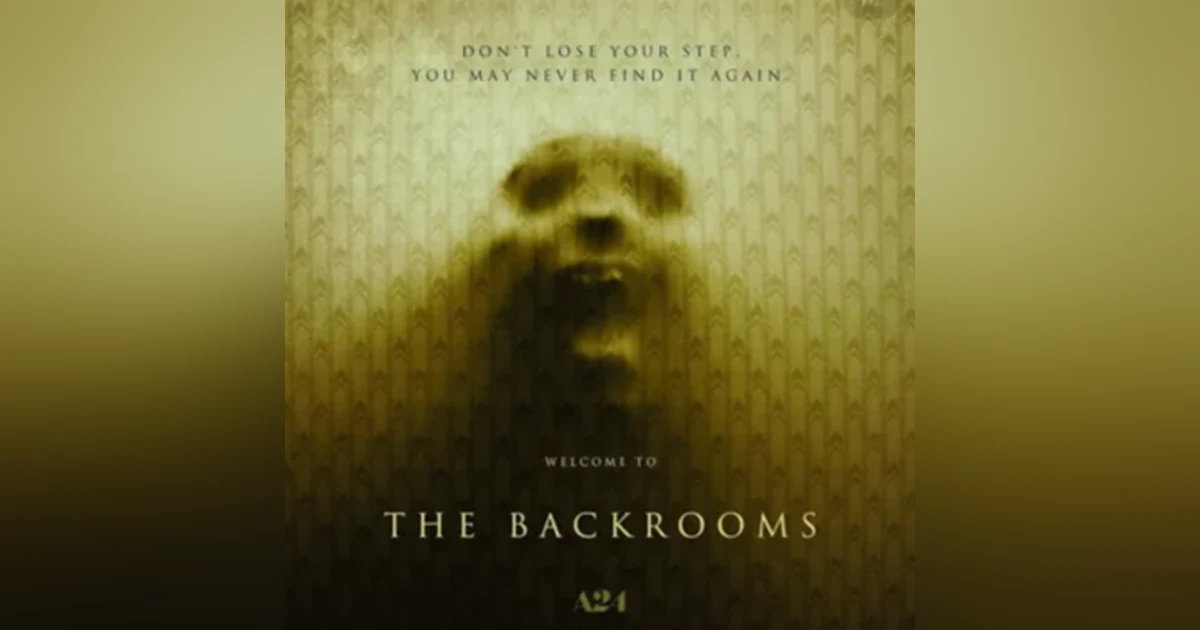
What happens when reality cracks open — not with a bang, but with a quiet, fluorescent hum? That is the unsettling premise at the heart of Backrooms, A24's boldest horror release of 2026. The film centers on Clark, played by Chiwetel Ejiofor, a divorced, emotionally adrift furniture store owner and failed architect, a man simmering with resentment over what his life has quietly become. One ordinary afternoon in his store's basement, Clark discovers something impossible: a section of wall that is not quite a wall — a portal into an infinite, labyrinthian dimension of endless, abandoned rooms.
What unfolds is less a conventional horror film than a descent into a philosophical nightmare. The Backrooms themselves — a sprawling purgatory of buzzing fluorescent lights, honey-mustard yellow walls, water-stained carpets, and chambers that seem to breed new corridors overnight — function as a mirror for Clark's interior world. The deeper he goes, the less he wants to return. Murky swimming pools open onto tighter passageways. Rooms divide and multiply. Architecture becomes surrealistic. And slowly, with devastating clarity, the film reveals its true horror: Clark isn't trapped — he's hiding.
Running parallel is Dr. Mary, played by Renate Reinsve, Clark's therapist, who grows increasingly alarmed by her patient's disappearance and begins to investigate the impossible space herself. Their two trajectories — one a freefall into the abyss, the other a desperate reach back toward the surface — give the film its emotional spine. Supporting turns from Mark Duplass, Finn Bennett, Lukita Maxwell, and Avan Jogia enrich the world around the edges. The production design is hypnotic, built across 30,000 square feet of real, practical sets — the kind of physical, handcrafted world that makes your skin crawl in the best way. Backrooms is not a film that will simply scare you. It is a film that will make you ask yourself how many walls in your own life you've been quietly mistaking for exits.
2. About the Director
If Hollywood runs on reinvention, Kane Parsons is something rarer: an originator. Born on June 18, 2005 — the same year YouTube launched — Parsons grew up in Petaluma, California, the son of a video game developer father and a therapist mother, both of whom quietly planted the seeds of his craft before divorcing when he was seven. He started experimenting with environments and lighting as a child through LittleBigPlanet, received a laptop infested with viruses trying to download Minecraft mods, and attended the Marin School of the Arts at Novato High School to formally study film.
Then, on January 7, 2022 — at just 16 years old — he posted a short nine-minute found footage to YouTube titled The Backrooms (Found Footage). It went viral almost instantly, eventually racking up over 79 million views. He followed it with roughly two dozen subsequent videos expanding the mythology, accumulating more than 197 million total views under his online handle, Kane Pixels. His YouTube channel now boasts 3.17 million subscribers and 337 million total views.
Hollywood noticed while Parsons was still a teenager. James Wan — the mind behind Saw and Insidious — had his first Zoom call with Parsons and was joined not by an agent, but by Parsons' dad. Wan believed in the project anyway, and the gamble proved visionary. With A24, Chernin Entertainment, Atomic Monster, and Blumhouse all aboard, Parsons made his feature directorial debut at 20, becoming the youngest director ever to top the global box office. Backrooms opened to $81.5 million domestically and $118 million worldwide, shattering A24's North American records. He also co-composed the film's haunting score with Edo Van Breemen. Kane Parsons is, quite simply, the most exciting directorial debut of this decade.
3. What Drew My Interest in Wanting to See This Movie?
There are movies you see because the trailer stops you cold, and you’re mesmerized. Then there are movies you feel compelled to see, as if ignoring them would be a small act of cowardice. Backrooms fell firmly into the second category for me, and the reasons are layered.
Let me explain.
It started, as it did for millions, with the original YouTube series. There is something uniquely modern about the Backrooms as a horror concept — it requires no monster, villain, or even a narrative. It requires only the sensation of being somewhere you should not be, in a space that has no exit you can find. The subtle horror aesthetic: long corridors, buzzing lights, rooms that feel vaguely institutional and deeply wrong, taps into something primal about human psychology. We are creatures wired to read environments for safety, and the Backrooms deny us that reassurance entirely. Watching Kane Parsons' original short at midnight with headphones on is one of the more genuinely unsettling experiences available on the internet, and the idea that this aesthetic could be expanded into a full cinematic world was tantalizing.
Then came the casting. Chiwetel Ejiofor is one of the most intelligent, physically expressive actors of his generation, and the idea of watching him inhabit a man swallowed by his own emotional avoidance — with the Backrooms as a literal externalization of that collapse — struck me as potentially extraordinary. Renate Reinsve, fresh off her acclaimed work in The Worst Person in the World, bringing her particular mix of warmth and unease to a therapist investigating the impossible, felt like a perfect counterweight.
And finally, there was the pure audacity of the story behind the story. A 20-year-old kid from Northern California — who taught himself visual effects through video games, who went viral in high school, who had his first studio meeting with his dad on the Zoom call — was making his feature debut with A24 and a $10 million budget. Whether the film succeeded or failed, it was going to be something. Art made by someone with genuine obsession always is.
4. What Can We Learn from This Movie? The Takeaway
Backrooms is, beneath its atmospheric dread and disorienting production design, a remarkably precise film about escape — and how the places we flee to can become more imprisoning than the lives we fled from. Clark does not stumble into the Backrooms and desperately seek a way out. He lingers. He explores. He makes his bed in meaninglessness rather than return to a real world freighted with failure, loss, and accountability. That is the film's quiet, devastating thesis: sometimes the maze is not the trap. The refusal to leave is.
In an era of unprecedented social alienation — where loneliness has become a public health crisis, where digital spaces offer endless, consequence-free rooms to wander — the Backrooms function as a lucid metaphor for the artificial worlds we increasingly prefer to the messy, difficult, irreplaceable texture of real life.
The film comments on the seduction of constructed environments, of simulated connection, of choosing the hum of fluorescent nothing over the friction of being truly known. That Parsons built his sets practically, by hand, partly through his own Blender designs, gives the allegory a particular weight: this world of hollow artifice was made with genuine human care.
The takeaway is not fatalistic. Mary's pursuit of Clark, her refusal to accept his disappearance, is the film's moral argument that love and presence are worth the danger of the search. The lesson Backrooms offers is an old one dressed in terrifyingly new clothes: a life half-lived in avoidance is its own kind of infinite corridor. The exit you are looking for is almost certainly behind you, in the direction of the things you are most afraid to face.
Well, there you go my friends, That's life, I swear.
For further information regarding the material covered in this episode, I invite you to visit my website, which can be found on Apple Podcasts, for show notes and the episode transcript.
As always, I thank you for the privilege of you listening and your interest.
Be sure to subscribe here or wherever you listen to podcasts so you don't miss an episode.
See you soon.


