
Run 26.2 Miles and 20 Wine Stops: What Could Go Wrong?
The real takeaway isn't about wine or running — it's about how people redefine "achievement" on their own terms. Supporting links 1. Marathon du Medoc, world’s booziest marathon [A Lady of Leisure] 2. Marathon du Médoc [Wikipedia] 3. Marathondumedoc [Instagram] Contact That's Life, I Swear Visit my website: https://www.thatslifeiswear.com Twitter at @RedPhantom Bluesky at @rickbarron.bsky.social Email us at http...

 Amazon Music
 Apple Podcasts
 Spotify
 iHeartRadio
 Youtube Music
 TuneIn
 Castro
 Audible
 RSS Feed
 The real takeaway isn't about wine or running — it's about how people redefine "achievement" on their own terms.
Supporting links
1. Marathon du Medoc, world’s booziest marathon [A Lady of Leisure]
2. Marathon du Médoc [Wikipedia]
3. Marathondumedoc [Instagram]
Contact That's Life, I Swear
- Visit my website: https://www.thatslifeiswear.com
- Twitter at @RedPhantom
- Bluesky at @rickbarron.bsky.social
- Email us at https://www.thatslifeiswear.com/contact/
Episode Review
- Submit on Apple Podcast
- Submit on That's Life, I Swear website
Other topics?
- Do you have topics of interest you'd like to hear for future podcasts? Please email us
Interviews
- Contact me here https://www.thatslifeiswear.com/contact/, if you wish to be a guest for a interview on a topic of interest
Listen to podcast audios
- Apple https://apple.co/3MAFxhb
- Spotify https://spoti.fi/3xCzww4
- My Website: https://bit.ly/39CE9MB
Other
- Music and/or Sound Effects are cour...
⏱️ 8 min read
Hi everyone, and welcome to my podcast, That’s Life, I Swear. I’m your host, Rick Barron
There’s an annual marathon that happens in France's Bordeaux region. Instead of the various water table stops, this one is a little different…way different. These stops, and there are 20 of them, are 20 wine ‘tasting’ stops.
Somewhere between mile 12 and a plate of Camembert, the average marathoner in Bordeaux stops asking "Am I hydrated enough?" and starts asking "Is this a Merlot or a Cabernet?" — and really, isn't that the more interesting question?
Cheese and 26.2 Miles: Yeah, what could go wrong?
Welcome to That's Life, I Swear. This podcast is about life's happenings in this world that conjure up such words as intriguing, frightening, life-changing, inspiring, and more. I'm Rick Barron your host.
That said, here's the rest of this story
Most marathon training plans involve tempo runs, foam rollers, and an obsessive relationship with electrolyte packets. Come September of 2026, the Marathon du Médoc involves all of that, plus something else: a rotating tour of pubs, each one a dress rehearsal for the 20 wine stations waiting for the runners on race day.
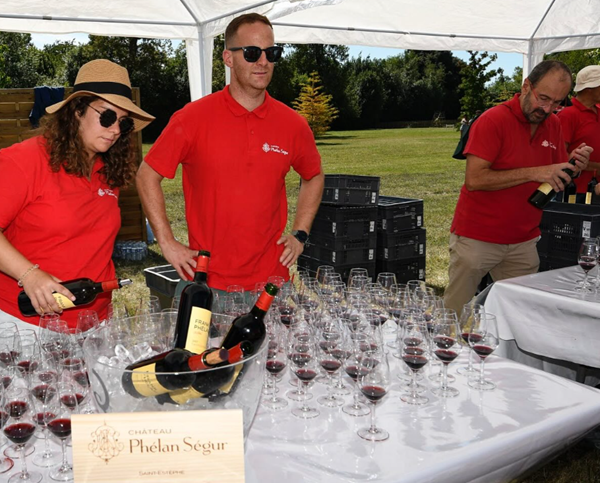
One of the 20 wine stations during the Marathon du Médoc. Courtesy of the Marathon du Médoc Instagram website
The Médoc course winds through France's storied Bordeaux wine country, and it asks runners to do something no marathon major would ever sanction — pace themselves not just against the clock, but against a glass. Twenty châteaux. Twenty pours. One 26.2-mile road race standing between the starting gun and the finish line, with cheese, oysters, croissants, steak, and ice cream stationed along the way like edible mile markers. Wonder if the race provides barf bags.
Nutritionists, understandably, are not fans. But for the 8,500 runners lucky enough to snag a bib — the field sold out in nine minutes this year, with a waitlist now three times the size of the race itself — that's rather the point.
"You also need to ensure that you're going to get to the end in one piece," said one runner.
Drinking while marathoning is serious business. On social media, runners post clips of themselves drinking along the racecourse, even during major marathons like Chicago’s and New York’s. Some come prepared with drinks for the race. Others take drinks passed to them by spectators.
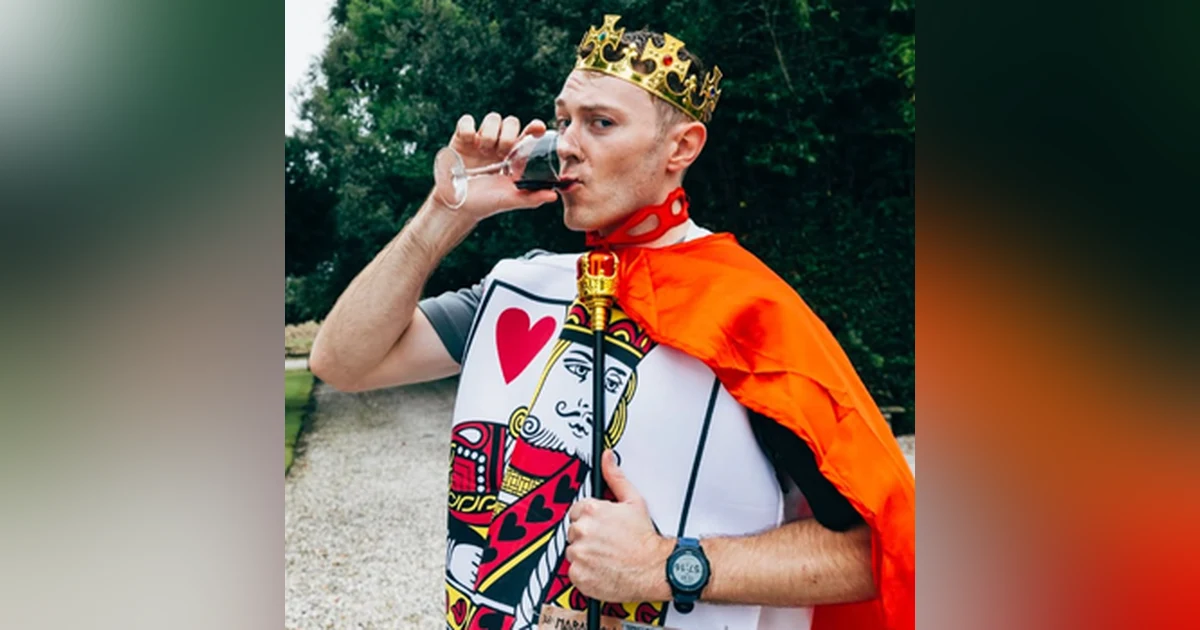
This year marks the race's 40th running, on September 5th, and it remains as gleefully absurd as ever. Runners get 6.5 hours to finish — a window comparable to major marathons — and every single one of them runs in costume. This year's theme: the 1980s, presumably meaning Bordeaux will soon be overrun by neon spandex and shoulder pads sprinting past vineyards older than most nations.
There’s a clear distinction between this French marathon and others around the world. For example, the Boston Marathon is the crown jewel of serious running. Médoc is something else entirely — a marathon that treats fine dining as a competitive advantage rather than a distraction.
Dietitian Farah Khan, who teaches sports nutrition at Lehman College and Long Island University, offers the kind of warning you'd expect:
Wine dehydrates; it interferes with the body's ability to process carbohydrates, and alcohol hits harder when the heart rate is already elevated. Her advice for those who refuse to skip the wine entirely borrows a page from professional tasters — sip, swirl, and spit, rather than swallow.
Race officials don’t dispute this assessment, but they insists the race was never designed as a drinking contest. It's a tasting tour that happens to be interrupted by 26.2 miles of running. Given that the average competitor is over 40, race officials expects a certain baseline of maturity on the course.
Reality, as usual, is a little messier than marketing. Pennsylvania running podcast hosts Laura Lee and Lorri Fechtman, both in their 50s, prepared for last year's race the way any sensible person would: by smuggling a bottle of wine into a local 10-mile training run and taking swigs at the one-mile mark. They expected trouble. Instead, Philadelphia police and firefighters found the whole thing hilarious enough to pose for a photo.
That training paid off in Bordeaux, where Lee discovered that wine and late-summer French heat don't always play nicely together. When she started feeling ill, she skipped several châteaux’s and switched to water — proof that even at a marathon built around indulgence, self-preservation eventually wins out.
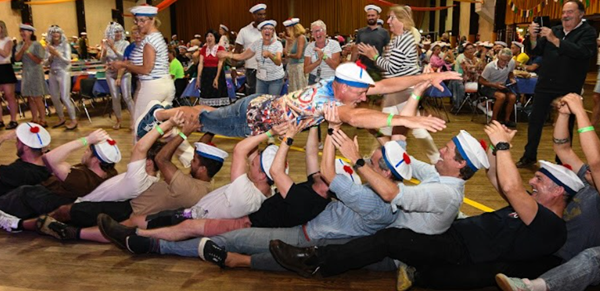
One of many parties after the marathon. Courtesy of the Marathon du Médoc Instagram website
One person took a more scientific approach, training with a swig of wine every half-mile alongside friends — and documenting the entire experiment on Instagram, because if a marathon is going to include wine, it should also include content.
I would guess staging photos of the race on Instagram lets your running buddies know what you're like when you're running and drinking at the same time.
There is, inevitably, a logistical wrinkle that no amount of carb-loading can solve: bathrooms.
Or rather, the lack of them. Fortunately, Bordeaux's endless rows of vineyards offer what is described as a fully embraced "vineyard-peeing culture" — an unofficial but widely practiced course amenity that draws exactly zero judgment from fellow runners.
Runners approaching this year's race have done their research:
1. anti-inflammatories
2. ibuprofen
3. and sunscreen packed for the journey, alongside his partner
For a vast number of runners, they aren't entirely sure what state they’ll be in by the finish line — happily buzzed on the achievement, or just plain buzzed.
Either way, the wine will keep flowing, the cheese will keep coming, and 8,500 people will keep proving that the fastest way to a marathoner's heart may run straight through a vineyard.
What can we learn from this story? What's the takeaway?
The real takeaway isn't about wine or running — it's about how people redefine "achievement" on their own terms.
For the Médoc crowd, finishing isn't the only goal; finishing well-fed and pleasantly tipsy is the goal. It's a reminder that endurance events don't have to be grim tests of willpower.
Community, humor, and a little irreverence can coexist with genuine physical accomplishment — if runners are honest with themselves (and their doctors) about the trade-offs.
Khan's sip-and-spit advice is the story's quiet moral: you can have the experience without overdoing it.
Well, there you go, my friends; that's life, I swear
For further information regarding the material covered in this episode, I invite you to visit my website, which can be found on Apple Podcasts, for show notes and the episode transcript.
As always, I thank you for the privilege of you listening and your interest.
Be sure to subscribe here or wherever you listen to podcasts so you don't miss an episode.
See you soon.


