
Movie Review from Rick’s Streaming Library: Casablanca
The movie, Casablanca, is the real thing; it was and still is a classic. supporting links 1. Casablanca [Wikipedia] 2. Casablanca trivia [YouTube] 3. Humphrey Bogart [Wikipedia] 4. Ingrid Bergman [Wikipedia] Contact That's Life, I Swear Visit my website: https://www.thatslifeiswear.com Twitter at @RedPhantom Bluesky at @rickbarron.bsky.social Email us at https://www.thatslifeiswear.com/contact/Epis...

 Amazon Music
 Apple Podcasts
 Spotify
 iHeartRadio
 Youtube Music
 TuneIn
 Castro
 Audible
 RSS Feed
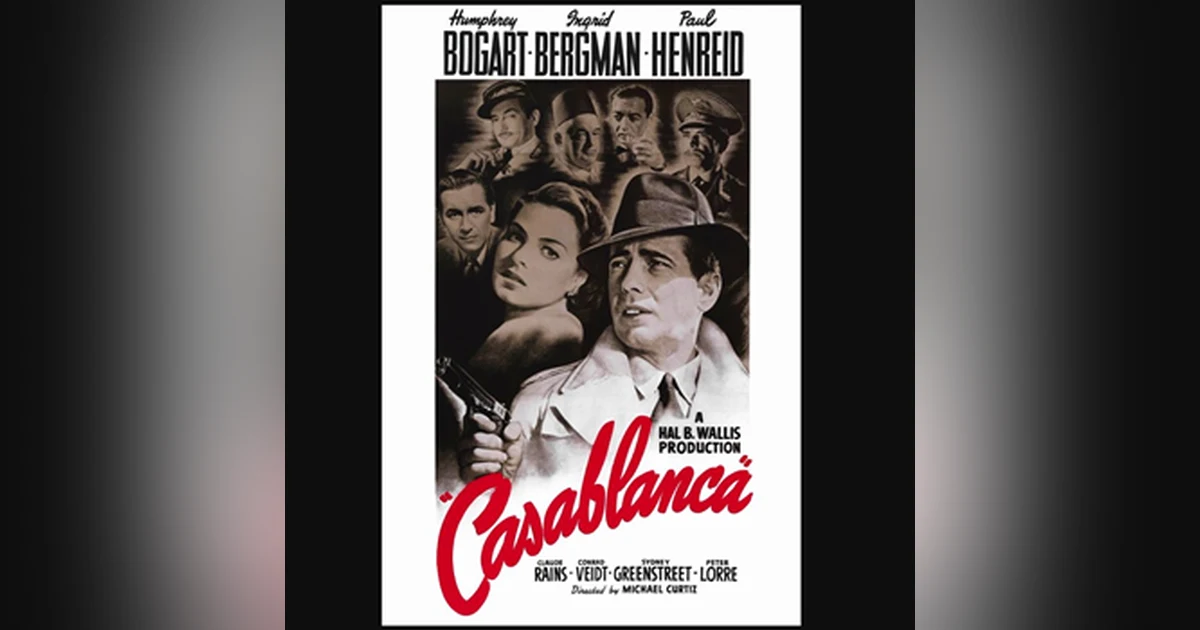
 The movie, Casablanca, is the real thing; it was and still is a classic.
supporting links
1. Casablanca [Wikipedia]
2. Casablanca trivia [YouTube]
3. Humphrey Bogart [Wikipedia]
4. Ingrid Bergman [Wikipedia]
Contact That's Life, I Swear
- Visit my website: https://www.thatslifeiswear.com
- Twitter at @RedPhantom
- Bluesky at @rickbarron.bsky.social
- Email us at https://www.thatslifeiswear.com/contact/
Episode Review
- Submit on Apple Podcast
- Submit on That's Life, I Swear website
Other topics?
- Do you have topics of interest you'd like to hear for future podcasts? Please email us
Interviews
- Contact me here https://www.thatslifeiswear.com/contact/, if you wish to be a guest for a interview on a topic of interest
Listen to podcast audios
- Apple https://apple.co/3MAFxhb
- Spotify https://spoti.fi/3xCzww4
- My Website: https://bit.ly/39CE9MB
Other
- Music and/or Sound Effects are cour...
⏱️ 11 min read
Imagine a film that almost didn't happen — one where the lead actors reportedly despised each other off-camera, where the ending was rewritten on the fly, and where no one on set was entirely sure whether they were making something great or just another wartime potboiler. Now imagine that same film going on to win three Academy Awards, including Best Picture, and becoming arguably the most quoted film in the history of cinema.
That film is Casablanca, and eighty-plus years [1942] after its release, it still has the power to make hardened cynics weep into their gin.
Today, we're diving into why this smoky, morally complicated love story set in a Moroccan nightclub during World War II remains the gold standard of Hollywood filmmaking — and what it quietly teaches us about sacrifice, integrity, and what it means to do the right thing when it costs you everything.
Ready to begin? Get your popcorn 🍿
Welcome to That's Life, I Swear. This podcast is about life's happenings in this world that conjure up such words as intriguing, frightening, life-changing, inspiring, and more. I'm Rick Barron, your host.
That said, here's the rest of this story
1. Plot of the Movie
Set against the chaos of World War II, Casablanca drops us into the Moroccan city of the same name — a purgatory of sorts, where refugees from Nazi-occupied Europe linger, desperate for transit papers that might carry them to neutral Lisbon, and eventually to America. At the center of this smoky moral maze is Rick Blaine (Humphrey Bogart), an American expatriate running the most popular café in town — Rick's Café Américain — with a studied air of detachment. "I stick my neck out for nobody," Rick insists, and for a while, we believe him.
Then she walks in. Ilsa Lund (Ingrid Bergman), luminous and heartbroken, arrives on the arm of Victor Laszlo (Paul Henreid), a celebrated Czech resistance leader who desperately needs those coveted letters of transit. But there's a problem. Rick and Ilsa have history — a raw, unfinished love affair that ended on a rain-soaked Paris train platform when Ilsa stood him up without explanation. Rick has been quietly marinating in bitterness ever since.
What unfolds is a masterpiece of dramatic tension, as Rick must choose between nursing his personal wounds and helping the greater Allied cause — with Ilsa's future hanging in the balance. The film is laced with memorable supporting characters: the opportunistic but oddly principled Captain Renault (Claude Rains), in possibly the greatest supporting performance in Hollywood history, the menacing Major Strasser, and the cheerful Sam (Dooley Wilson), whose piano carries the film's aching emotional core.
Trivia worth knowing: The film's most iconic line — "Here's looking at you, kid" — was reportedly improvised by Bogart on set and never appeared in the original script. And that classic closer, "Louis, I think this is the beginning of a beautiful friendship," was dubbed in post-production after test screenings. Perhaps most astonishing: the ending was not finalized when shooting began. The cast reportedly didn't know until the last days of filming whether Ilsa would leave with Rick or Laszlo. Even Bergman didn't know which man to play her scenes toward — a fact that may explain her character's intensely ambiguous expression throughout the film.
Goof alert: Sharp-eyed viewers will notice that the letters of transit are signed by General Weygand a real French general who had, by the time the film was set, already been arrested and was imprisoned in Germany. A small historical whoops that slipped past everyone.
2. About the Director
Michael Curtiz is one of Hollywood's great unsung writers — a man whose name rarely appears on casual "greatest directors" lists, yet whose fingerprints are on an extraordinary range of beloved classics. Born Manó Kaminer in Budapest in 1886, Curtiz immigrated to Hollywood after building a career in Hungarian and Austrian cinema, eventually landing at Warner Bros. where he would spend over two decades directing at a pace that was, frankly, superhuman.
Curtiz was not an artist who agonized over personal vision in the way of a Welles or a Hitchcock. He was a craftsman of the highest order — a director who could move between genres with uncommon ease, extracting the best from his material and his casts through a combination of relentless drive and an instinctive visual intelligence. He directed The Adventures of Robin Hood (1938), Yankee Doodle Dandy (1942), and White Christmas (1954) — all in the same decade as Casablanca — which gives some sense of his astonishing range.
On the set of Casablanca, Curtiz was reportedly a demanding and at times volatile presence. His English, famously, was never entirely reliable — he was known for malapropisms that became the stuff of Hollywood legend. ("Bring on the empty horses!" he allegedly commanded during a cavalry scene, prompting writer David Niven to title his memoir accordingly.) Yet when the camera rolled, his instincts were accurate. He won the Academy Award for Best Director for Casablanca — his only Oscar, and one that many felt was long overdue.
What makes Curtiz's direction of Casablanca so quietly remarkable is how invisible it is. He never calls attention to himself with showy technique; instead, he built atmosphere through light and shadow (the film's cinematographer Arthur Edeson deserves enormous credit here), pacing through editing, and character through small, unscripted moments he was sharp enough to preserve. The famous shot of Ilsa's face dissolving in tears as Sam plays "As Time Goes By" is pure cinema — not because of any technical trick, but because Curtiz simply knew when to hold the camera still and let Bergman do the rest.
3. What Drew My Interest in Wanting to See This Movie?
I'll confess: for years, I wondered how a film made in 1942 — black-and-white, studio-bound, drenched in Hollywood glamour — could possibly speak to a modern viewer raised on the fragmented, ironic storytelling of contemporary cinema? It felt like homework. It felt like eating your vegetables.
Then, during a particularly aimless night, I finally caved. Within ten minutes, I understood why people have been losing their minds over this film for eight decades.
What drew me in initially was Bogart — specifically, the idea of Bogart. Here was a leading man who looked nothing like the chiseled archetypes Hollywood actors typically served up. He was not impossibly handsome. He was compact, world-weary, with a slightly crooked delivery that made every line sound like he'd thought it through and decided honesty was less exhausting than pretense. Rick Blaine felt like a real person in a way that Hollywood protagonists often do not — flawed, wounded, genuinely uncertain about the right thing to do.
Then there was Bergman. It is impossible to watch Ingrid Bergman in this film without understanding why she became one of the great icons of 20th-century cinema. She doesn't play Ilsa as a passive love interest or a plot device. She plays her as a woman genuinely torn — between duty and desire, between what she owes the world and what she owes herself. The uncertainty that Curtiz allowed into her performance (partly born from the genuine uncertainty about the film's ending) gives Ilsa a depth that is still rare on screen.
But what truly hooked me was the film's refusal to be simple. At a moment in history when propaganda was the currency of wartime cinema, Casablanca dared to ask complicated questions — about loyalty, about love, about whether a cynic can be redeemed. The film trusts its audience to sit with ambiguity, and that trust feels, even now, like a gift.
4. What Can We Learn from This Movie? The Takeaway
Casablanca is, at its core, a film about sacrifice — and about the quiet, agonizing nobility of doing the right thing precisely because it costs you something. Rick doesn't help Laszlo because it's easy or because he has nothing to lose. He does it at enormous personal cost, surrendering the woman he loves to a man he might easily resent. And in that sacrifice — in that moment of selfless clarity — he becomes, finally, the man he might always have been before the world disappointed him.
That is the deepest lesson Casablanca offers: that cynicism is not sophistication, it is armor. Rick's posture of detachment — "I stick my neck out for nobody" — is not a philosophy; it is a scar. And the film gently, devastatingly argues that we cannot hide behind our wounds forever. At some point, the world makes its claim on us, and how we respond to that claim reveals everything about who we are.
There is also something worth noting about the film's ethics in context. Released in November 1942, just weeks after American forces landed in North Africa, Casablanca was a piece of wartime filmmaking — but it earns its moral stance rather than simply asserting it. It acknowledges that choosing the right side is hard. It acknowledges that love and duty are not always neatly aligned. And it suggests that honor is not something you either have or you don't — it is something you choose, often at the worst possible moment.
More than eighty years on, Rick's closing walk across that fog-drenched tarmac still lands like a punch. Not because the film manipulates us into feeling something cheap, but because it has spent a hundred minutes making us understand — truly understand — what that walk costs him. That is the particular genius of Casablanca: it earns every tear. For me, Casablanca is the real thing; it was and still is a classic.
Well, there you go my friends, That's life, I swear.
For further information regarding the material covered in this episode, I invite you to visit my website, which can be found on Apple Podcasts, for show notes and the episode transcript.
As always, I thank you for the privilege of you listening and your interest.
Be sure to subscribe here or wherever you listen to podcasts so you don't miss an episode.
See you soon.


