
The Million-Dollar Sisterhood: How 8 Women Are Cashing In on A.I.'s Boys' Club








Learn how FoundHer House, an all-female hacker home in San Francisco, where women in A.I. are rewriting Silicon Valley's future, one startup at a time.
Supporting links
1. FoundherHouse [Purple MA.I.'a]
2. FoundherHouse [Website]
3. FoundherHouse [Instagram]
4. FoundherHouse [Twitter]
5. FoundherHouse [USA Today]
6. FoundherHouse [VPN WebProNews]
Contact That's Life, I Swear
- Visit my website: https://www.thatslifeiswear.com
- Twitter at @RedPhantom
- Bluesky at @rickbarron.bsky.social
- Email us at https://www.thatslifeiswear.com/contact/
Episode Review
- Submit on Apple Podcast
- Submit on That's Life, I Swear website
Other topics?
- Do you have topics of interest you'd like to hear for future podcasts? Please email us
Interviews
- Contact me here https://www.thatslifeiswear.com/contact/, if you wish to be a guest for a interview on a topic of interest
Listen to podcast audios
- Apple https://apple.co/3MAFxhb
- Spotify https://spoti.fi/3xCzww4
- My Website: https://bit.ly/39CE9MB
Other
- Music ...
⏱️ 16 min read
Located in San Francisco's Glen Park neighborhood, instead of the typical tech bro mansion filled with energy drinks and gaming chairs, you’ll find something revolutionary happening. Eight young women are huddled around a mismatched dining table, laptops blazing, plotting their assault on Silicon Valley's most lucrative frontier: artificial intelligence.
Welcome to FoundHer House—the scrappy all-female hacker house that's about to school the tech world on what happens when you bet on brilliance over bravado.
Yes, indeed. These eight women are about to break A.I.'s Glass Ceiling
Welcome to That's Life, I Swear. This podcast is about life's happenings in this world that conjure up such words as intriguing, frightening, life-changing, inspiring, and more. I'm Rick Barron your host.
That said, here's the rest of this story
Miki Safronov-Yamamoto, barely 18 and already a rising sophomore at USC, glances up from her laptop with the kind of laser focus that makes venture capitalists reach for their checkbooks. "We should low-key talk more about presentation timing," she declares, discussing their upcoming demo day with the casual confidence of someone who's about to disrupt a trillion-dollar industry. Three minutes per pitch, she suggests—because in Silicon Valley, time literally is money, and these women aren't wasting a second of it.
Across the table, Ava Poole, 20, fine-tunes her A.I. payment platform while fielding investor interest with the skill of a seasoned Wall Street trader. "Is the audience mostly investors?" she asks, because understanding your market is Business 101, even when you're barely old enough to rent a car.
"A lot of investors, but also founders," replies Safronov-Yamamoto, who's building an A.I. startup that could save the healthcare industry billions by catching medical billing errors. Next to them, Chloe Hughes, 21, bobs her head to Sabrina Carpenter while architecting an A.I. platform that's set to revolutionize commercial real estate deals—because why shouldn't disruption have a soundtrack?
FoundHer House represents something far more valuable than real estate: it's a calculated investment in the future of A.I., wrapped in a two-story stucco home that's become ground zero for the most exciting financial opportunity the tech world has seen in years.
The Trillion-Dollar Gender Gap That Smart Money Is Finally Noticing

The goal of FoundHer House was to create a supportive community for women to build their start-ups in San Francisco. Courtesy of New York Times
Here's the kicker that should have every savvy investor paying attention: while Silicon Valley throws billions at A.I. startups led by the usual suspects—Sam Altman, Jensen Huang, Dario Amodei—there's a massive opportunity sitting right under their noses.
For all its promise of revolutionizing everything from healthcare to finance, the A.I. boom has one glaring blind spot: it's overwhelmingly male.
Navrina Singh, CEO of Credo A.I. and a veteran of the Valley's funding wars, cuts straight to the financial reality: "We're not seeing as many women, and the few women who are leading the charge in artificial intelligence are not well capitalized, they're not well funded." Translation? Undervalued assets everywhere.
The numbers don't lie, and they paint a picture that would make any contrarian investor salivate.
Of 3,212 venture capital deals with A.I. startups through mid-August of 2025, fewer than 20% involved companies with at least one female founder, according to PitchBook. That's not just a diversity problem—it's a massive market inefficiency that's leaving money on the table. A lot of money.
Think about it from a pure investment theory: Half the population is systematically underrepresented in the sector that's projected to add $13 trillion to global economic output by 2030. That's not just an oversight—it's the opportunity of a lifetime for investors smart enough to spot undervalued talent before the market corrects itself.
The $40K Summer Investment That Could Pay Dividends for Decades
FoundHer House, which was started in May of 2025, wasn't born from some feel-good diversity initiative—it was born from pure entrepreneurial necessity and financial pragmatism. When Safronov-Yamamoto and co-founder Anantika Mannby, 21, decided to relocate to San Francisco for the summer to accelerate their startups, they faced the same brutal economic reality every founder knows: San Francisco real estate prices that could bankrupt a small country.
But instead of accepting the status quo—overpriced housing in male-dominated hacker houses—these women did what every successful entrepreneur does: they identified a market gap and built a solution. After scouring Zillow with the determination of day traders hunting for the next Tesla, they found their Glen Park goldmine: a four-bedroom, three-bathroom Airbnb for $40,000 for the summer.
The funding structure reads like a masterclass in creative financing.
· A $500 donation from Precursor Ventures
· $1,000 from angel investor Alice Leung
· A game-changing $10,000 from Brad Feld, partner at Foundry Group and TechStars co-founder.
Brad Feld's investment rationale? Simple pure market logic. "Men had disproportionately founded tech companies," he explains, "and these young women were taking action in the middle of this moment where technology is changing." Smart money recognizes smart money, regardless of gender or age.
Meet the Portfolio: 8 Startups, Infinite Potential
FoundHer House isn't some summer camp for aspiring influencers—this is a concentrated portfolio of high-growth potential ventures that would make any accelerator jealous:
Miki Safronov-Yamamoto is tackling medical billing errors with A.I.—a market opportunity worth billions annually, considering that billing mistakes cost the US healthcare system an estimated $68 billion…per year.
Ava Poole is streamlining digital payments with A.I. agents in a fintech market that's projected to reach $305 billion by 2025.
Chloe Hughes is revolutionizing commercial real estate deals with A.I.—targeting a $1 trillion global market that's notoriously resistant to technological innovation.
Sonya Jin, 20, is building A.I. agent training platforms, positioning herself at the intersection of A.I. and enterprise software—a market segment that's absolutely exploding.
Danica Sun, 19, is in clean energy startups, riding the wave of the $1.8 trillion energy transition.
Fatimah Hussain, 19, created an online mentoring program for high schoolers, tapping into the $366 billion global education technology market.
Naciima Mohamed, 20, developed A.I. tools to help children understand medical diagnoses—addressing both healthcare and pediatric markets simultaneously.
Anantika Mannby is building a digital shopping startup in the e-commerce space that's worth over $5 trillion globally.
Accomplishments thus far with this team: Two have already raised investor funding, six have launched products, and all are targeting massive market opportunities. That's a success rate that would make most venture funds weep with envy.
The Demo Day That Had Silicon Valley Talking
When FoundHer House announced their demo day, it wasn't just another pitch event—it was a market-making moment. Hosted at Entrepreneurs First in downtown San Francisco, the event filled all 150 chairs quickly, with standing room only for overflow attendance.
The preparation alone demonstrated the kind of work ethic that separates successful startups from wannabes: two consecutive all-nighters perfecting presentations, with residents collaborating like a well-oiled investment banking team during earnings season.
Each founder took exactly four minutes to present—because in venture capital, conciseness is profitability. The audience wasn't just politely interested observers; they were active market participants, ready to deploy capital.
Aileen Lee, founder of Cowboy Ventures, delivered the kind of endorsement that moves markets: "This is one of the better demo days I've ever gone to in my professional career." When a venture capitalist with Lee's track record makes that kind of statement, smart money pays attention.
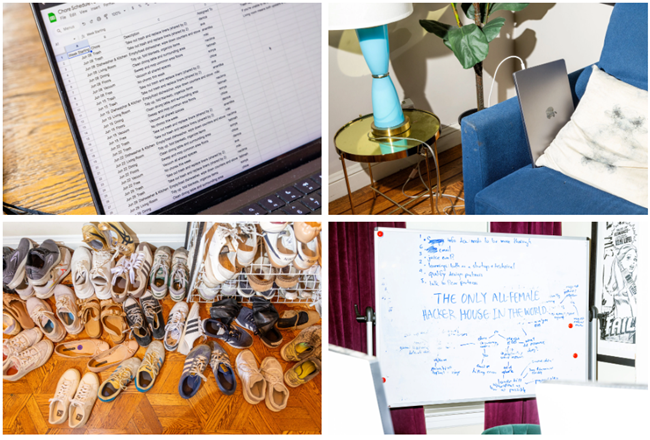
FoundHer House has four bedrooms and three bathrooms shared by the eight women. Courtesy of New York Times
The Network Effect: When VCs Come Calling
FoundHer House quickly became more than just shared housing—it evolved into a networking goldmine that attracted Silicon Valley's most influential investors. Venture capital firms like Andreessen Horowitz and Bain Capital Ventures sponsored dinners and panel discussions, treating the house like their own private deal flow pipeline.
These venture capitalists recognize that FoundHer House residents represented untapped alpha in a market increasingly desperate for differentiated deal flow.
The Economics of Disruption: Why Female-Led A.I. Startups Are Undervalued Assets
From a pure financial perspective, the opportunity here is staggering. Consider the market dynamics:
Supply Side Scarcity: With less than 20% of A.I. venture deals involving female founders, supply is artificially constrained—precisely the kind of market inefficiency that creates outsized returns for early investors.
Demand Side Growth: Consumer markets are increasingly influenced by female decision-makers, who control or influence 73% of global consumer spending. A.I. products designed with diverse perspectives have a better market fit for this demographic.
Talent Market: While male-dominated A.I. startups compete for the same pool of engineers and resources, driving up costs, female-founded startups can access overlooked talent at more reasonable valuations.
ESG Premium: Environmental, Social, and Governance (ESG) investing is driving trillions in capital flows toward diverse leadership teams, creating a sustainable premium for companies that meet these criteria.
The women of FoundHer House understand these market forces intuitively. They're not just building companies—they're positioning themselves at the intersection of multiple mega-trends that could create generational wealth.
The Two-Drop-Out Success Metric
When Sonya Jin and Naciima Mohamed decided to drop out of college to focus full-time on their startups, it wasn't reckless youth—it was calculated risk assessment. These aren't starry-eyed dreamers; they're entrepreneurs who've done the math and decided the opportunity cost of staying in school outweighs the potential returns of going all-in on their ventures.
The dropout rate might seem concerning to traditional investors, but in Silicon Valley, it's often a leading indicator of serious commitment. Bill Gates, Mark Zuckerberg, and Michael Dell all made similar calculated decisions. The difference is that Jin and Mohamed are making these choices in a market environment that's potentially more lucrative than any their male predecessors ever entered.
The Closing Bell: Why This Story Is Just Getting Started
FoundHer House officially closed on Tuesday, August 26, 2025. However, should anyone think this represents an ending, they are missing the bigger financial picture. The Summer of 2025 represented a proof of concept—a beta test for a model that could reshape how the venture capital industry identifies and develops early-stage talent.
As residents packed up their belongings and said goodbye to their Glen Park headquarters, they weren't dissolving a company—they were graduating from an accelerator program that happened to be disguised as shared housing. Each resident left with more than just stickers bearing the FoundHer House logo:
· they went with a network,
· proven business models,
· investor interest,
· and the kind of hustle that creates unicorn companies.
Miki Safronov-Yamamoto's parting words capture the financial opportunity perfectly: "It's definitely bittersweet. I was sad, but I was happy we had the opportunity to be together this summer. I'm also very excited and ready for the next chapter."
That next chapter is where the real money gets made.
The Investment Thesis: Why Smart Money Is Betting on Female-Led A.I.
The macro trends are undeniable:
- Market Size: The A.I. market is targeted to reach $1.8 trillion by 2030…five years away!
- Gender Gap: Massive underrepresentation creates huge opportunities
- Consumer Alignment: Female-led companies often better understand diverse consumer bases
- Capital Efficiency: Less competition for talent and resources means better unit economics
- ESG Tailwinds: Sustainable investing trends favor diverse leadership teams
FoundHer House proved that when you give talented women access to capital, community, and market opportunities, they don't just participate in the A.I. revolution—they lead it.
The eight women who spent their summer in that Glen Park house aren't just founders building interesting companies. They're the vanguard of a market correction that's been decades in the making. They represent billions in potential value creation that the market has systematically overlooked.
For investors smart enough to recognize this opportunity, the message is obvious: the future of A.I. isn't just male, and the future of venture returns might belong to those who understand that diversity isn't just good ethics—it's good business for crying out loud!
The glass ceiling in A.I. is about to shatter, and when it does, the fragments are going to cut straight through to some very impressive internal rate of return, which means calculating an investment's rate of return.
The only question left is: are you positioned to catch the windfall, or are you still betting on the same old boys' club that's been leaving money on the table?
Because in Silicon Valley, being late to the party doesn't just mean missing the networking—it means missing the returns that create generational wealth. And these eight women from FoundHer House? They're not just attending the party. They're hosting it.
What can we learn from this story? What's the takeaway?
FoundHer House in San Francisco was more than just a hacker home — it was a community of young women building A.I. startups, challenging tech's gender gap, and breaking barriers in Silicon Valley. From late-night coding sessions to high-stakes demo days, these female founders were reshaping artificial intelligence and proving that the future of tech isn't just male.
Well, there you go, my friends; that's life, I swear
For further information regarding the material covered in this episode, I invite you to visit my website, which can be found on Apple Podcasts, for show notes and the episode transcript.
As always, I thank you for the privilege of you listening and your interest.
Be sure to subscribe here or wherever you listen to podcasts so you don't miss an episode.
See you soon.